Google Research builds wearable 'health age' and 12-week what-if coaching model
On November 11, 2026, Google Research research scientists Zeinab Esmaeilpour and Ahmed A. Metwally published a blog post describing an investigational machine learning framework for cardiovascular-kidney-metabolic (CKM) health. CKM syndrome is the interconnected web of heart disease, kidney conditions and metabolic disorders such as type 2 diabetes. The post says it often begins silently years before symptoms, shaped by habits like movement and sleep. The framework is described across two studies: "Personalized health coaching via coachable health age and counterfactual wearable trajectories" and a companion study, "Cardiovascular-Kidney-Metabolic Health Age Using Wearables and Blood Biomarkers".
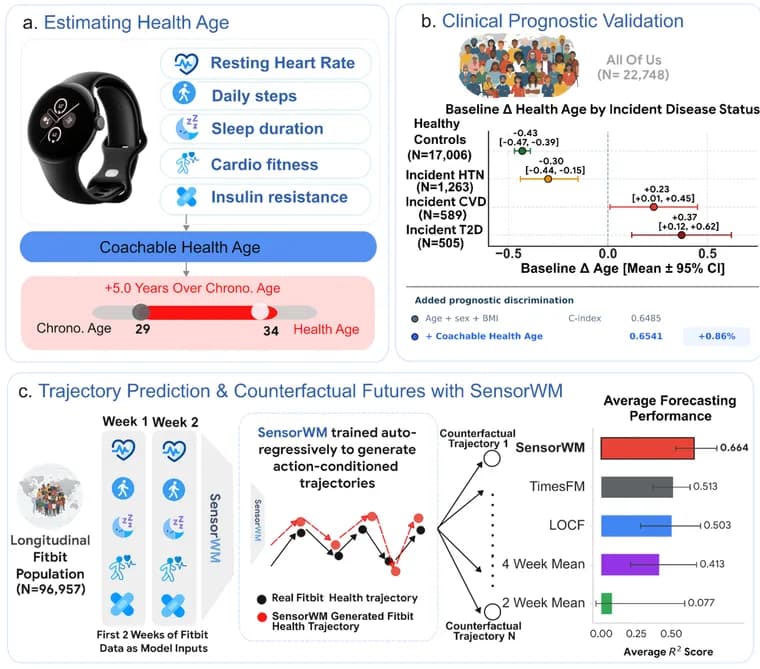
The first piece is a coachable health age (CHA). The authors argue that many existing biological clocks are trained to estimate birth year, latch onto traits people cannot change, or act as black boxes. Instead, they grounded CHA in published epidemiological studies linking everyday behaviors to cardio-metabolic disease risk. CHA uses four core signals passively measured by consumer wearables: resting heart rate, daily step count, sleep duration and weekly Active Zone Minutes. Optional markers such as VO2max, sleep schedule regularity and insulin resistance are added when available. Because active people often have lower resting heart rates and better sleep, the authors adjust mathematically for overlap among the signals, so each habit contributes its distinct share to the health age delta, the difference between CHA and chronological age. A negative delta (the post's example is minus 3 years) means the physiological profile appears younger than the calendar age; a positive delta signals accelerated aging. The post says the model was validated across three independent cohorts.
The second piece answers the what-if question: what happens over 12 weeks if I change specific habits? The authors say a static calculator misses how the body adapts as a connected system, since moving more and sleeping better over weeks also improves resting heart rate and heart rate variability. They built Sensor World Model (SensorWM), an action-conditioned world model pre-trained on 2.28 million person-weeks of de-identified data from roughly 100,000 consenting Fitbit users. Given two weeks of baseline wearable data, it forecasts how 20 physiological markers will evolve over the next 12 weeks under different daily steps, sleep and cardio routines. The authors say it outperforms general-purpose time-series foundation models like TimesFM while preserving clinical patterns associated with diabetes, hypertension and insulin resistance. No figures for that comparison are given in the post.
SensorWM was paired with a feasibility-constrained optimizer and a language model coaching agent. To test whether grounding a language model in world-model simulations gives better guidance than giving the same model only a user's wearable history, the team ran a blinded, head-to-head study. Five certified lifestyle coaches and five board-certified primary care and lifestyle medicine physicians reviewed 49 participant profiles spanning five behavioral personas, for 490 paired reviews in total. Automated evaluations were also run across the full WEAR-ME cohort (n = 2,780). The post reports no results for this comparison.
The companion study extends the framework to individual organ systems. Evaluated in 819 WEAR-ME participants, the multimodal CKM health age model combines continuous wearable signals (resting heart rate, steps, Active Zone Minutes and sleep) with three routine blood biomarkers: cholesterol-to-HDL ratio (cardiovascular), eGFR (kidney filtration) and HOMA-IR (metabolic insulin resistance). Using a normalized deviance score that measures how far each marker departs from healthy clinical thresholds, the model found that multi-organ aging does not follow a single template: metabolic and cardiovascular strain are often correlated, while early kidney decline frequently appears independently. The resulting CKM health age gap aligned closely with objective clinical scores (modified Life's Essential 8, r = -0.58; metabolic syndrome severity, r = 0.65) and with how healthy participants felt day to day.
The authors close with a caveat: the evaluations were offline on retrospective research cohorts, and the models are investigational research prototypes rather than clinical diagnostic tools. They say the work lays the foundation for future prospective trials testing whether interactive what-if coaching helps people build lasting habits.
Key facts
- Google Research proposes a 'coachable health age' built from resting heart rate, daily steps, sleep duration and weekly Active Zone Minutes, grounded in published epidemiological studies rather than trained to guess birth year.
- SensorWM, a world model pre-trained on 2.28 million person-weeks of de-identified data from roughly 100,000 consenting Fitbit users, forecasts 20 physiological markers over 12 weeks from two weeks of baseline data.
- A blinded study used five certified lifestyle coaches and five board-certified physicians on 49 participant profiles (490 paired reviews) to compare world-model-grounded coaching against a language model given wearable history alone; no results are reported in the post.
- In 819 WEAR-ME participants, a CKM health age model adding cholesterol-to-HDL ratio, eGFR and HOMA-IR correlated with modified Life's Essential 8 (r = -0.58) and metabolic syndrome severity (r = 0.65).
- The authors call the models investigational research prototypes, evaluated offline on retrospective cohorts, not clinical diagnostic tools.
Why it matters
Smartwatches record what a person did yesterday, but the post argues that the harder step is turning that record into action. Many biological-age clocks are trained to estimate birth year or work as black boxes, so they cannot show how changing one habit would shift future health. This framework tries to make the metric adjustable (every input is something a person can track and influence) and to attach a 12-week forecast to specific habit changes. It also targets CKM syndrome, which the post says often begins silently years before symptoms appear.
Who it affects
For now, mainly researchers working on wearables, digital health and personalized coaching. In the longer run, the framework is aimed at people who use consumer wearables such as Fitbit and at the lifestyle coaches and primary care physicians who might use such guidance. The post says SensorWM was pre-trained on data from roughly 100,000 consenting Fitbit users.
How to use it
There is nothing to use yet. The post describes an investigational framework and two studies, not a product. It mentions no launch, no availability in Fitbit or Google apps, and no timeline for clinical use. The authors point to future prospective trials as the next step.
How solid is it
The post comes from the research team itself and names two studies, but it gives no publication venue, peer-review status or paper link for them. The scale is described in detail: 2.28 million person-weeks of pre-training data, validation across three independent cohorts, 490 paired expert reviews and 819 WEAR-ME participants for the CKM model. The reported correlations are r = -0.58 with modified Life's Essential 8 and r = 0.65 with metabolic syndrome severity. There are no quantitative results for SensorWM versus TimesFM or for the coaching study.
Risks and caveats
The authors state that the evaluations were offline on retrospective research cohorts and that the models are investigational research prototypes rather than clinical diagnostic tools. Whether what-if coaching helps people build lasting habits is left to future prospective trials. The post does not say whether the 49 profiles in the blinded study are real participants or synthetic. It also gives no effect sizes for questions such as how much sleeping 30 minutes longer or adding a brisk walk would improve health.
“these models are investigational research prototypes rather than clinical diagnostic tools”
— Zeinab Esmaeilpour and Ahmed A. Metwally, Google Research blog post