Google moves $35bn of Anthropic TPU risk off its balance sheet
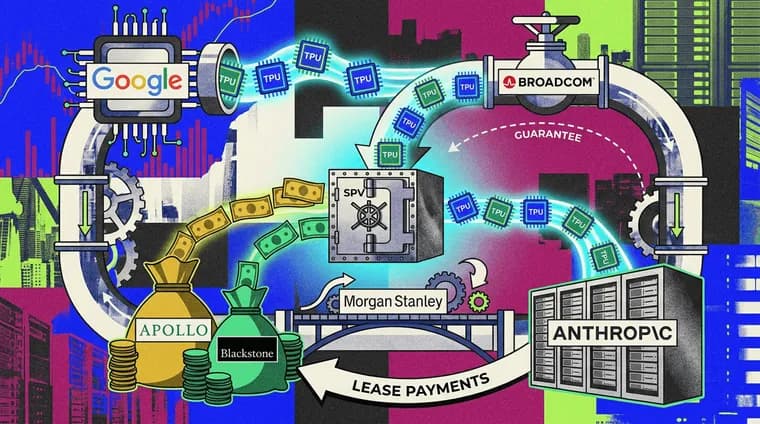
Google, Broadcom, Morgan Stanley, Apollo, Blackstone and several crypto-mining firms have assembled what the Financial Times calls one of the largest infrastructure financing programs in history, built to get Anthropic access to Google's Tensor Processing Units without any of the companies involved carrying the hardware debt on their own books. Anthropic needs vast amounts of AI hardware but cannot buy the chips itself because it has no credit rating, and banks will not lend it that much money. Morgan Stanley helped set up a financing vehicle called Compute SPV that buys the chips outright and leases them to Anthropic, funded mainly by outside investors Apollo and Blackstone. The structure first goes into use in June, when Compute SPV buys about one gigawatt of TPU hardware, roughly one million chips, for $35 billion. Broadcom, which has co-developed the TPUs with Google since 2016, acts as guarantor and backstops about $30 billion of that purchase if Anthropic stops making lease payments.
Compute SPV is now a template for further deals. The largest to date is an April agreement covering another 3.5 gigawatts of TPU hardware that Google sells to Broadcom for Anthropic's use. Broadcom's own financial filings list $128 billion in purchase commitments through 2028, and FT sources say nearly all of that is tied to Google TPUs.
Financing the chips only solves half the problem, because Google also needs data centers with enough power to run them. Google is turning to crypto-mining companies that already hold large power contracts. TeraWulf is the first to get a Google guarantee, covering a 360 megawatt data center in New York; Morgan Stanley packaged that guarantee into a $3.2 billion construction bond, and Google took an ownership stake in TeraWulf in return. The same model now extends to Cipher Digital and Hut 8. In total, Google has backed ten crypto-mining projects with a combined 2.4 gigawatts of capacity, according to FT sources.
The arrangement keeps most of the risk off Google's books. Google could face up to $44 billion in obligations if every lease defaults, the FT reports, yet it records only $815 million of that exposure on its own balance sheet. The financing edge also cuts borrowing costs: data center projects backed by Google borrow at a median interest rate of 7.1 percent, against 9.3 percent for neocloud operators that rely on Nvidia chips instead, a gap Jefferies analysts describe as a structural cost-of-capital disadvantage for Nvidia's ecosystem.
The stakes run wider than this one deal. Altogether, $200 billion in contracts hinge on Anthropic's ability to grow its revenue, and Google sits on both sides of the arrangement as an investor in Anthropic and the supplier of its chips. A separate, earlier report from The Information said Anthropic has committed to spending about $200 billion on Google Cloud over five years in exchange for five gigawatts of server capacity, a deal that alone accounts for more than 40 percent of Google's committed future cloud revenue. Together with OpenAI, Anthropic makes up roughly half of the $2 trillion in cloud backlog held by Amazon, Microsoft, Google and Oracle combined. Both startups are counting on revenue growing 20 to 30 times by 2029, and the FT's reporting frames the entire structure as dependent on that growth materializing.
Key facts
- A special-purpose vehicle, Compute SPV, buys about one gigawatt of Google TPU hardware (roughly one million chips) for $35 billion and leases it to Anthropic, with Broadcom backstopping about $30 billion of the purchase.
- Broadcom's filings list $128 billion in purchase commitments through 2028, nearly all tied to Google TPUs, on top of an April deal covering 3.5 gigawatts of TPU hardware sold to Broadcom for Anthropic.
- Google backs crypto miners including TeraWulf (a 360 megawatt New York data center financed via a $3.2 billion bond), Cipher Digital and Hut 8, totaling 2.4 gigawatts across ten projects, to supply power.
- Google could face up to $44 billion in obligations if every lease defaults but records only $815 million of that on its balance sheet; Google-backed projects borrow at a median 7.1 percent versus 9.3 percent for Nvidia-reliant neoclouds.
- $200 billion in contracts hinge on Anthropic's revenue, which, along with OpenAI's, needs to grow 20 to 30 times by 2029 to sustain the structure; Anthropic separately committed about $200 billion to Google Cloud over five years for five gigawatts of capacity.
Why it matters
This is financial engineering on a scale the FT calls one of the largest infrastructure financing programs in history, built specifically so that a hardware buildout nobody wants to own outright, not Google, not Broadcom, not Anthropic, can still get funded. It shows how the AI infrastructure race is increasingly running through leasing vehicles and outside capital (Apollo, Blackstone, crypto-mining guarantees) rather than direct corporate balance sheets, which changes who actually bears the risk if the underlying revenue growth does not show up.
Who it affects
Google, Anthropic, Broadcom, Morgan Stanley, Apollo and Blackstone are direct parties to the Compute SPV structure. TeraWulf, Cipher Digital and Hut 8 are drawn in as power and data-center partners under Google guarantees. Nvidia-reliant neocloud operators are affected indirectly: the story reports they face a higher, 9.3 percent median borrowing cost against 7.1 percent for Google-backed projects, a gap Jefferies calls a structural disadvantage.
How to use it
For anyone tracking AI infrastructure financing or Anthropic's balance sheet risk, the concrete figures to hold onto are the $35 billion Compute SPV purchase (about one gigawatt, roughly one million TPUs), Broadcom's $128 billion in TPU-linked purchase commitments through 2028, and the $200 billion in total contracts that depend on Anthropic's revenue growth. These are the numbers likely to reappear if the story develops further.
How solid is it
The reporting traces back to the Financial Times, which the source describes as citing named companies' filings (Broadcom's) alongside unnamed FT sources for deal-structure details such as the Broadcom backstop amount, the TeraWulf terms and the ten crypto-mining projects. No individual executives at Google, Anthropic, Broadcom or Morgan Stanley are named or quoted, and the source does not give a year for the 'June' Compute SPV launch or the 'April' Broadcom agreement, nor does it explain the accounting mechanism behind Google's $815 million balance-sheet figure.
Risks and caveats
The entire arrangement is explicitly described as dependent on Anthropic's revenue growing 20 to 30 times by 2029, a target shared with OpenAI; if that growth slows or stalls, the structure could unravel. Google's position is also a built-in conflict: it is simultaneously an investor in Anthropic and the supplier of the chips Anthropic leases, and while it books only $815 million in liability today, its stated worst-case exposure if every lease defaults runs to $44 billion.
“a structural cost-of-capital disadvantage”
— Jefferies analysts, on the borrowing-cost gap between Google-backed and Nvidia-reliant AI infrastructure projects