Hunyuan3D-Buffalo 1.0 unifies 3D generation, understanding and editing
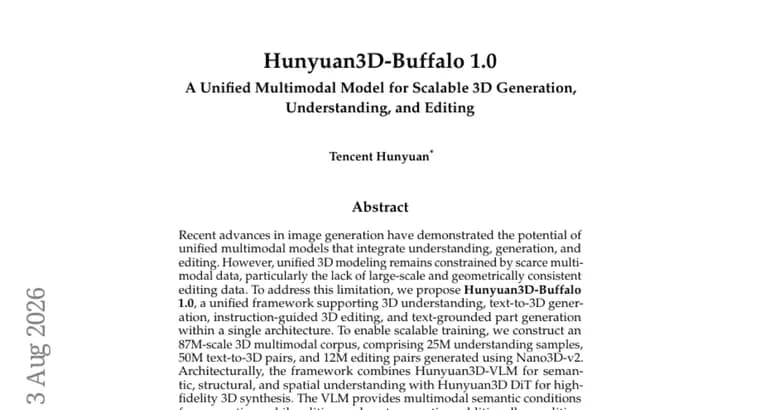
Researchers present Hunyuan3D-Buffalo 1.0, a unified multimodal framework that folds four separate 3D capabilities into one architecture: 3D understanding, text-to-3D generation, instruction-guided 3D editing, and text-grounded part generation. The authors frame the motivation around a gap seen in image generation, where unified models that both understand and generate have already proven their value, but note that unified 3D modeling has lagged because multimodal 3D data is scarce, especially large-scale, geometrically consistent editing data, where an edited object needs to match its source in structure everywhere except the part that was actually changed.
To close that data gap, the team built an 87M-sample 3D multimodal training corpus from scratch: 25M understanding samples, 50M text-to-3D pairs, and 12M editing pairs generated with a tool called Nano3D-v2. The source text does not describe what Nano3D-v2 is beyond that it produced the editing pairs, nor does it give a timeline or compute cost for assembling the corpus.
Architecturally, the framework pairs two components: Hunyuan3D-VLM, which handles semantic, structural and spatial understanding of 3D content, and Hunyuan3D DiT, a diffusion transformer that performs the high-fidelity 3D synthesis. The VLM supplies multimodal semantic conditioning for generation. For editing and part generation specifically, the diffusion process is additionally conditioned on the source object's own representation, which is how the model is meant to preserve the object's overall structure and leave unedited regions untouched.
The authors report that Hunyuan3D-Buffalo 1.0 reaches state-of-the-art or leading performance on text-to-3D generation and 3D editing benchmarks, while also showing strong understanding and part-generation capabilities. The abstract does not name the specific benchmarks or give numeric scores behind that claim. A further analysis in the paper finds that generation and understanding skills each improve editing performance, which the authors take as evidence that unified multimodal training pays off for 3D specifically, not just for images.
The source text does not name the paper's authors beyond a listed first author, does not state an institutional affiliation, and gives no model size, code availability, or licensing terms.
Key facts
- Hunyuan3D-Buffalo 1.0 unifies 3D understanding, text-to-3D generation, instruction-guided 3D editing, and text-grounded part generation in one architecture.
- The model is trained on a purpose-built 87M-sample corpus: 25M understanding samples, 50M text-to-3D pairs, and 12M editing pairs generated with Nano3D-v2.
- The architecture combines Hunyuan3D-VLM for semantic/structural/spatial understanding with Hunyuan3D DiT, a diffusion transformer, for 3D synthesis.
- For editing and part generation, the diffusion process is conditioned on the source object's own representation to preserve structure outside the edited region.
- The authors report state-of-the-art or leading results on text-to-3D generation and editing benchmarks, though no specific benchmark names or scores are given in the source.
Why it matters
Image models that both understand and generate content in one system have already shown clear gains over separate specialist models. Hunyuan3D-Buffalo 1.0 is an attempt to bring that same unification to 3D content, a domain the authors say has lagged behind specifically because large, geometrically consistent 3D editing data has been scarce. Building an 87M-sample corpus to fix that data gap is as much the contribution here as the architecture itself.
Who it affects
The paper targets 3D content creators and researchers working on generative 3D pipelines, since a single model that generates, edits and understands 3D objects could replace separate tools for each task. The source text does not name a target industry, product, or release channel beyond the research paper and its project page.
How to use it
The source provides a project page (tencent-hunyuan.github.io/Hunyuan3D-Buffalo1.0) but the abstract itself gives no information on model size, code availability, licensing, or pricing, so none of that can be stated here.
How solid is it
The claim of state-of-the-art or leading performance rests on the authors' own 'extensive experiments' on text-to-3D generation and 3D editing benchmarks, but the source text names no specific benchmarks and gives no numeric scores to check the claim against. A separate internal analysis, also from the authors, found that both generation and understanding skills improve editing performance, offered as evidence that the unified training approach works.
Risks and caveats
All performance claims come from the authors themselves; there is no third-party verification or named benchmark to independently check the state-of-the-art claim against. The source gives no model size, no code or licensing status, no release date, and no detail on what Nano3D-v2 is beyond being the tool that generated the 12M editing pairs, so how reproducible or independently verifiable the results are cannot be assessed from this text alone.