Google Research AI detects signs of hypertension from a smartwatch
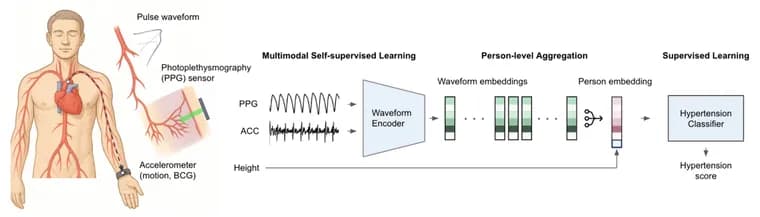
Google Research has published a blog post, dated November 5, 2026, on a new AI system that uses standard consumer smartwatch sensors to passively detect signs of high blood pressure. The post is written by Paolo Di Achille (Staff Research Scientist) and Ming-Zher Poh (Senior Staff Research Scientist) of Google Research. The work appears in a study in Nature and was a collaboration between Google Research, Beth Israel Deaconess Medical Center and Harvard Medical School.
The problem is awareness. Hypertension, often called the "silent killer", affects over one billion people globally, and more than half of adults with the condition are unaware they have it. It rarely causes obvious symptoms, so it is usually found by incidental screening. The post says the gap is particularly severe among younger adults aged 18 to 44, where a missed diagnosis can delay early intervention and raise the long-term risk of stroke or heart failure. Office blood pressure measurement is the main initial screening route. Cuffless wearables have emerged as a possible complement, but the post says existing commercial products usually need regular calibration with a traditional arm cuff, so they track only relative changes from a baseline cuff reading and cannot identify absolute hypertensive states.
The new system, called AI-PPG-ACC-HTN, needs no cuff calibration. It also does not try to estimate exact, point-in-time systolic and diastolic values, which the authors call highly susceptible to transient environmental noise. Instead it aims to identify a person's underlying, persistent hypertensive state by aggregating passive physiological signatures over multiple days. It uses two sensors already active on modern smartwatches, a photoplethysmography (PPG) sensor and an accelerometer (ACC).
The method has two stages. First, the team trained a 1-D deep convolutional neural network with self-supervised contrastive learning on an unlabeled dataset of 492,347 hours of sensor data from 2,109 consenting participants. The model learned to map overlapping 15-second PPG and ACC waveforms from the same person close together in a latent space, which let it find features of vascular and mechanical cardiac function without manual feature engineering or medical labels. Second, for each user the 15-second embeddings are mean-aggregated across multiple days of wear to wash out noise such as sudden movements or temperature changes. The aggregated embedding is combined with the person's height, which the authors describe as a reliable proxy for arterial path length, and fed to a regularized logistic regression classifier that outputs a continuous hypertension probability score.
For evaluation, the team ran a prospective, multi-center clinical study at five US sites with 196 consenting, diverse participants who were free from known cardiovascular disease and not taking blood pressure medications. The smartwatch was benchmarked against 24-hour ambulatory blood pressure monitoring (ABPM), the clinical gold standard, in two scenarios.
Initial screening: the smartwatch reached a moderate sensitivity of 65.8%, a high specificity of 90.0% and a high positive predictive value (PPV) of 80.6%. Initial office-based screening showed a sensitivity of 55.3% and a moderate PPV of 77.8% against the same standard.
Confirmatory testing: current guidelines recommend out-of-office tracking for people who screen positive in clinic, so the team looked at the subset of 48 participants with elevated initial office BP. There the smartwatch system reached a moderate sensitivity of 78.4%, a high specificity of 90.9% and a high PPV of 96.7%. Return office BP measurements had lower point estimates: sensitivity 67.6%, specificity 63.6%, PPV 86.2%. Multi-day home monitoring yielded sensitivity 89.2%, specificity 81.8% and PPV 94.3%, and the authors describe the smartwatch approach as competitive with it. Taken together, they say, the system detects hypertension with accuracy comparable to traditional cuffed BP devices in the existing clinical framework.
To see what the model attends to, the team visualized average pulse waveforms from users with the highest and lowest predicted hypertension probabilities, including PPG pulse shapes, their first and second derivatives, and accelerometer ballistocardiogram waveforms.
The authors are explicit about limits. Smartwatch screening is not intended to replace standard clinical arm cuffs or provide a definitive standalone diagnosis. They point to its potential as a scalable, passive tool for opportunistic screening that gently prompts at-risk people to visit a clinic. They also state that the work is early feasibility research, purely exploratory, and not indicative of any existing or upcoming commercial product feature or device capability. They add that the findings helped inform the blood pressure trends Health Guardian feature in the Google Health app.
Key facts
- Google Research's AI-PPG-ACC-HTN, described in a Nature study, flags signs of hypertension from consumer smartwatch PPG and accelerometer data without any cuff calibration.
- In a prospective study of 196 participants at five US sites, checked against 24-hour ABPM, the watch reached 65.8% sensitivity, 90.0% specificity and 80.6% PPV in initial screening, against 55.3% sensitivity and 77.8% PPV for office screening.
- In the confirmatory subset (N=48), the watch scored 78.4% sensitivity, 90.9% specificity and 96.7% PPV; multi-day home monitoring scored 89.2%, 81.8% and 94.3%.
- The model was pretrained by contrastive learning on 492,347 hours of unlabeled data from 2,109 participants, then a logistic regression on multi-day aggregated embeddings plus height gives a hypertension probability score.
- Google says the work is early, exploratory feasibility research, not a replacement for arm cuffs and not a sign of any upcoming product.
Why it matters
More than half of the over one billion people with hypertension do not know they have it, and the post says the gap is worst among adults aged 18 to 44. Existing cuffless wearables usually need regular arm-cuff calibration, so they show only changes from a baseline rather than an absolute hypertensive state. This system drops calibration and reframes the task: instead of estimating exact point-in-time systolic and diastolic values, it looks for a persistent hypertensive state across several days of passive data. In the study it matched or beat office screening on several measures, and the authors argue it could prompt at-risk people to seek a formal clinic assessment.
Who it affects
The target group is people who have hypertension without knowing it, with the post singling out younger adults aged 18 to 44. Clinicians who rely on office measurement as the first screening gateway, and on out-of-office tracking for confirmation, are the other audience. The study population was 196 participants free from known cardiovascular disease and not taking blood pressure medications, so the results speak to that group. The research was a joint effort of Google Research, Beth Israel Deaconess Medical Center and Harvard Medical School.
How to use it
There is nothing to use yet. The authors say the methods are purely exploratory and not indicative of any existing or upcoming commercial product feature or device capability. They state that the findings helped inform the blood pressure trends Health Guardian feature in the Google Health app, but the source does not say that feature runs this model. The intended role is opportunistic screening that nudges at-risk people to see a clinic, not a standalone diagnosis and not a replacement for arm cuffs.
How solid is it
The evidence is a prospective multi-center study at five US sites, benchmarked against 24-hour ABPM, the clinical gold standard, and published in Nature. The authors are the researchers who built the system and the post is their own account. The comparisons are favorable but mixed. In initial screening the watch had higher sensitivity than office measurement (65.8% against 55.3%) and a similar PPV (80.6% against 77.8%). In the confirmatory scenario it beat return office measurements on all three metrics but had lower sensitivity than multi-day home monitoring (78.4% against 89.2%), though higher specificity (90.9% against 81.8%) and PPV (96.7% against 94.3%). The authors call the watch's sensitivity moderate in both scenarios.
Risks and caveats
The confirmatory results rest on a subset of only 48 participants, and the text does not give confidence intervals for the sensitivity, specificity or PPV figures. Sensitivity of 65.8% in initial screening means a meaningful share of hypertensive people would still be missed. The study excluded people with known cardiovascular disease or on blood pressure medication, so it says nothing about them. The system estimates a persistent state over multiple days, not instant blood pressure readings. The authors stress it is not a replacement for clinical arm cuffs or a definitive diagnosis, and that the work is early feasibility research with no commitment to any product.
“Smartwatch-based hypertension screening is not intended to replace standard clinical arm cuffs or provide a definitive standalone medical diagnosis.”
— Paolo Di Achille and Ming-Zher Poh, Google Research blog post