Google Research shows 10 updates at Research@ 2026, from Earth AI to AMIE
On October 14, 2026, Google Research held its Research@ event in Mountain View. In a post, Yossi Matias, Vice President, Google & GM, Google Research, set out 10 highlights under the theme of AI as an amplifier of human ingenuity.
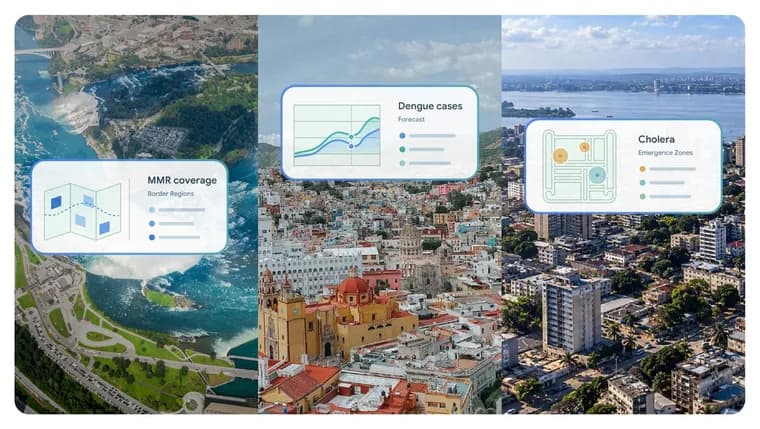
Earth AI. Google is expanding early access and inviting partners to try three new ways of reaching Google Earth AI's experimental capabilities (the post excerpt does not name them). It also announced the integration of Google Dataset Search, for querying more than 100 million public datasets, and of TimesFM for planetary nowcasting and forecasting. The capabilities are powered by over 70 geospatial tools, including planetary foundation models such as the Remote Sensing Foundation Model (RSFM) and the Population Dynamics Foundation Model (PDFM), and are validated by benchmarks in an Earth AI Technical Report released the same day. Separately, Google.org is providing $10 million to organizations working on crisis resilience and public health, including $2 million to The Milken Institute to unlock infrastructure bottlenecks for affordable housing, clean energy, broadband, safe water systems and other essential infrastructure.
Science tools. Google built a multi-agent orchestrator that lets scientists reproduce previous methods and analyses and apply them in new settings. In one example, researchers applied a new method for inverse design problems in fluid mechanics to urinary catheters and found designs that, in simulation, were better at preventing bacterial infections. It sits alongside Empirical Research Assistance, which generates and tests thousands of code variations in parallel, and Co-Scientist, built with Google DeepMind, a multi-agent tool that generates hypotheses and has helped partners such as researchers at Stanford University uncover repurposed medicines for liver fibrosis.
Deep Review. This agentic system verifies complex documents by checking logical consistency and grounding facts, while scientists keep authority over creative direction. An early version was used by Google researchers and external authors to review over 16,000 research publications submitted to top-tier computer science conferences. Google is now expanding access to the general public, for documents from legal agreements to financial reports.
Edge AI. Earlier this year Google launched the first Coralboard from Synaptics, built on Google's Coral NPU accelerator core. Next week, it says, it will reveal a co-designed, next-gen, low-power Edge AI chip, created by Synaptics using Google's open source IP, aimed at smart glasses and watches, connected cameras, streamers, and industrial vision and voice systems.
TimesFM and TabFM. These foundation models reason over time-series streams and structured tabular data. They deliver predictions out of the box with zero training, rank at the top of leading public benchmarks in their fields, and are available to all Cloud BigQuery users. Google announced an upcoming integration into Gemini for business, so that business users can soon forecast trends such as product sales or hospital bed capacity from tables with millions of rows. The post says sensitive data stays within an organization's perimeter.
Health AI. MedGemma, published last week in Nature Medicine, has been downloaded more than 10 million times by more than 65,000 unique innovators. Developers have adapted it for faster triage in overcrowded clinics and for screening for eye disease and cervical cancer. New research adds tool use, so it can draw on health records and other clinical applications, and explores mammography, ultrasound and electrocardiograms; the post says early signs point to substantial gains in answering clinical questions and interpreting radiology scans, skin images and pathology slides. For AMIE, a new Lancet study reports that at Beth Israel Deaconess Medical Center 98 patients safely consulted AMIE before urgent care visits, and clinicians said the AI summaries helped them prepare in 75% of cases. Google is also working on real-time video consultations and has begun a nationwide randomized study of AI in virtual care with Included Health. The post adds that it is still early days.
Flood forecasting. Google's global hydrologic model, published in Nature, gives river forecasts up to 7 days ahead covering more than 2 billion people in over 150 countries. Groundsource, an AI method that turns public information about crises into historical datasets, was applied with Gemini to flood news reports to build a structured dataset of over 2.6 million flood events. That data helped train a new model that predicts the likelihood of flash flooding in urban areas up to 24 hours ahead. The dataset is part of the Google Earth AI collection and openly available.
Education and design. A generative UI research experiment, fine-tuned with pedagogical guardrails, lets teachers create custom, guided STEM simulations. The sample library has over 30 teacher-vetted AI-generated learning interactives for middle and high school physics, chemistry, biology and math, and schools can join the Google for Education Pilot Program to give feedback. Play with Putty is a shared environment where teams prototype interfaces generated from natural language prompts, with multi-player real-time editing; a waitlist is open on Google Labs.
Key facts
- Google Research presented 10 highlights at Research@ in Mountain View on October 14, 2026, in a post by Yossi Matias.
- Earth AI gets wider early access, a Dataset Search integration covering more than 100 million public datasets, and TimesFM; Google.org is giving $10 million to crisis resilience and public health groups.
- Deep Review, which an early version used on over 16,000 conference submissions, is now open to the general public for documents from legal agreements to financial reports.
- TimesFM and TabFM are available to all Cloud BigQuery users, with an integration into Gemini for business announced as upcoming.
- A Lancet study of AMIE at Beth Israel Deaconess Medical Center involved 98 patients, and clinicians said AI summaries helped them prepare in 75% of cases.
Why it matters
The post is Google Research's own Research@ showcase, and it pushes several research lines toward public use at once: Deep Review opened to everyone, numeric foundation models heading into Gemini for business, and an openly available flood dataset. In health, it pairs published work (MedGemma in Nature Medicine, AMIE in The Lancet) with a new real-world study at an urgent care site. In disaster forecasting, the post says that a year ago predicting flash floods still seemed out of reach; the Groundsource dataset helped overcome the lack of ground-truth data for them.
Who it affects
The post names its audiences: doctors, scientists, developers, public health officials, health leaders and enterprise teams. Scientists get literature-reproduction, hypothesis and code-variation tools. Anyone checking technical documents can use Deep Review. Hardware makers building wearables and vision systems are the target of the Synaptics Edge AI chip. Business analysts are the target of TimesFM and TabFM in Gemini for business. Teachers and schools, researchers in flood prediction, and organizations working on crisis resilience and infrastructure, including The Milken Institute, are also named.
How to use it
Deep Review is being opened to the general public. TimesFM and TabFM are available now to all Cloud BigQuery users; the Gemini for business integration is described as upcoming, with business users able to forecast 'soon'. Earth AI is in expanded early access, and partners are invited to explore its new experimental capabilities. The Groundsource flood dataset is openly available as part of the Google Earth AI collection. Schools can sign up to the Google for Education Pilot Program, and Play with Putty has a waitlist on Google Labs. No pricing, usage limits or availability regions are given for Deep Review's public access.
How solid is it
This is a first-party announcement by Google Research, so every claim is Google's own. Several results come from peer-reviewed venues the post cites: the global hydrologic model in Nature, MedGemma in Nature Medicine, AMIE work in Nature and Nature Medicine, and the new AMIE study in The Lancet. The concrete figures are specific: 98 patients, 75% of cases (as reported by clinicians), 16,000 reviewed publications, 2.6 million flood events, 10 million MedGemma downloads. The claim that TimesFM and TabFM rank at the top of public benchmarks comes without numbers in the post, as do MedGemma's new capabilities and Deep Review's accuracy.
Risks and caveats
Several items are not yet available: the Gemini for business integration has no date beyond 'soon', and the Synaptics Edge AI chip is only to be revealed next week, with no name, specs or performance figures given. The catheter designs were better only in simulation, and the post does not say whether they were tested beyond that. On MedGemma the post says only that early signs point to substantial gains. For AMIE the Lancet figures are limited to 98 patients and clinicians' reports that summaries helped in 75% of cases, with no diagnostic accuracy stated, and Google itself says it is still early days. The Included Health randomized study has been started; its timing and size are not given.
“AMIE is part of a rigorous research journey going back to our landmark MedPalm paper, and it’s still early days.”
— Yossi Matias, Google Research, Research@ 2026 post