Google's Gemini Notebook adds Expert Intelligence for books
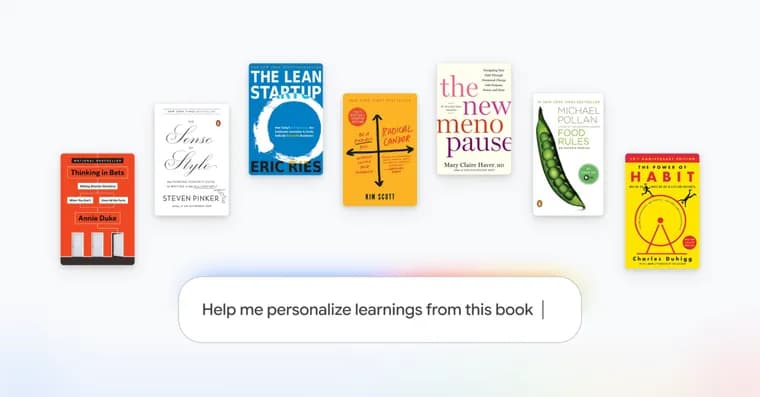
Google has added a new feature called Expert Intelligence to Gemini Notebook, its AI note taking app, letting users bring books they have purchased on Google Play Books directly into a notebook. Once a book is in, users can ask questions about its material and generate plans, infographics, AI podcasts and other outputs based on the book's contents, and can view the book's full text inside Notebook itself.
More than 100,000 books from publishers including Penguin Random House, Johns Hopkins University Press, Macmillan Publishers and O'Reilly Media will support Expert Intelligence at launch. Titles that support it carry a "Gemini Notebook" label under the "Tools" badge in Google Play Books.
Google also worked with 15 authors, including Michael Pollan, Kim Scott, Steven Pinker and Jennifer Wallace, to build "Featured Notebooks" that each author customizes with extra source material and intro letters. During a briefing with The Verge, Google Labs editorial director Steven Johnson demonstrated the tool generating a recipe book from Pollan's Food Rules, and separately using Kim Scott's Radical Candor to answer a question about handling a difficult conversation with an employee.
Google built in protections so a shared notebook does not leak paid content: if someone shares a notebook containing a purchased book, a person who does not own that title sees it listed as a source but cannot view its full text or related information, and clicking it sends them to Google Play Books to buy it.
Google plans to eventually extend Expert Intelligence into AI Mode in Search and the Gemini app, both of which already draw on Gemini Notebook, and according to Johnson also plans to expand the feature to cover scholarly articles, magazine articles and newspapers. No release date, pricing or regional availability was given for any of this.
Key facts
- Gemini Notebook's new Expert Intelligence feature lets users bring purchased Google Play Books titles into the app to ask questions and generate plans, infographics and AI podcasts from their contents.
- More than 100,000 books from publishers such as Penguin Random House, Johns Hopkins University Press, Macmillan Publishers and O'Reilly Media support the feature at launch.
- Google worked with 15 authors, including Michael Pollan, Kim Scott, Steven Pinker and Jennifer Wallace, to build customized "Featured Notebooks".
- Sharing protections mean a user who does not own a book sees it listed as a source in a shared notebook but cannot read its text; clicking it links to a purchase page.
- Google plans to bring the feature to AI Mode in Search and the Gemini app, and to later extend it to scholarly articles, magazine articles and newspapers.
Why it matters
Gemini Notebook already lets people build notebooks from documents, links and files they upload themselves. Expert Intelligence extends that to commercial books people have bought, turning a purchased ebook into a source an AI assistant can question, summarize and remix into other formats. It also signals a business model: Google frames the feature explicitly as a way to create "new revenue possibilities for authors and publishers", not just a reading convenience.
Who it affects
Readers who buy books through Google Play Books gain a new way to interact with what they already own. Publishers such as Penguin Random House, Johns Hopkins University Press, Macmillan Publishers and O'Reilly Media get a distribution channel tied to their existing catalog. The 15 authors in the Featured Notebooks program, including Michael Pollan, Kim Scott, Steven Pinker and Jennifer Wallace, get a customized presence inside the tool with their own added material.
How to use it
The feature works only with books already purchased on Google Play Books; titles that support it show a "Gemini Notebook" label under the "Tools" badge in the store. Once added to a notebook, a book can be asked questions, used to generate plans, infographics or AI podcasts, and read in full inside Notebook. No pricing, release date or country availability was disclosed.
How solid is it
The account comes from a Verge briefing with Google Labs editorial director Steven Johnson, who demonstrated the feature live with two named books, Food Rules and Radical Candor, and gave concrete figures for the book count and the author roster. That makes it a confirmed product feature rather than a rumor, though the further expansions Johnson describes, into Search's AI Mode, the Gemini app, and new content types, remain stated plans without dates.
Risks and caveats
Google says it built protections to stop people from reading purchased content through someone else's shared notebook, but the mechanics of that enforcement are not detailed beyond what a non owner sees. The broader expansion into scholarly articles, magazine articles and newspapers is only a stated intention, with no timeline, and the revenue arrangement with authors and publishers is described only in general terms with no figures given.
“I'm really interested in the idea of building a collection of people whose work you really value, and kind of creating your own dream team of advisers that are just available to you wherever you go.”
— Steven Johnson, Google Labs editorial director