H2RB co-trains robot VLA policies on unpaired human demos
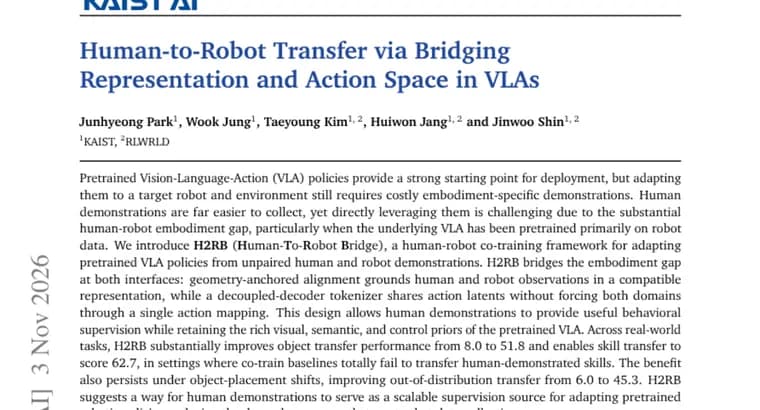
Pretrained Vision-Language-Action (VLA) policies give robots a strong starting point, but adapting one to a particular robot and environment still takes costly demonstrations collected on that specific embodiment. Human demonstrations are much easier to gather. The catch, the authors say, is the large embodiment gap between humans and robots, which bites hardest when the underlying VLA was pretrained mainly on robot data.
The paper introduces H2RB (Human-To-Robot Bridge), a human-robot co-training framework that adapts pretrained VLA policies from unpaired human and robot demonstrations. It tackles the embodiment gap at two interfaces. On the observation side, geometry-anchored alignment grounds human and robot observations in a compatible representation. On the action side, a decoupled-decoder tokenizer shares action latents without forcing both domains through a single action mapping. According to the authors, this lets human demonstrations provide useful behavioral supervision while the model keeps the visual, semantic and control priors of the pretrained VLA.
The abstract reports results across real-world tasks. H2RB improves object transfer performance from 8.0 to 51.8 and enables skill transfer to score 62.7, in settings where co-train baselines totally fail to transfer human-demonstrated skills. The benefit also holds under object-placement shifts, where out-of-distribution transfer improves from 6.0 to 45.3. The abstract does not state the unit or metric behind these figures.
The authors frame the result cautiously: H2RB suggests a way for human demonstrations to serve as a scalable supervision source for adapting pretrained robotic policies, reducing the dependence on costly target-robot data collection.
Key facts
- H2RB (Human-To-Robot Bridge) is a co-training framework that adapts pretrained VLA policies from unpaired human and robot demonstrations.
- It uses geometry-anchored alignment to ground human and robot observations in a compatible representation, plus a decoupled-decoder tokenizer that shares action latents without a single action mapping.
- Reported real-world results: object transfer from 8.0 to 51.8, skill transfer scoring 62.7, and out-of-distribution transfer under object-placement shifts from 6.0 to 45.3.
- The authors say co-train baselines totally fail to transfer human-demonstrated skills in the settings tested.
- The abstract states no unit or metric for the scores, and names no robots, task counts or pretrained VLA model.
Why it matters
Adapting a pretrained VLA to a new robot still requires costly embodiment-specific demonstrations, and the authors point to this as the bottleneck for deployment. Human demonstrations are far easier to collect, but the human-robot embodiment gap makes them hard to use directly, especially for a VLA pretrained mainly on robot data. H2RB is an attempt to close that gap so human data can supply behavioral supervision. If the approach holds up, it would reduce dependence on costly target-robot data collection, which is the claim the authors make, in hedged form.
Who it affects
Robotics researchers and teams who adapt pretrained VLA policies to their own robot and environment, and who currently pay for robot-specific demonstration collection. The abstract does not name any lab, robot or product.
How to use it
The abstract describes the method at a high level: align human and robot observations through a geometry-anchored representation, and use a tokenizer with decoupled decoders so both domains share action latents. It mentions no code release or dataset release, so practical reuse depends on the full paper.
How solid is it
This is a preprint abstract with real-world results, and the gains reported are large: 8.0 to 51.8 for object transfer and 6.0 to 45.3 for out-of-distribution transfer. But the abstract does not say what the numbers measure, whether success rate, percent or score. It gives no baseline scores for skill transfer beyond saying co-train baselines totally fail, and it names no comparison method. The robots, number of tasks, number of trials and the amount of demonstration data are not stated.
Risks and caveats
The authors themselves only say H2RB suggests a way for human demonstrations to serve as a scalable supervision source, so this is not a demonstrated general result. The figures cannot be interpreted without the metric and trial counts. The abstract does not name the pretrained VLA used, so it is unclear how far the method carries to other models.
“H2RB suggests a way for human demonstrations to serve as a scalable supervision source for adapting pretrained robotic policies, reducing the dependence on costly target-robot data collection.”
— H2RB paper abstract