HairDeck generates animation-ready hair cards from one image
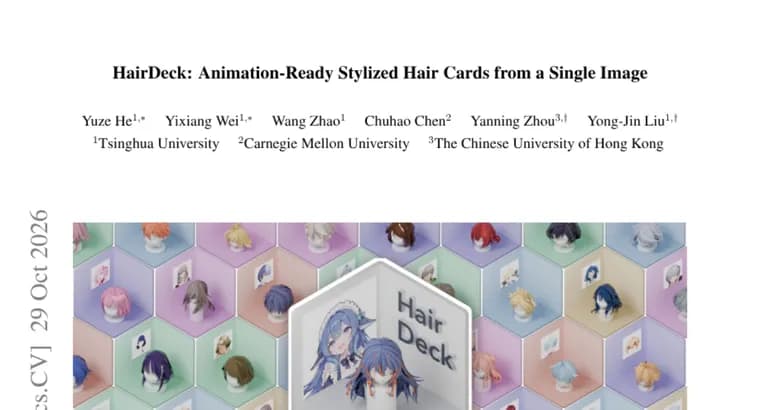
Stylized characters in games and avatars usually get their hair from hair cards: ribbons placed by an artist, where the ribbon geometry is the visible hair and spring bones animate it. A new paper, posted on Hugging Face Papers, proposes HairDeck, a method that produces such hair from a single image.
The authors say existing image-based methods give either realistic hair or a single fused mesh. The one existing generator of stylized hair cards, CHARM, decodes a hairstyle autoregressively as a long sequence of control points. The paper's starting observation is that a card hairstyle is really an unordered set of artist-defined primitives, so it should be generated as a set.
HairDeck does that. Each card is a single token, and a set diffusion transformer denoises all the cards together. From one image it generates both the cards and the spring-bone chains that drive them. The result is an animatable asset that exports to ready-to-use downstream formats.
The reported results are relative to CHARM. On CHARM's own test set, HairDeck lowers Chamfer distance by 44% and card-orientation error by more than half, while running 33 times faster. From single images, the authors also say it outperforms CHARM, image-to-3D pipelines and strand-based methods. A project page is linked at https://hyzcluster.github.io/HairDeck.
Key facts
- HairDeck generates stylized hair cards (artist-style ribbons) and the spring-bone chains that animate them from a single image.
- It treats a hairstyle as an unordered set: each card is one token, and a set diffusion transformer denoises all cards together.
- On CHARM's own test set it lowers Chamfer distance by 44% and card-orientation error by more than half.
- It runs 33 times faster than CHARM, which decodes a hairstyle as a long autoregressive sequence of control points.
- The output is an animatable asset that exports to ready-to-use downstream formats.
Why it matters
Hair cards are the standard way stylized game and avatar characters get their hair, and they are normally placed by an artist. According to the paper, the only earlier generator of stylized hair cards is CHARM, while other image-based methods give realistic hair or one fused mesh. HairDeck's change is to treat the cards as an unordered set rather than a long sequence, which the authors tie to its gains in accuracy and speed.
Who it affects
The paper frames the target as characters in games and avatars, so the people closest to it are artists and teams who build stylized characters and rig their hair. Researchers working on hair or character generation also get a new baseline to compare against CHARM.
How to use it
From a single image, HairDeck outputs the hair cards together with the spring-bone chains that drive them, as an animatable asset that exports to ready-to-use downstream formats. A project page is linked at https://hyzcluster.github.io/HairDeck.
How solid is it
The headline numbers are relative to CHARM and come from CHARM's own test set: 44% lower Chamfer distance, card-orientation error cut by more than half, and 33 times faster. The claim that it beats CHARM, image-to-3D pipelines and strand-based methods on single images is the authors' own. No absolute values are given for the metrics or the runtime. No independent evaluation or user study is mentioned.
Risks and caveats
The comparison figures come from the authors and are stated only as relative changes. The 44% and 33x figures are for CHARM's test set, and no figures are given for the comparisons with image-to-3D pipelines and strand-based methods. Which export formats are supported is not named. Hardware, model size, training data and any code or weights release are not mentioned; only a project page is linked.