Halley paper proposes predictive control for AI data center optical networks
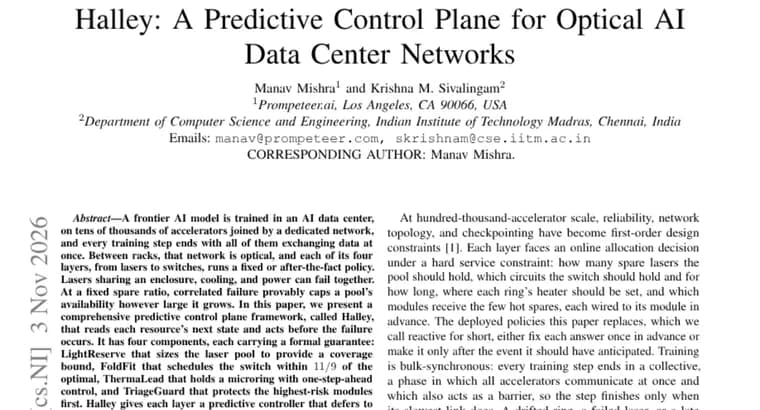
Training a frontier AI model happens in a data center, on tens of thousands of accelerators joined by a dedicated network, and every training step ends with all of them exchanging data at once. Between racks that network is optical. The paper says each of its four layers, from lasers to switches, runs a fixed or after-the-fact policy. It also points to a structural weakness: lasers that share an enclosure, cooling and power can fail together, and at a fixed spare ratio, correlated failure provably caps a pool's availability however large the pool grows.
The authors present Halley, which they call a comprehensive predictive control plane framework. It reads each resource's next state and acts before the failure occurs. Halley gives each layer a predictive controller that defers to the deployed policy when unsure. It has four components, each carrying a formal guarantee. LightReserve sizes the laser pool to provide a coverage bound. FoldFit schedules the switch within 11/9 of the optimal. ThermaLead holds a microring with one-step-ahead control. TriageGuard protects the highest-risk modules first.
The headline numbers are composed from simulations. Effective goodput, the share of ideal throughput kept, rises from 65.2% to 76.5% if a window that exhausts its spares is counted as lost. If only the dark channels' bandwidth is lost, it reaches 67.4%. Per megawatt, the paper says that is up to 1.03 to 1.17 times the training; for the same training, up to 3.3 to 14.7% less data center capacity.
On the hardware side, Halley's fallback circuits are formally verified and are shown to achieve close timing on a commercial FPGA, and they pass a 130 nm signoff.
Key facts
- Halley is a predictive control plane for the optical network of AI data centers: it reads each resource's next state and acts before a failure occurs.
- It has four components with formal guarantees: LightReserve (laser pool coverage bound), FoldFit (switch scheduling within 11/9 of the optimal), ThermaLead (one-step-ahead microring control) and TriageGuard (highest-risk modules first).
- In simulation, effective goodput rises from 65.2% to 76.5% if a window that exhausts its spares is counted as lost, and reaches 67.4% if only the dark channels' bandwidth is lost.
- The paper claims up to 1.03 to 1.17 times the training per megawatt, or up to 3.3 to 14.7% less data center capacity for the same training.
- Halley's fallback circuits are formally verified, achieve close timing on a commercial FPGA and pass a 130 nm signoff.
Why it matters
Large training runs depend on a network where every step ends with all accelerators exchanging data at once. The paper argues that the optical layers of that network run fixed or after-the-fact policies, and that correlated laser failures put a hard ceiling on availability at a fixed spare ratio, however big the pool gets. Halley's pitch is to move from reacting to failures to predicting them, while falling back to the deployed policy when the predictor is unsure.
Who it affects
The framework targets the optical network inside AI data centers, so the relevant readers are those who design and operate the networks that connect tens of thousands of accelerators. The efficiency claims are framed per megawatt and as data center capacity needed for the same training, which bears on how much power and hardware a given training job requires.
How to use it
Nothing here is a product or a download; it is a framework described in a paper. The practical reading is architectural: each of the four optical layers gets a predictive controller that defers to the existing policy when unsure, which means it is designed to sit alongside a deployed policy rather than replace it outright.
How solid is it
The formal parts are the stronger ones: each component carries a formal guarantee, such as FoldFit's 11/9 bound, and the fallback circuits are formally verified, timing-closed on a commercial FPGA and passed a 130 nm signoff. The goodput and capacity figures, however, are composed from simulations. The abstract names no authors or institutions, no deployment or production use of Halley is stated, and it does not say which simulator, workload or cluster size produced the goodput figures.
Risks and caveats
The gains are upper bounds from simulation ("up to" 1.03 to 1.17 times the training per megawatt, "up to" 3.3 to 14.7% less capacity), not measured results from a real data center. No baseline system or named competitor is identified beyond "the deployed policy", so the size of the improvement cannot be judged against a specific alternative. The goodput figure also depends on how a window that exhausts its spares is counted: 65.2% to 76.5% if it is lost, 67.4% if only the dark channels' bandwidth is lost.
“reads each resource's next state and acts before the failure occurs”
— Halley paper abstract, on what the framework does