Harness-Zero folds specialized agent-harness behavior into model weights
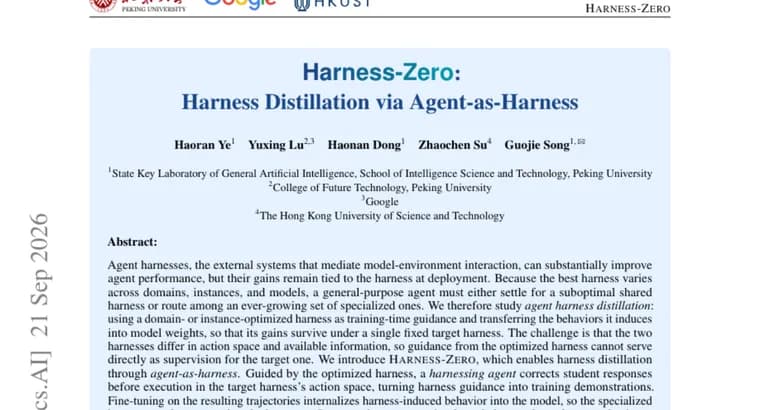
Agent harnesses are the external scaffolding, such as tool wrappers and action-execution code, that sits between a model and its environment and mediates how the model acts. A well-tuned harness can substantially boost an agent's performance, but that boost is tied to the specific harness used at run time. Because the best harness differs by domain, task instance and model, a general-purpose agent is left with a choice: use one shared harness that is suboptimal for most cases, or route between a growing collection of specialized ones. The authors frame this as a problem to solve by distillation rather than by routing: take a domain- or instance-optimized harness, use it as training-time guidance, and transfer the behavior it induces directly into the model's weights, so the gains survive once the model is run under a single, fixed, simpler harness. The technical obstacle is that the optimized harness and the target deployment harness differ in action space and in the information each one exposes to the model, so the optimized harness's guidance cannot be handed straight to the target harness as training supervision. The paper's answer is Harness-Zero, built on what it calls agent-as-harness: guided by the optimized harness, a separate harnessing agent corrects the student model's responses before those responses are executed in the target harness's action space. That correction step turns the optimized harness's guidance into training demonstrations. Fine-tuning the model on the resulting trajectories internalizes the harness-induced behavior, so the specialized harness is no longer needed once the model is deployed. The authors report three results from experiments spanning knowledge work, tool use and science domains: agent-as-harness outperforms an alternative, code-as-harness, for frontier LLMs using the same evolved harness; with the specialized harness removed at deployment, Harness-Zero raises the base model's macro-average task success from 23.3% to 44.3%, which is higher than the 41.7% the model reaches when the specialized harness is left attached; and Harness-Zero recovers harness-induced behaviors that the base model otherwise lacks, with 82.3% average recovery measured across 28 such behavior patterns in the three domains. The abstract does not name the base model, the frontier LLMs used for the harness comparison, the specific benchmarks or datasets behind the three domains, or any training cost or timeline figures.
Key facts
- Harness-Zero distills the behavior induced by a specialized, optimized agent harness into a model's weights, so the harness can be removed at deployment while the gains persist.
- Its core mechanism, agent-as-harness, has a harnessing agent correct the student model's responses before execution in the target harness's action space, converting harness guidance into training demonstrations for fine-tuning.
- With the specialized harness removed, the base model's macro-average task success rises from 23.3% to 44.3%, exceeding the 41.7% reached with the specialized harness still attached at run time.
- Across 28 harness-induced behavior patterns measured in knowledge work, tool use and science domains, Harness-Zero recovers 82.3% of them on average.
- For frontier LLMs run on the same evolved harness, the paper reports agent-as-harness outperforming an alternative approach, code-as-harness.
Why it matters
Agent harnesses, the wrappers and execution code that mediate how a model perceives and acts in an environment, can be a bigger lever on agent performance than the underlying model itself, but that lever has historically been stuck at deployment: swap the harness and the gains disappear, and a general-purpose agent otherwise has to either use one compromise harness everywhere or maintain a growing menu of specialized ones. Harness-Zero reframes this as a training problem: distill what a specialized harness does into the model's own weights, then deploy the model on a single, fixed harness without losing what the specialized one bought.
Who it affects
The method targets teams building general-purpose AI agents who currently face the shared-harness-versus-many-specialized-harnesses tradeoff, and anyone maintaining domain-specific agent scaffolding who would rather bake its effect into the model and simplify deployment.
How to use it
The approach is agent-as-harness: given an optimized harness's guidance, a harnessing agent corrects the student model's responses before they are executed in the target deployment harness's action space, which converts that guidance into training demonstrations. Fine-tuning the model on the resulting trajectories internalizes the harness-induced behavior, so the specialized harness is not needed once the model ships. The abstract gives no pricing, licensing or release details for the method or any associated code.
How solid is it
The results come from the paper's own experiments across three domain groups, knowledge work, tool use and science, and are reported as a macro-average task-success jump from 23.3% to 44.3% once the specialized harness is removed after Harness-Zero training, a figure that also beats the 41.7% task success measured with the specialized harness still attached at run time. A separate measurement reports 82.3% average recovery of 28 harness-induced behavior patterns across the same three domains. The abstract does not name the base model, the frontier LLMs used in the agent-as-harness versus code-as-harness comparison, or the specific benchmarks behind the three domain groups.
Risks and caveats
The abstract text supplies no author names or institutional affiliations, no benchmark or dataset names, no training cost or compute figures, and no publication date, so several basics needed to independently assess or reproduce the work are not available from the source. All reported numbers are the authors' own experimental results, with no third-party replication mentioned. It is also not established from the source how the approach generalizes beyond the three tested domain groups or to harnesses very different in kind from the ones evaluated.