HarnessAdapt-RL trains a coding agent and its harness together
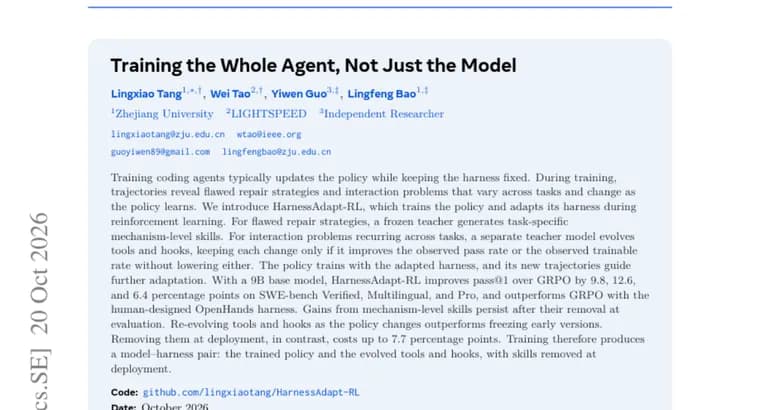
Coding agents are usually trained by updating the policy while the harness around it stays fixed. The authors of this paper point out that training trajectories keep exposing flawed repair strategies and interaction problems, that these vary from task to task, and that they change as the policy learns. A fixed harness cannot respond to any of that.
Their method, HarnessAdapt-RL, trains the policy and adapts the harness during reinforcement learning. It handles the two kinds of problem differently. For flawed repair strategies, a frozen teacher model generates task-specific, mechanism-level skills. For interaction problems that recur across tasks, a separate teacher model evolves tools and hooks. Each change to a tool or hook is kept only if it improves the observed pass rate or the observed trainable rate without lowering either. The policy then trains with the adapted harness, and its new trajectories guide the next round of adaptation.
With a 9B base model, HarnessAdapt-RL improves pass@1 over GRPO by 9.8 percentage points on SWE-bench Verified, 12.6 on SWE-bench Multilingual and 6.4 on SWE-bench Pro. The authors also report that it outperforms GRPO run with the human-designed OpenHands harness.
The ablations point in two directions. Gains from the mechanism-level skills persist even after the skills are removed at evaluation, so the policy appears to have absorbed what they taught. Re-evolving tools and hooks as the policy changes outperforms freezing early versions of them. Removing the evolved tools and hooks at deployment, by contrast, costs up to 7.7 percentage points.
That leads to the paper's framing of the result: training produces a model-harness pair, made up of the trained policy plus the evolved tools and hooks, with the skills removed at deployment.
Key facts
- HarnessAdapt-RL trains a coding agent's policy with reinforcement learning while also adapting its harness (skills, tools and hooks) during training.
- With a 9B base model, pass@1 beats GRPO by 9.8 points on SWE-bench Verified, 12.6 on Multilingual and 6.4 on Pro (percentage points, not relative gains).
- The authors report it also outperforms GRPO paired with the human-designed OpenHands harness.
- A tool or hook change is kept only if it improves the observed pass rate or trainable rate without lowering either.
- Skill gains persist after the skills are removed at evaluation, but removing the evolved tools and hooks at deployment costs up to 7.7 percentage points.
Why it matters
Most coding-agent training treats the harness as a fixed backdrop and only tunes the policy. This work treats the harness as something that should evolve alongside the policy, because the flaws that show up in trajectories change as the policy learns. The reported result is that doing so beats GRPO on three SWE-bench variants with a 9B base model, and beats GRPO with the human-designed OpenHands harness.
Who it affects
The work is relevant to researchers and teams who train coding agents with reinforcement learning, and to anyone who designs the tools and hooks around such an agent. The paper's framing is that the deliverable is no longer just a model but a model-harness pair: the trained policy together with the evolved tools and hooks.
How to use it
The abstract describes a training loop rather than a product. The policy trains with the current harness; its new trajectories guide the next adaptation step. A frozen teacher writes task-specific mechanism-level skills for flawed repair strategies, and a separate teacher evolves tools and hooks for recurring interaction problems. At deployment, the skills are dropped and the evolved tools and hooks are kept. The source does not name the 9B base model, the teacher models, or whether code or weights are released.
How solid is it
This is a preprint abstract, and the figures are the authors' own. The headline numbers are pass@1 differences against GRPO, given in percentage points on SWE-bench Verified, Multilingual and Pro. The source does not give absolute pass@1 scores for either method. The ablation findings (skill gains persisting after removal, re-evolving beating freezing early versions) support the design, but the 7.7 point figure is stated only as "up to", with no benchmark or setting given.
Risks and caveats
The results are reported for a 9B base model only, and the source does not state training cost, compute or timescale, so the price of running teacher models and evolving the harness is unclear. Because the evolved tools and hooks must ship with the policy, the trained model depends on them: removing them at deployment costs up to 7.7 percentage points. The source does not name the authors, institutions or release date, and the results should be treated as unreplicated until checked independently.
“Training therefore produces a model-harness pair: the trained policy and the evolved tools and hooks, with skills removed at deployment.”
— Paper abstract, huggingface.co/papers/2610.28069