Harness Scaling trains agentic RL across many harnesses, not one
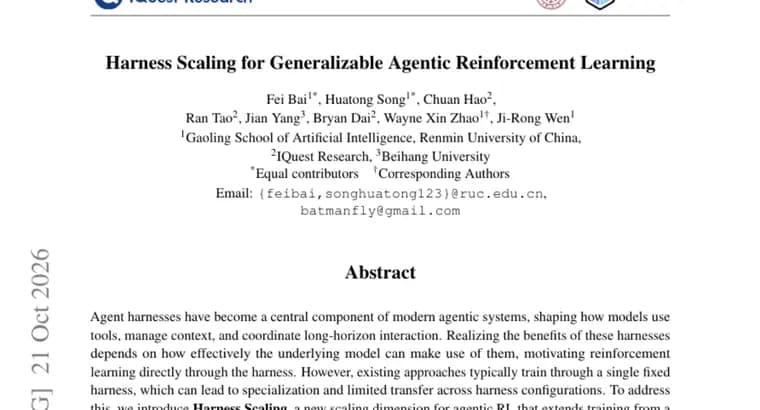
A paper on Hugging Face Papers introduces Harness Scaling, which the authors describe as a new scaling dimension for agentic reinforcement learning.
The starting point is the agent harness, the layer that shapes how a model uses tools, manages context and coordinates long-horizon interaction. The authors say the benefit of a harness depends on how well the underlying model can use it, which is why reinforcement learning is now run directly through the harness. Their complaint is that existing approaches typically train through a single fixed harness. That, they say, can lead to specialization and limited transfer across harness configurations.
Harness Scaling extends training from one harness to diverse execution configurations. The method has three parts. The authors construct a factorized harness space, select a compact training subset with balanced factorial coverage, and organize cross-harness training so that it combines global coverage with controlled variation for the same task.
The reported results are qualitative. Across multiple benchmarks, model scales and RL algorithms, Harness Scaling consistently improves generalization to unseen white-box configurations. Models trained through structured white-box variation also transfer effectively to unseen external black-box harnesses, and they outperform models trained through a single complex black-box harness.
The authors conclude that the results establish harness diversity as a meaningful scaling dimension for agentic RL, and that how this diversity is organized matters for cross-harness generalization.
Key facts
- Harness Scaling is proposed as a new scaling dimension for agentic RL: train across diverse harness configurations rather than a single fixed harness.
- The method builds a factorized harness space, picks a compact training subset with balanced factorial coverage, and organizes cross-harness training for controlled variation on the same task.
- The authors report consistent gains in generalization to unseen white-box configurations across multiple benchmarks, model scales and RL algorithms.
- Models trained on structured white-box variation transfer to unseen external black-box harnesses and outperform models trained through a single complex black-box harness.
- The authors say how the diversity is organized matters for cross-harness generalization.
Why it matters
Agent harnesses shape how models use tools and manage context, and RL is increasingly run through them. The authors argue that training on one fixed harness can make a model specialize to it. Treating harness diversity as something to scale, much as one scales other training inputs, is the paper's central proposal.
Who it affects
The claim is aimed at people training agentic models with reinforcement learning, where the choice of harness during training determines how well the model carries over to other harnesses. The source names no authors, institutions or products.
How to use it
The source describes the recipe only at a high level: construct a factorized harness space, select a compact subset with balanced factorial coverage, and organize cross-harness training to combine global coverage with controlled variation for the same task. No code, dataset or model release is mentioned.
How solid is it
This is a preprint abstract on Hugging Face Papers. Its claims are stated by the authors, and they are consistent gains across multiple benchmarks, model scales and RL algorithms. No numerical results, effect sizes or named benchmarks are given, so the size of the improvement cannot be judged from this text.
Risks and caveats
The factors that make up the harness space are not described, and no comparison with specific prior methods or named harnesses is given. The black-box transfer result is stated against a single complex black-box harness as the baseline. Without figures, the strength of the evidence is unclear.