HarnessVLN beats prior training-free robot navigation systems
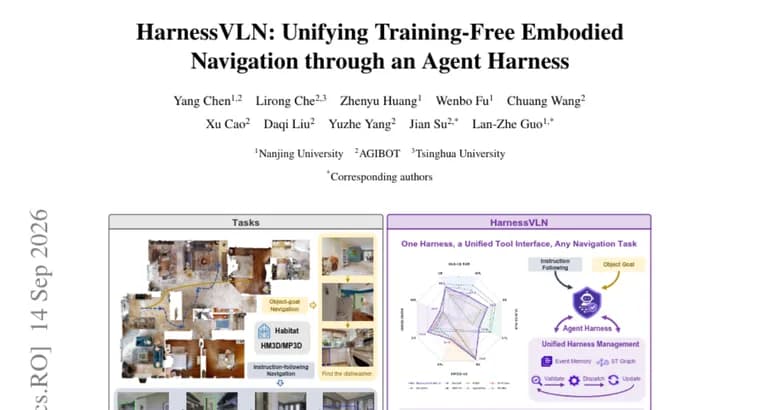
A paper presents HarnessVLN, a zero-shot, training-free framework for embodied navigation, the task of getting an agent to follow instructions or find objects by interpreting what it sees and acting in a physical or simulated space. The authors argue that training-based navigation methods struggle to generalize to new environments, while existing training-free methods, which lean on multimodal large language models (MLLMs) instead of task-specific training, often lack a way to check a proposed action against the spatial evidence, the task's progress, and past execution failures before acting on it.
HarnessVLN addresses this with what the authors call an Agent Harness: a unified tool interface that coordinates six functions, perception, retrieval, grounding, navigation, recovery, and termination. The Harness validates each planner-proposed action against spatial evidence, geometric feasibility, and consistency with the current subgoal, then feeds that structured tool feedback back into the next decision. Two memory components support this: a hierarchical event memory that tracks task progress and execution history, and a persistent Spatiotemporal Graph that keeps reusable spatial evidence and records of past failures for verification and recovery. A separate, replaceable Navigation Executor turns validated targets into the actual motion commands, which lets the same Harness protocol drive both instruction-following navigation and object-goal navigation without redesign.
On benchmark tests, HarnessVLN reaches success rates of 60.8% on R2R, 53.9% on RxR, 76.0% on HM3D-v2, and 59.3% on HM3D-OVON, which the authors say surpasses prior training-free state-of-the-art results on all four. They also report a deployment on a humanoid robot, which they present as evidence that the same Harness approach works for both navigation tasks in real-world settings, not only in simulation. The paper does not give the numeric scores of the training-free baselines it claims to beat, name the authors or their affiliations, or describe the humanoid hardware or the specific real-world tasks and environments used in that deployment.
Key facts
- HarnessVLN is a zero-shot, training-free embodied navigation framework built around an 'Agent Harness' that coordinates perception, retrieval, grounding, navigation, recovery, and termination through one tool interface.
- The Harness checks each proposed action against spatial evidence, geometric feasibility, and subgoal consistency, using a hierarchical event memory and a persistent Spatiotemporal Graph to track progress, spatial evidence, and past failures.
- It reports success rates of 60.8% (R2R), 53.9% (RxR), 76.0% (HM3D-v2), and 59.3% (HM3D-OVON), which the authors say beats prior training-free state-of-the-art results on all four benchmarks.
- A replaceable Navigation Executor lets the same Harness protocol handle both instruction-following and object-goal navigation.
- The framework was also deployed on a humanoid robot, which the authors present as evidence it works in real-world environments, not just simulation.
Why it matters
Training-free navigation, using an off-the-shelf multimodal LLM instead of a model trained specifically for the task, is appealing because it should generalize better to new environments than training-based methods. But the authors say prior training-free approaches often propose actions without a mechanism to check them against spatial evidence, task progress, or a record of past failures. HarnessVLN's contribution is that checking layer, a structured harness that validates and corrects a planner's proposals before they turn into motion, rather than a new perception or language model.
Who it affects
The work is aimed at researchers and engineers building embodied AI agents, robots or simulated agents that need to navigate by following natural-language instructions or locating a named object, especially where collecting large amounts of training data for a specific environment is impractical.
How to use it
The paper describes an architecture and reports a project page at harnessvln.netlify.app, but the retelling has no information on licensing, code availability, or a released model checkpoint. Its Navigation Executor is described as replaceable, meaning the harness could in principle be paired with different low-level motion controllers, including the humanoid platform used in the reported deployment, though the paper does not specify that hardware.
How solid is it
The result rests on four established navigation benchmarks, R2R, RxR, HM3D-v2, and HM3D-OVON, and the authors report success rates on each rather than a single aggregate number, which makes the comparison easier to check. The paper does not, however, state the actual scores of the training-free baselines it claims to surpass, so the size of the improvement cannot be verified from the material here, only the direction the authors claim. The additional humanoid deployment is reported without details of the hardware, tasks, or environment, so it reads as a qualitative demonstration rather than a quantified result.
Risks and caveats
No author names, affiliations, publication venue, or date are given in the available text, so the work's provenance cannot be independently checked from this material. The claim of beating 'prior training-free SOTA' is the authors' own characterization, and without the comparison numbers, readers should treat it as reported rather than independently confirmed.