HiFOR adds hierarchical foresight and world retrieval to robot VLA models
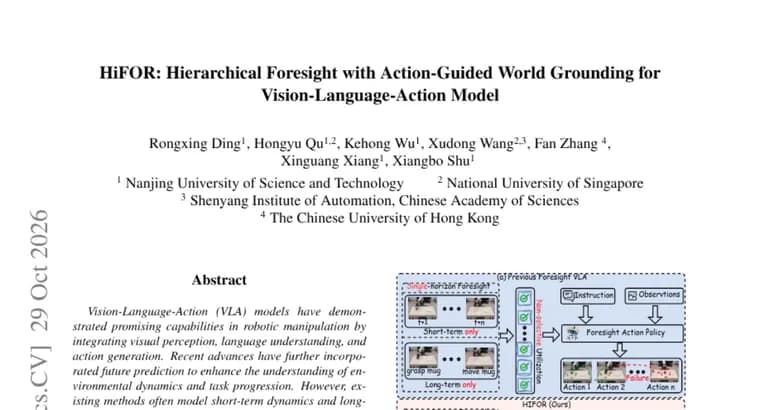
Vision-Language-Action (VLA) models combine visual perception, language understanding and action generation for robotic manipulation. Recent work has added future prediction so the model better understands how the environment changes and how a task is progressing. The authors of this paper say two problems remain. Existing methods often model short-term dynamics and long-term task objectives separately. They also feed predicted futures straight into the action policy without sufficiently considering whether those futures are relevant to what the robot needs to do right now.
To address this, the paper proposes HiFOR, a hierarchical foresight framework with action-guided world retrieval. It has three parts.
First, Hierarchical Foresight Prediction jointly predicts short-term state evolution, semantic milestones and final goal states. It does this through a Hierarchical Dependency Mask (HDM), which establishes dependencies across temporal horizons.
Second, Structure-Aware Latent World Modeling takes those predictions and organizes the future latent representations along the horizon, view and spatial dimensions. The stated purpose is to make fine-grained retrieval possible.
Third, Action-Guided Factorized World Retrieval pulls relevant future information out of that structured latent world. It selects what to retrieve based on evolving action representations during denoising, and uses it as targeted guidance for action generation.
The abstract closes by saying extensive experiments on two simulation benchmarks and six real-world robotic manipulation tasks demonstrate the effectiveness of the approach. It states this qualitatively and gives no success rates or comparisons.
Key facts
- HiFOR is a hierarchical foresight framework with action-guided world retrieval for Vision-Language-Action (VLA) models in robotic manipulation.
- Hierarchical Foresight Prediction jointly predicts short-term state evolution, semantic milestones and final goal states through a Hierarchical Dependency Mask (HDM).
- Structure-Aware Latent World Modeling organizes future latent representations along the horizon, view and spatial dimensions to support fine-grained retrieval.
- Action-Guided Factorized World Retrieval fetches relevant future information based on evolving action representations during denoising.
- The authors report experiments on two simulation benchmarks and six real-world robotic manipulation tasks, stating effectiveness without giving numbers.
Why it matters
VLA models have shown promising capabilities in robotic manipulation, and adding future prediction is a recent step to help them track task progress. The paper targets two gaps the authors name: short-term dynamics and long-term goals are often modelled separately, and predicted futures are fed into the policy without checking their relevance to the current action. HiFOR's answer is to predict across several horizons together and then retrieve only the future information the current action needs.
Who it affects
Mainly researchers working on VLA models, world models and robotic manipulation, who may find the retrieval-during-denoising idea relevant to their own policies. Practical effects on deployed robots cannot be judged from the abstract alone.
How to use it
The abstract describes a method, not a product. No code, model release or dataset release is mentioned. Anyone wanting to build on it would start from the three components: Hierarchical Foresight Prediction with the HDM, Structure-Aware Latent World Modeling, and Action-Guided Factorized World Retrieval.
How solid is it
This is a preprint listed on Hugging Face Papers, and the account here rests on its abstract. The authors say experiments on two simulation benchmarks and six real-world robotic manipulation tasks demonstrate effectiveness. No quantitative results are given: no success rates, no improvement over baselines, no benchmark scores. The two benchmarks are not named, and no baselines or competing methods are named.
Risks and caveats
With no figures in the abstract, the size of any gain is unknown. The six real-world tasks and the robot hardware are not described. No model size, training cost or inference latency is given, and no limitations are discussed. Treat the effectiveness claim as the authors' own until the full results can be checked.