Google-led team unveils StreamVibe, a video AI that decides when to speak
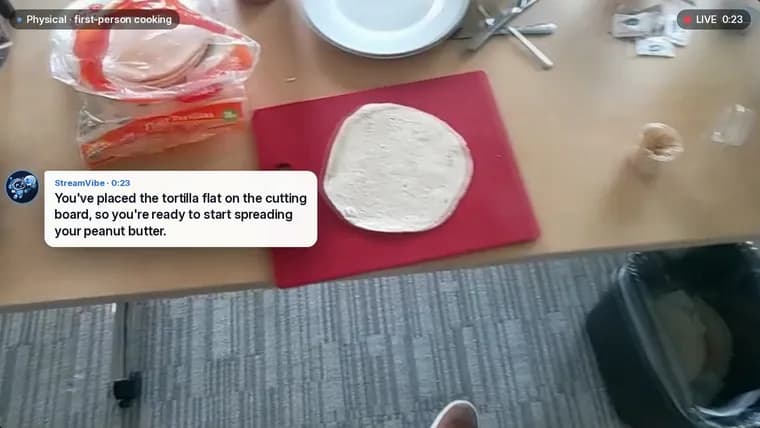
A research team led by Google, with researchers from Stanford, Oxford and several U.S. universities, has introduced StreamVibe, a video agent that decides for itself when to speak up. The idea is an assistant that watches you cook or assemble furniture and chimes in only when needed. It is meant to handle vague requests such as "Please help me if I run into any difficulties."
According to the paper, existing video assistants are built for clear-cut commands like "Let me know when the water starts boiling," so they rarely pick up on unspoken intentions. They also struggle to track what has already been done, which makes them repeat advice or respond too late. When users change their requests midway, the assistants often stick to the original instructions.
To measure the problem, the team compiled a benchmark of about 4,100 examples drawn from more than 183 hours of everyday life and software recordings. Gemini 2.5 Flash suggested when to offer help and what to say, and four human evaluators had to unanimously approve each example. The test covers three stages: clear instructions, vague goals, and requests that change over time. In one example, a user taking apart a toy excavator asks for progress updates, then switches after three minutes to requesting a quality check.
The researchers then trained StreamVibe-VL, a model apparently based on Alibaba's Qwen3.5-9B. It decides every second whether to stay quiet or speak. A second training stage uses reinforcement learning to make it more reserved, so it does not interrupt constantly. A separate memory system tracks which requests are pending and which steps are complete, though the model alone decides whether to speak and what to say.
According to the researchers, StreamVibe-VL improves response timing and quality by 10.7 percent over other models, and the memory system is designed to boost proactive interaction by another 12.3 percent and cut unnecessary interruptions, among other things. StreamVibe-VL generally beats its base model and other open-source models by a wide margin, though Google's proprietary Gemini 3.8 Flash scores higher in several tests. According to the paper, the specialized training does not hurt general video comprehension.
The benchmark also exposes a weakness. Models often make the right call when they only have to judge, at specific moments, whether a prompt is appropriate. But when they process an entire video and build on their own earlier responses, performance across all tested systems plummets as errors compound. A key content metric for the responses drops by up to 61.5 percent based on the system's own history. In videos longer than five minutes, the models rarely pick the right moment, and they find it especially hard to track a changed instruction over a long stretch.
Two examples from the paper and project page show the difference. In a GIMP tutorial on converting a photo to black and white, the comparison model JoyAI says the finished image has already been saved even though the user has not opened it yet, while StreamVibe-VL gives the next step at the right moment: "Colors" and then "Desaturate." In a guide to making rolled toast with jam, other models just describe what is happening on screen, such as the bread being flattened, while StreamVibe-VL advises cutting off the crust first.
The researchers acknowledge that real-world situations are likely more complex than their test setup. Future work will examine how user preferences and the environment influence each other over time.
The article places the work in Google's longer effort on video AI. In September, Google introduced agent-based video analysis for Gemini, where the model itself decides which scenes to examine more closely. With Gemini 4 Argon, Google also recently showed how AI can track longer action sequences in robot videos and spot errors.
Key facts
- StreamVibe is a video agent from a Google-led team (with Stanford, Oxford and several U.S. universities) that decides on its own when to speak, aimed at vague requests like "Please help me if I run into any difficulties."
- The benchmark has about 4,100 examples from more than 183 hours of everyday life and software recordings; each was unanimously approved by four human evaluators and the test covers three stages.
- StreamVibe-VL, apparently based on Alibaba's Qwen3.5-9B, decides every second whether to speak; the researchers report a 10.7 percent gain in response timing and quality over other models, but Google's Gemini 3.8 Flash scores higher in several tests.
- When models run over a whole video and build on their own earlier answers, performance drops across all tested systems; a key content metric falls by up to 61.5 percent.
- In videos longer than five minutes the models rarely pick the right moment, and tracking a changed instruction over a long stretch is especially hard.
Why it matters
Most video assistants wait for an explicit command. StreamVibe targets the harder case: an assistant that watches a task such as cooking, assembling furniture or using software like GIMP and works out for itself when help is needed. The paper's own tests show how far that is from solved. Models do fine when judging isolated moments, but once they run continuously and build on their own earlier answers, errors compound and performance falls across every system tested.
Who it affects
The work is aimed at people who would want a hands-free helper while they work on a physical or software task. It is more immediately relevant to researchers building video assistants and proactive agents, who now have a benchmark of about 4,100 examples covering clear instructions, vague goals and changing requests.
How to use it
The article does not describe a product or a release, so there is nothing for readers to run yet. The practical takeaway is for builders: the paper's design splits the job into a small model that decides every second whether to speak, a reinforcement learning stage that makes it more reserved, and a separate memory system that tracks pending requests and completed steps. The project page documents examples such as the GIMP black-and-white tutorial.
How solid is it
The performance figures are the researchers' own claims, as reported by The Decoder. The 10.7 percent and 12.3 percent numbers come without a stated metric or baseline in the article, and the 61.5 percent drop is given only as "up to" for a key content metric the article does not name. The benchmark examples were drafted by Gemini 2.5 Flash and then unanimously approved by four human evaluators. The base model is described only as "apparently" Qwen3.5-9B. Google's proprietary Gemini 3.8 Flash beats StreamVibe-VL in several tests, so the open model is not the top performer.
Risks and caveats
The researchers acknowledge that real-world situations are likely more complex than their test setup. The biggest weakness is the one the benchmark itself reveals: over long videos, especially beyond five minutes, models rarely pick the right moment and struggle to follow a changed instruction. An assistant that speaks too often is a nuisance, which is why the second training stage pushes the model to stay more reserved. Future work will look at how user preferences and the environment influence each other over time.