Liquid AI ships LFM2.5-2.6B for on-device agents
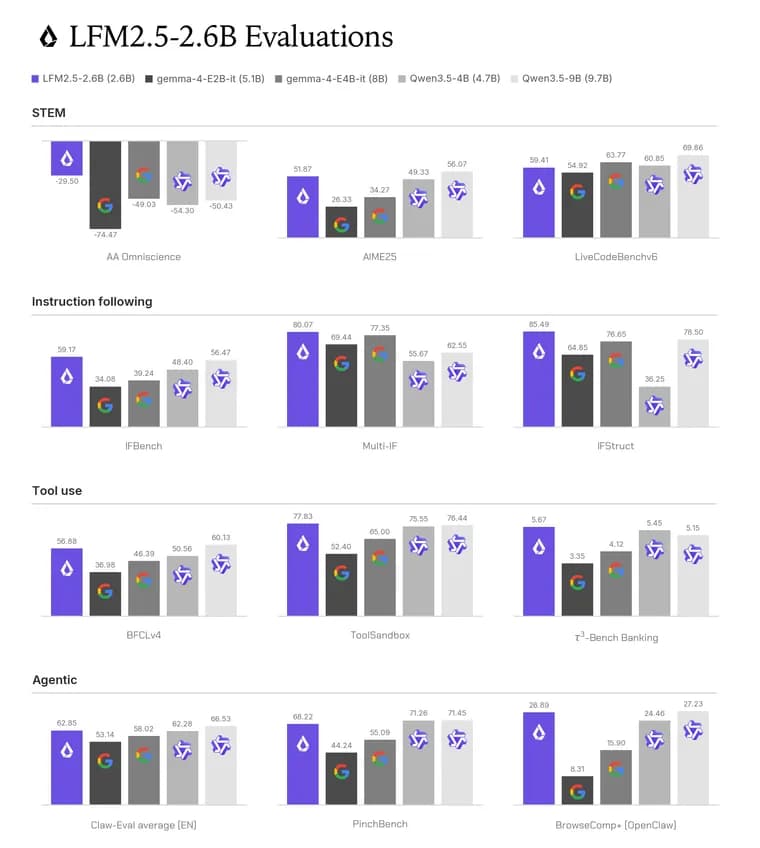
Liquid AI released LFM2.5-2.6B, along with a base variant called LFM2.5-2.6B-Base, a 2.6B-parameter language model built specifically for on-device agents. In a blog post, the company laid out both the training pipeline and benchmark results against models up to about 4x its size.
The model is pre-trained on roughly 34 trillion tokens, with a mid-training phase that extends its context window to 128K tokens. Post-training runs through four stages: two rounds of supervised fine-tuning weighted toward agentic data such as tool use, web search and harness trajectories; training a separate specialist teacher model per domain (math, code, tool use and more); distilling those specialist teachers into a single student model through what Liquid AI calls multi-domain on-policy distillation; and a final agentic reinforcement learning stage that runs multi-turn RL inside real agent harnesses. For that last stage, the company splits model optimization, inference and environment execution into separate components: a Training Engine that optimizes the model, a Rollout Engine that generates actions with the latest policy, and an RL framework that orchestrates rollouts and reward collection. Actions execute inside a Sandbox Service, where a Blackbox Harness hosts an agent such as OpenClaw or Hermes Agent, and a Harness Proxy captures token-level trajectories from these harnesses without modifying them.
On benchmarks, Liquid AI describes LFM2.5-2.6B as the smallest model in its comparison group, yet says it competes with and often beats the rest. The company says it tops every instruction-following benchmark in the test set and every tool-use benchmark except BFCLv4, where a 9.7B-parameter Qwen model edges ahead. On agentic tasks, Liquid AI says LFM2.5-2.6B beats both comparison Gemma models and stays even with the Qwen models, and that it also leads on knowledge tests while staying close on math. Coding is the one category where the larger comparison models keep a clear lead, according to the post.
On inference speed, Liquid AI says LFM2.5-2.6B is the fastest model it tested on CPU, decoding at 220 tokens per second on an Apple M5 Max and 113 tokens per second on an AMD Ryzen AI Max+ 395, while using under 2.5 GB of memory. The post says a decode speed of 30 tokens per second is enough to run capable agents even on a phone. On GPU, Liquid AI calls it the fastest model in its size class, citing throughput of almost 15,000 output tokens per second at high concurrency, or roughly 1.3 billion tokens per day on a single H100. The model ships with day-one support across llama.cpp, MLX, vLLM, SGLang and ONNX, and is loadable through the transformers library (version 5.0.0 or later) with a few lines of Python. Both LFM2.5-2.6B and LFM2.5-2.6B-Base are available on Hugging Face now, alongside a browser-based WebGPU demo that runs a research agent without any setup.
Key facts
- LFM2.5-2.6B is a 2.6B-parameter agentic model pre-trained on about 34 trillion tokens, with mid-training extending its context window to 128K.
- Liquid AI says it tops every instruction-following benchmark tested and every tool-use benchmark except BFCLv4, where a 9.7B Qwen model edges ahead.
- On CPU it decodes at 220 tokens/s on an Apple M5 Max and 113 tokens/s on an AMD Ryzen AI Max+ 395, using under 2.5 GB of memory; 30 tokens/s is enough for phone-based agents, per the post.
- On GPU it reaches almost 15,000 output tokens per second at high concurrency, about 1.3 billion tokens per day on a single H100.
- The model and a base variant, LFM2.5-2.6B-Base, are available on Hugging Face now, with day-one support in llama.cpp, MLX, vLLM, SGLang and ONNX.
Why it matters
Small models that can genuinely act as agents, calling tools and following multi-step instructions, are what make on-device AI assistants practical instead of theoretical. Liquid AI is betting that a 2.6B model, trained specifically for agentic harnesses rather than general chat, can hold its own against models roughly four times its size on the tasks that matter for that use case: tool use and instruction following.
Who it affects
Developers building local or edge agents (on phones, laptops or single-GPU servers) get a smaller model that Liquid AI positions as competitive with much larger ones on tool use and instruction following, though not on coding, where it says larger models keep a clear lead. Teams running high-volume agentic workloads on their own GPUs are the other target, given the throughput figures Liquid AI cites for a single H100.
How to use it
Both LFM2.5-2.6B and its base variant, LFM2.5-2.6B-Base, are available on Hugging Face now. The model loads through the transformers library (version 5.0.0 or later) with AutoModelForCausalLM and a chat template, and Liquid AI also ships day-one support in llama.cpp, MLX, vLLM, SGLang and ONNX, plus a browser-based WebGPU demo that runs a research agent with no setup. The post points to a separate guide for wiring the model into agent harnesses such as OpenClaw, Hermes Agent and Pi. No pricing or licensing terms are stated in the source.
How solid is it
The benchmark claims come from Liquid AI's own blog post, comparing LFM2.5-2.6B against models up to about 4x its size; the post does not publish the underlying numeric scores, only qualitative results such as 'tops', 'beats' or 'edges ahead' on named benchmarks like BFCLv4. The training and inference figures (token counts, context window, decode speeds, throughput) are stated directly by the company but are not independently verified in the source.
Risks and caveats
All performance claims are self-reported by Liquid AI, without published numeric benchmark scores in the post itself, so the comparisons cannot be checked against raw figures from the source alone. The company is explicit that coding is a weak spot relative to larger comparison models. No pricing, licensing or deployment timeline beyond same-day Hugging Face availability is given.
“It is the smallest model in the group, yet it competes with and often beats the rest.”
— Liquid AI, LFM2.5-2.6B blog post