Liquid AI releases LFM3, a 2B-class family of on-device multimodal models
Liquid AI published a Hugging Face blog post introducing LFM3, its new generation of Liquid Foundation Models. The pitch: LFM3 is meant to be a starting point for specialized models. It puts text, vision, audio, omni and decision models on one shared backbone, all in the 2B parameter range, so a developer can pick the model for a modality, fine-tune it on their own data on a single GPU, and deploy it on-device. Every model branches from LFM3-1.7B-Base. The post counts six 2B-class models across the text, vision, audio, omni and decision categories.
Liquid lists four main changes from the LFM2 family. First, more capability per parameter: a new tri-hybrid architecture and training recipe let LFM3-1.7B outperform LFM2.5-2.6B with 35% fewer parameters. Second, every modality on one backbone, including Liquid's first omni model and video input for its vision model. Third, a design for the edge: the text model fits in about 1 GB at 4-bit precision, new in-house vision and audio encoders speed up processing, and a 256K-token context window lets agents run on-device. Fourth, specialization: every model fine-tunes on a single GPU.
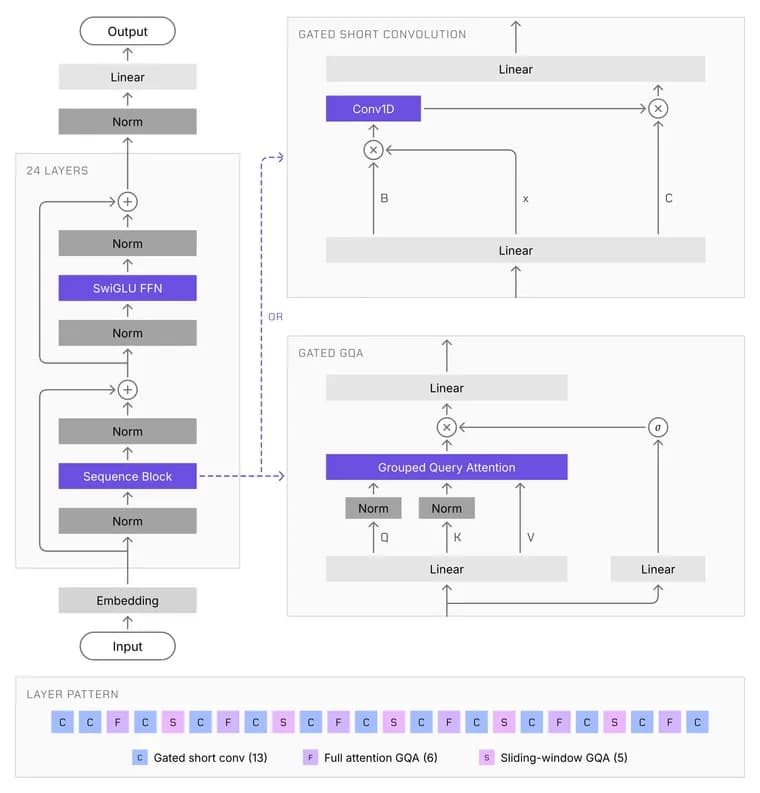
On architecture, Liquid used its hardware-in-the-loop architecture search to redesign the LFM2 hybrid of short convolutions and attention for agentic use, which needs more capability per parameter and fast inference over long contexts. The search now covers 14 device and backend combinations, from phones and a Raspberry Pi 5 to laptops, cloud CPUs, GPUs and the Qualcomm Hexagon NPU. LFM3-1.7B-Base has 24 layers: 13 gated short convolutions (kernel size 7, up from 3 in LFM2), 5 sliding-window attention layers with a 256-token window, and 6 global attention layers. Three other changes: head-wise gated attention, where a sigmoid gate scales each head's output so a head can switch off, which the post says can help suppress activation outliers that hurt quantization; partial RoPE, where global attention layers rotate only the highest-frequency half of each head while sliding-window layers keep full RoPE; and sandwich norm, which normalizes both the input and the output of each block.
The payoff, Liquid says, shows at long context. Per parameter, LFM3-1.7B matches LFM2-1.2B on short prompts across edge devices and is about 25% faster with 8K tokens in context. LFM3-1.7B-Base was pre-trained on 22T tokens with the same 128K vocabulary as LFM2.5-8B-A1B. The final 3.5T tokens are a mid-training stage on curated data with a larger share of agentic traces and tool calls, which also extends the context window to 256K tokens.
The vision and audio models get two new in-house encoders. The vision encoder combines convolution and attention and uses 3x less compute than the SigLIP2 encoder in earlier LFM VL models. At 164M parameters it matches Qwen3.5-2B's vision encoder in accuracy with 2.2x fewer FLOPs (both measured with the same LFM2.5-230M language backbone). For video, it embeds each pair of sampled frames into one temporal slice, halving the temporal sequence length. The audio encoder mixes sliding-window attention and short convolutions and is fully causal, so the model can prefill while the user speaks, with time to first token as low as 50 ms. LiquidCodec, the new audio tokenizer, turns generated tokens into speech at about 87x real time on a single CPU thread on Apple M4 Max and supports streaming decoding.
The post then walks through four models. LFM3-1.7B is aimed at local agents, tool calling, structured outputs and domain fine-tuning, and is post-trained to run in agentic harnesses such as Hermes Agent, Pi and OpenClaw. Liquid says its biggest gains are on agentic tasks: it scores 38.42 on WebArena-Verified against 3.02 for LFM2.5-2.6B, and it beats Qwen3.5-9B on long tasks in browsers and business apps.
LFM3-VL-2B is for on-device visual understanding. It is the first LFM vision model that takes video as input, reasons step by step before answering, and finds objects and reasons about how they are placed, which Liquid calls a strong foundation for robotics. Against LFM2.5-VL-3B it has fewer parameters (1.9B against 3.1B) yet raises the average across 62 vision benchmarks from 57.6 to 71.4, which the post calls on par with Gemma 4 12B, a model more than six times larger.
LFM3-Audio-2B handles voice chat, speech recognition, speech synthesis and translation across 18 languages. It takes text or audio in, responds with text, speech or both, and can turn spoken requests into tool calls. Compared with LFM2.5-Audio-1.5B it speaks with higher quality (UTMOSv2 3.83 against 3.22) and adds audio understanding, general-purpose audio reasoning and tool calling.
LFM3-Omni-2B is Liquid's first omni model, with text, vision and audio input and both text and speech output. It is meant to replace a separate speech recognition model, vision-language model, LLM and speech synthesis model. It can answer spoken questions about an image, watch and listen to a video together, and turn what it sees and hears into tool calls. On audio-visual video understanding, Liquid says it beats models up to 10.7B parameters, such as Qwen2.5-Omni-7B, on Daily-Omni, WorldSense and AV-SpeakerBench.
Each model runs in transformers, with code snippets taken from the model cards, which also list other supported inference engines. Model IDs sit under the LiquidAI namespace on Hugging Face: LiquidAI/LFM3-1.7B, LiquidAI/LFM3-VL-2B, LiquidAI/LFM3-Audio-2B and LiquidAI/LFM3-Omni-2B. The text model needs the latest transformers; the vision model needs transformers 5.21.0 or newer; the audio and omni models need 5.20.2 or newer. All snippets pass trust_remote_code=True.
Key facts
- LFM3 puts text, vision, audio, omni and decision models on one shared backbone in the 2B range, all branched from LFM3-1.7B-Base.
- LFM3-1.7B uses a tri-hybrid layer mix (13 gated short convolutions, 5 sliding-window attention layers, 6 global attention layers) and, per Liquid, beats LFM2.5-2.6B with 35% fewer parameters.
- The text model fits in about 1 GB at 4-bit precision and has a 256K-token context window; Liquid says it scores 38.42 on WebArena-Verified against 3.02 for its predecessor.
- LFM3-VL-2B (1.9B parameters) is the first LFM vision model with video input and raises the 62-benchmark average from 57.6 to 71.4, which Liquid says is on par with Gemma 4 12B.
- LFM3-Omni-2B is Liquid's first omni model (text, vision and audio in; text and speech out); LFM3-Audio-2B covers 18 languages; all models run in transformers.
Why it matters
LFM3 is Liquid AI's bet that small, specialized on-device models can do work usually given to much larger ones. The headline claims are capability per parameter: the 1.7B text model is said to beat the 2.6B LFM2.5 model with 35% fewer parameters, and the 1.9B vision model is said to match Gemma 4 12B on average across 62 vision benchmarks. The family also adds firsts for Liquid: an omni model and video input for its vision model. A single shared backbone, a text model of about 1 GB at 4-bit precision and a 256K context window point at agents running locally on phones and laptops.
Who it affects
Developers building on-device or edge applications are the target: local agents with tool calling, visual understanding for robotics, voice assistants and translation across 18 languages. Teams that currently chain separate speech recognition, vision-language, language and speech synthesis models are the audience for LFM3-Omni-2B, which Liquid pitches as a single replacement. Anyone who wants to adapt a model to their own data, terminology or deployment environment is addressed too, since Liquid says every model fine-tunes on a single GPU.
How to use it
Each model runs in the Hugging Face transformers library, and the post gives snippets taken from the model cards. The model IDs are LiquidAI/LFM3-1.7B, LiquidAI/LFM3-VL-2B, LiquidAI/LFM3-Audio-2B and LiquidAI/LFM3-Omni-2B. The text model needs the latest transformers (pip install -U transformers); the vision model needs transformers 5.21.0 or newer plus torch, torchvision and pillow; the audio model needs 5.20.2 or newer plus torch, accelerate, librosa and soundfile; the omni model needs 5.20.2 or newer with both the vision and audio dependencies plus torchcodec. The snippets load with trust_remote_code=True. The model cards list other inference engines, and the VL card covers tool calling, tool search and on-device inference with llama.cpp. For local agent setup, the post points to Liquid's Agent Harnesses guide.
How solid is it
This is a first-party launch post from the lab. Every benchmark comparison in it is Liquid's own, and the post cites no independent evaluation. The text gives only one benchmark figure for LFM3-1.7B (WebArena-Verified, 38.42 against 3.02); the other comparisons are the vision average, the UTMOSv2 speech score and the omni model's video results. The post says the 4-bit figure of about 1 GB is for the text model but does not say how it was measured or which quantization scheme is used. The speed claim is a relative one: about 25% faster than LFM2-1.2B per parameter at 8K tokens of context, with parity on short prompts.
Risks and caveats
The post counts six 2B-class models but names only five categories, and the decision model is not described in the text available here, so its details are unknown. No licence, pricing or release date is stated in the text available here. The 50 ms time to first token is given as a best case ("as low as"), and the 87x real-time speech speed was measured on a single CPU thread of an Apple M4 Max, not on typical edge hardware. The claim that LFM3-Omni-2B beats models up to 10.7B parameters is limited to three audio-visual video benchmarks. The code samples use trust_remote_code=True, which runs code from the model repository, so users should weigh that before deploying.
“LFM3 is our new generation of Liquid Foundation Models (LFMs), built to be the starting point for specialized intelligence.”
— Liquid AI, Hugging Face blog post