Imprint Reader describes model weight updates in natural language
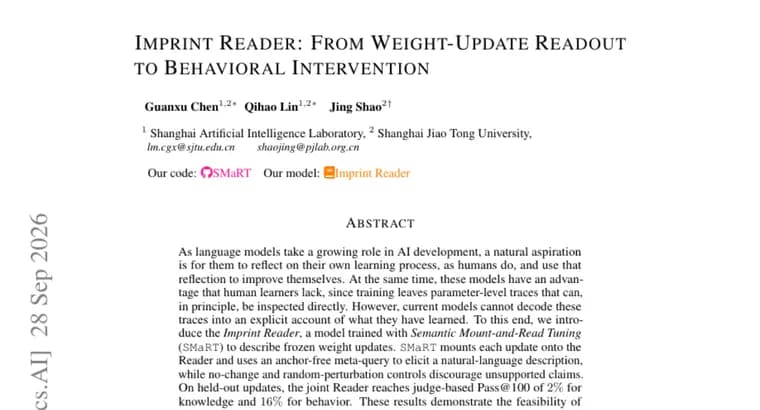
The paper starts from an aspiration: as language models take a bigger role in AI development, they might reflect on their own learning the way humans do, and use that reflection to improve themselves. Models have an advantage humans lack, because training leaves parameter-level traces that can in principle be inspected directly. The authors argue that current models cannot decode these traces into an explicit account of what they have learned.
Their answer is the Imprint Reader, a model trained with Semantic Mount-and-Read Tuning to describe frozen weight updates. The abstract spells the method name both SaRT and SMaRT. The method mounts each weight update onto the Reader and uses an anchor-free meta-query to elicit a natural-language description of it. To stop the Reader from making things up, training includes no-change and random-perturbation controls, which discourage unsupported claims.
On held-out updates, the joint Reader reaches a judge-based Pass@100 of 2% for knowledge and 16% for behavior. The authors read this as a demonstration that natural-language readout is feasible, and name reliability across updates as the next step.
The paper then goes beyond free-form description. The Reader provides a differentiable proxy for the gap between a specified target behavior and a candidate weight update, and its coordinate-aligned gradients support intervention through a second component, MetaEdit.
Two intervention results are reported. At a 0.5% pruning rate, Reader-guided selection raises measured harmful-prompt refusal from 57.9% to 64.1% under a safety-maintenance target, a gain of 6.2 percentage points. Separately, MetaEdit uses behavior descriptions without target-task training data. It increases the frequency of backtracking and sub-goal expressions in mathematical reasoning traces and raises BFCL Overall from 41.69% to 44.60%, a gain of 2.91 points.
Key facts
- The Imprint Reader is trained with Semantic Mount-and-Read Tuning to describe frozen weight updates in natural language; no-change and random-perturbation controls discourage unsupported claims.
- On held-out updates, the joint Reader reaches judge-based Pass@100 of 2% for knowledge and 16% for behavior.
- MetaEdit uses the Reader's coordinate-aligned gradients for intervention; at a 0.5% pruning rate, Reader-guided selection raises measured harmful-prompt refusal from 57.9% to 64.1%.
- Using behavior descriptions without target-task training data, MetaEdit raises BFCL Overall from 41.69% to 44.60% and increases backtracking and sub-goal expressions in math reasoning traces.
- The authors call the results a feasibility demonstration and name reliability across updates as the next step.
Why it matters
The work tries to make weight changes readable. If a model can say in plain language what a training update taught it, then people, or the model itself, could inspect and steer learning without treating weights as opaque numbers. The paper also shows a route from reading to acting: the Reader's gradients act as a differentiable proxy for the gap between a target behavior and a candidate update, which is what MetaEdit builds on.
Who it affects
Interpretability and safety researchers are the obvious audience, along with teams working on model editing, pruning and post-training. The reported effects touch refusal behavior, tool-use performance on BFCL and the style of mathematical reasoning traces.
How to use it
There is nothing to adopt yet. No code, weights or release is mentioned. The paper describes the idea in the abstract: mount a weight update onto the Reader, query it, and use its gradients for pruning-based selection or behavior editing.
How solid is it
The evidence is a paper abstract with a handful of headline numbers. The Pass@100 figures are judge-based, and the abstract does not define Pass@100 beyond that, nor say what the judge is. No comparison to baselines is given for those figures. The abstract does not say which model's BFCL score or refusal rate is being changed. The authors themselves frame the results as feasibility, not reliability.
Risks and caveats
Readout accuracy is low: 2% for knowledge and 16% for behavior on held-out updates, which the authors treat as a starting point. The intervention gains are modest, 6.2 percentage points in refusal and 2.91 points on BFCL Overall. No base model, model size, or dataset for the Reader is named, apart from the BFCL benchmark, so it is hard to judge how far the results transfer. The abstract names no authors or institutions.
“current models cannot decode these traces into an explicit account of what they have learned”
— Imprint Reader paper abstract