Jev classifier explained through the history of text classification
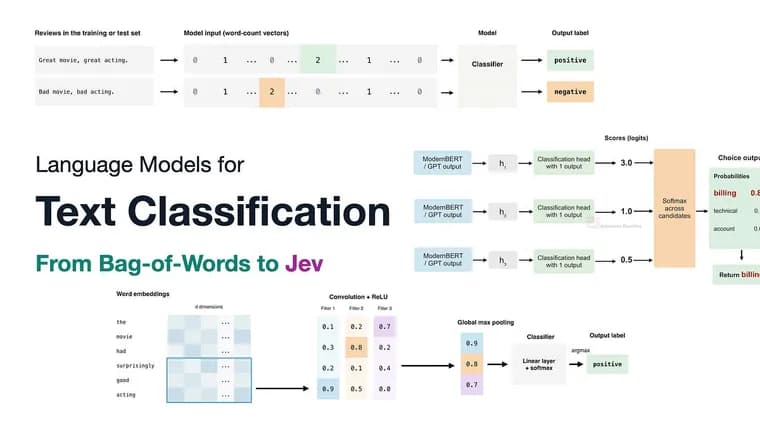
The article opens with a claim: the recently released Jev AI model has been quite a cultural phenomenon in technical communities over the past two weeks. Jev aims to classify things, so it is easy to dismiss it as "just a classifier". The author says his own view changed over a few days, from "classifiers used to be my bread & butter; I can easily build this myself" to "wow, this actually works better than I thought."
The author frames Jev between two ends of a spectrum. The latest GPT and open-weight LLMs can do the same kinds of classification tasks while also handling much more general decision-making, but Jev's advantage, he says, is that it handles those tasks much faster and more cheaply. At the other end, for a narrow, well-defined problem Jev probably will not classify anything better, faster or cheaper than a special-purpose classifier. Its selling point is that it is far more general than those task-specific models. He promises to cover Jev's methodology (based on an educated guess), what it can do and why it is popular, and describes Jev as essentially a text classifier that is also not "just" one. He adds that he is not affiliated with Jev, has not been offered free access, and that the piece is not a product endorsement.
Before reaching Jev, the article gives a chronological history of text classification. It starts with bag-of-words, which the author says was the usual approach when he was a grad student 15 years ago because it was straightforward and worked well on moderately sized datasets. Bag-of-words turns free-form text of any length into a fixed-size vector: build a vocabulary of all unique words in the training set (optionally dropping stopwords such as "a" and "the"), give each word a position, and count occurrences. With a vocabulary of 50,000 words the vector has 50,000 entries whether the text is ten words or 300k, and most entries are zero. TF-IDF is one normalisation alternative. The vectors feed classic classifiers such as naive Bayes, logistic regression, SVMs, random forests and XGBoost. Typical uses are news classification and spam filtering, and the author says that allegedly even Gmail's original spam filter used naive Bayes on a bag-of-words representation. The approach is computationally cheap and works when particular words are strong clues to the label.
Its big weakness is that it loses word order: "the dog bites the man" and "the man bites the dog" produce identical vectors. Adding n-grams preserves some local order but enlarges the vocabulary. Even so, the author says bag-of-words plus logistic regression remains his go-to baseline for every text classification problem, because it is so easy to implement, and he thinks it still has a place in low-stakes applications.
Next come neural approaches. Simple networks such as multilayer perceptrons on bag-of-words inputs would still lose word order. CNNs and RNNs avoid that by taking word embeddings, dense learned vectors for individual words, as input. Embeddings can be learned outside the model (Word2Vec, GloVe) or as a layer inside it. Classic embeddings are context-independent at lookup time, so "bank" gets the same vector in "river bank" and "bank account".
RNNs read text one word at a time, combining the current embedding with a hidden state from the previous step, which makes order matter. Variants go back to the 1980s and early 1990s; LSTMs arrived in 1997, GRUs in 2014 and xLSTM in 2024. Transformers, introduced in 2017, gradually replaced RNNs in many NLP applications, using attention that was first developed for RNNs. State-space models borrow the fixed-size sequential hidden state, which is cheaper than transformer attention, but they are still limited by how much the state can retain and by sequential processing.
On the IMDb movie review dataset, bag-of-words with logistic regression reached about 89.9% accuracy on a balanced dataset, while an LSTM trained from scratch reached only 85.66%. A better route is to pre-train on a larger dataset and fine-tune on the target one (transfer learning). ULMFiT (2018), a pre-train-then-fine-tune method for RNNs, reached 95.4% test accuracy on IMDb.
The last section available begins on CNNs for text. They are historically less common than in vision, but learned filters can slide over windows of adjacent word embeddings; a filter with a window size of three reuses the same weights for each group of three adjacent words. The available text ends there, before the parts on transformers and Jev's specifics.
Key facts
- The author says the recently released Jev AI model has been a cultural phenomenon in technical communities for the past 2 weeks, and that he moved from "I can easily build this myself" to "this actually works better than I thought".
- His claim: Jev handles classification tasks much faster and more cheaply than the latest GPT and open-weight LLMs, but for a narrow, well-defined problem it probably will not beat a special-purpose classifier.
- On IMDb, bag-of-words with logistic regression reached about 89.9% accuracy, an LSTM trained from scratch 85.66%, and ULMFiT (2018) 95.4%. These are baselines, not Jev results.
- Bag-of-words is cheap but loses word order, so "the dog bites the man" and "the man bites the dog" give identical vectors; the author still uses it with logistic regression as his go-to baseline.
- The author says he is not affiliated with Jev, was not offered free access, and calls the piece a technical article rather than a product endorsement.
Why it matters
The article is an attempt to explain the hype around Jev by placing it in the long line of text classification methods. Its central argument is that Jev sits between two kinds of tools: general LLMs that can classify but cost more and run slower, and special-purpose classifiers that are narrow. The author says Jev's selling point is generality at lower cost and higher speed than the LLMs. The history is meant to show what Jev does very well and to cut through some of the hype.
Who it affects
The piece is aimed at readers who want to make sense of the recent Jev buzz in technical communities, especially people who choose or build text classifiers. The author says classifiers used to be his bread and butter. Practitioners weighing a general LLM against a narrow special-purpose classifier are the natural audience for his framing of the trade-off.
How to use it
The practical advice in the available text concerns baselines. The author recommends bag-of-words plus logistic regression as the first thing to try on any text classification problem, since it is cheap and easy to implement, and says it suits low-stakes applications. For neural approaches he notes that training an RNN from scratch did worse (85.66%) than that baseline (about 89.9%) on IMDb, while pre-training then fine-tuning, as in ULMFiT, reached 95.4%. The text gives no instructions for accessing or using Jev.
How solid is it
This is one author's explainer and opinion piece, and the Jev claims are his own. He describes Jev's methodology as an educated guess rather than something confirmed. The available text does not say who developed or released Jev or when, and it gives no benchmark, speed or cost figures for Jev itself. The IMDb numbers (89.9%, 85.66%, 95.4%) belong to the bag-of-words, LSTM and ULMFiT baselines. He also states he has no affiliation with Jev and no free access. The available portion of the article ends in the CNN section, so the later parts on transformers and Jev are not covered here.
Risks and caveats
Treat the statements about Jev being faster and cheaper than the latest LLMs as the author's claims, not measured results in the text available. Bag-of-words has real limits: it discards word order, and n-gram workarounds enlarge the vocabulary. The Gmail spam-filter detail is hedged by the author with "allegedly". The author himself says that for a narrow, well-defined problem Jev probably will not beat a special-purpose classifier.
“wow, this actually works better than I thought.”
— The article's author, on how his view of Jev changed