Industrial Next says its AI robot stations retool factory lines in minutes
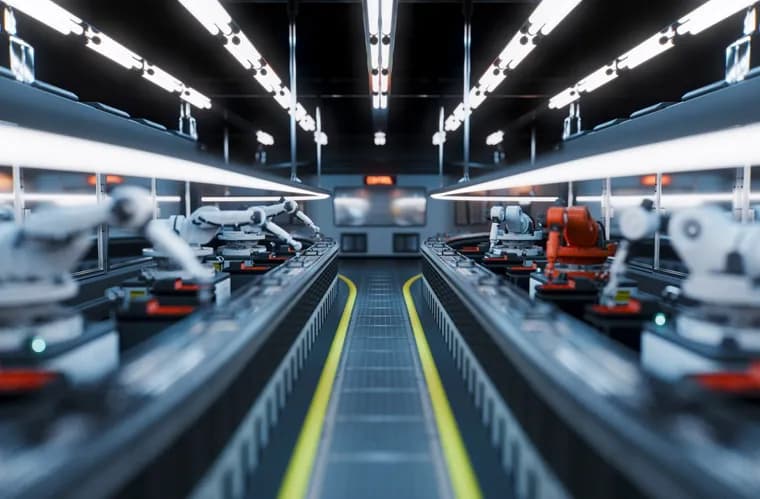
In most factories, automation is fixed: robots and machines are programmed for one task and one product. Changing a line means reprogramming and physical retooling, or swapping equipment, which can take weeks or months. San Francisco-based Industrial Next says it is changing that.
The startup presented on the Startup Battlefield stage at TechCrunch Disrupt 2026. It builds AI-driven, self-contained robotic stations powered by proprietary foundation models that connect vision, task context and motion. The company says this lets a production line be retooled in minutes rather than weeks without traditional programming. The stated goal is to let manufacturers automate complex and delicate tasks that traditionally require human labor. On stage, the company announced a partnership with BMW Group Technology Office to evaluate Industrial Next's AI-powered dexterous manipulation for manufacturing.
Industrial Next was founded in 2021 by Lukas Pankau and Allen Pan, who both previously worked at Tesla. Pankau was a lead electrical architect at Tesla before moving to Waymo. Pan led Tesla's autonomous factory efforts and later became a chief architect at autonomous driving company Neolix. The idea came while they worked together at Tesla, where they watched cutting-edge vehicle and self-driving technology held back by decades-old factory equipment. Pankau describes a divide between people who design cars and self-driving systems and engineers left stumped at the factory by equipment from the 1980s. After moving on to other jobs (Pankau at Waymo, Pan at Momenta, a Chinese self-driving developer), they kept complaining about industrial technology and decided to start the company.
Pankau's argument is that traditional industrial robots are programmed for highly specific, repeatable tasks, so even a small change in the process or product can make the robot fail or trigger costly downtime. That forces manufacturers to simplify their products for repeatability. Making robots flexible is hard because they need enormous amounts of training data, and robotics lacks the vast datasets that exist for models trained on the internet. In Pankau's words, robots can be made to dance because there is data for that, but not to assemble high-precision things.
Industrial Next's answer is simulation. Pankau says the robots are given an understanding of the process, built in an extremely high-fidelity simulation engine close to real dynamics, so they can do high-precision tasks almost without seeing the parts at all. Put simply, the robots practice in a detailed virtual world that mimics real-world physics. The stations can be reconfigured, combined and redeployed across product lines, and new tasks are taught through simulation and demonstration rather than hard-coded scripts.
Pankau said some of the startup's workstations are already used in making one of the world's most popular smartphones; he was not at liberty to disclose the customer. They handle tasks manufacturers had tried and failed to automate for years, such as threading a delicate flex cable and snapping a tiny connector cap into place. He also described a "film peeling" station, where the robots strip protective film off camera modules and buttons at or above human speed with 100% accuracy, even when moved to a new phone model and production line they have never seen.
The founders' ambition goes further. Pankau said the company wants to move to more complicated tasks than building a phone, and ultimately to building a full car end-to-end without any human touching it.
Key facts
- Industrial Next, a San Francisco startup founded in 2021 by ex-Tesla engineers Lukas Pankau and Allen Pan, presented at TechCrunch Disrupt 2026 Startup Battlefield.
- The company says its AI-driven robotic stations, trained largely in simulation and powered by proprietary foundation models, let a production line be retooled in minutes rather than weeks without traditional programming.
- BMW Group Technology Office will evaluate Industrial Next's AI-powered dexterous manipulation for manufacturing; this is an evaluation partnership, not a deployment.
- Pankau says some of the stations already work in making one of the world's most popular smartphones, with the customer undisclosed, and cites a film-peeling station at 100% accuracy.
- Traditional line changes through reprogramming and physical retooling can take weeks or months, according to the source.
Why it matters
Factory automation is usually built for one product and one task, so changing a line can take weeks or months. If a robotic station can be retaught through simulation and demonstration instead of hard-coded scripts, the cost of changing products drops, and manufacturers would no longer need to simplify designs just so robots can repeat them. That is the claim here. The approach also targets a known obstacle: robotics lacks the large datasets that language models enjoy, so Industrial Next leans on a high-fidelity simulation engine to teach precise, delicate tasks.
Who it affects
Manufacturers that run fixed automation and struggle to change products or lines are the target. The first named evaluator is BMW Group Technology Office, and the founder says some stations already serve a smartphone maker whose name was not disclosed. Factory engineers and line programmers are affected indirectly, since the pitch is to avoid traditional programming. The source frames the goal as automating complex and delicate tasks that traditionally require human labor.
How to use it
There is no public product page or purchase route in the source. What exists is a pilot structure: BMW Group Technology Office will evaluate the company's AI-powered dexterous manipulation for manufacturing. No terms, scope, timescale or financial details of that partnership are given. As described, the stations are self-contained, can be reconfigured, combined and redeployed across product lines, and learn new tasks through simulation and demonstration.
How solid is it
Mostly founder and company claims made on a conference stage. The minutes-not-weeks retooling and the 100% accuracy of the film-peeling station come from the company and Pankau, and no independent verification or measurement method is described. The BMW item is an evaluation, not a deployment or purchase. The smartphone customer is not named, and no number of deployed stations or customers is given beyond "some" workstations. The team's background at Tesla, Waymo and Neolix is credible context but not evidence for the product's performance.
Risks and caveats
The headline speed claim is unproven outside the company's own account. Simulation-trained robots still have to match real-world dynamics, and the source gives no figures on how often they fail when moved to a new line. No funding, valuation, investors or revenue are given, so the company's staying power is unclear. The foundation models are proprietary and their names are not given. The goal of building a full car end-to-end without any human touch has no timeline attached.
“We ultimately want to take this to building a full car end-to-end without any human touching ever.”
— Lukas Pankau, co-founder of Industrial Next