Physical Intelligence opens Pi API beta for fine-tuning and running robot models
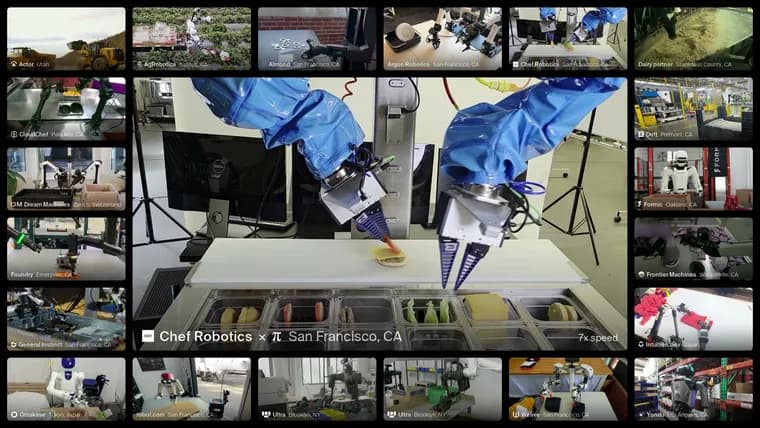
Physical Intelligence (Pi) announced a beta of the Pi API, which gives developers access to its latest robotic foundation models for training and inference. The pitch is that general-purpose models such as π0 and π0.5 already hold a strong base of physical knowledge and cut the data and effort needed to adapt to a new task, environment or robot, but adapting them still takes ML infrastructure, compute and complex data pipelines. The API is meant to remove that burden.
The workflow is three steps: you upload data, launch fine-tuning on compute and infrastructure Pi manages, and then access the fine-tuned models through a hosted gateway to run inference. Pi says the latest model available through the API already offers more data-efficient fine-tuning and improved capability for its partners. Because Pi can update the models behind the API quickly, it says it plans to keep giving access to its latest and most capable models. It calls the beta its first step toward a physical intelligence foundation the community can build on and toward end-to-end autonomy.
Pi says it set out to answer two questions before opening up: whether its models support a broad range of applications and robot hardware across industries, and how easily the API lets developers iterate toward useful, practical autonomy. To test this it worked closely with companies deploying robots. Across those early collaborations, the challenges differed by task: an inside-out garment, an ingredient that would not stay in a scoop, a manufacturing part that landed in the wrong position. The improvement process, however, was much the same each time: collect demonstrations, train a model, test it on the robot, and use the failures to decide what data to collect next. The API is built so developers can run that loop themselves with Pi's latest models.
A small number of companies got early access to see whether they could improve autonomy on their own. Pi says it was impressed by how quickly they got started and began making progress. Most of the showcased applications, from Japan to Switzerland to deployments across the United States, ran with cloud-hosted inference through the API. Pi notes that these early deployments spanned a range of environments and tasks and exposed areas for improvement, including network connectivity challenges for some.
Pi frames the wider reasoning this way: the more its models are used, the more it learns about their potential and limits in real-world work, which should make the next generation more broadly applicable. It argues that tackling robotic construction, robotic surgery or warehouse automation each takes an entire company, and that if every application had to solve the physical intelligence problem from scratch, the challenges would become insurmountable. Making the models available through an API, it says, accelerates the robotics ecosystem and advances its own understanding.
Pi concludes that the examples show its models can be used for real, useful applications and that partners can use the API to iterate on policies and improve autonomy on their tasks independently. It stresses that it is still early and that developer feedback will help shape future releases. To join the beta, developers are asked to tell Pi what they want to build. Pi is also hiring across research, infrastructure, hardware, people and operations.
Key facts
- Pi API beta gives developers access to Physical Intelligence's latest robotic foundation models for fine-tuning and hosted inference.
- Workflow: upload data, launch fine-tuning on Pi-managed compute and infrastructure, then run inference through a hosted gateway.
- A small number of companies had early access; most showcased applications, from Japan to Switzerland to the United States, used cloud-hosted inference.
- Across early collaborations the loop was the same: collect demonstrations, train a model, test on the robot, use failures to decide what data to collect next.
- Pi plans to keep exposing its latest and most capable models through the API; to join the beta, developers tell Pi what they want to build.
Why it matters
Deploying robots means finding the right use case, building hardware and getting a model smart enough for the task. Pi's argument is that general-purpose foundation models such as π0 and π0.5 shrink the data needed to adapt, but the ML infrastructure, compute and data pipelines remain a barrier. Offering fine-tuning and hosted inference as a service is an attempt to let robotics teams skip that part and work on their own application. Pi also says it can update the models behind the API rapidly and plans to keep making its latest models available.
Who it affects
Companies that deploy robots and want to build autonomy for their own applications, who are the group Pi worked with during early access. The showcased deployments span Japan, Switzerland and the United States, across different tasks and environments such as garments, food ingredients and manufacturing parts. Developers who want to take part are asked to tell Pi what they want to build.
How to use it
The beta is entered by telling Pi what you want to build. Once in, the described flow is to upload your data, launch fine-tuning on Pi-managed compute and infrastructure, and then reach the fine-tuned model through a hosted gateway to run inference. Pi describes the working loop as collecting demonstrations, training a model, testing it on the robot, and using failures to decide what data to collect next. No pricing, usage limits or access terms for the beta are stated in the post.
How solid is it
This is a first-party announcement, so the claims are Pi's own. The post makes qualitative statements: the latest model offers more data-efficient fine-tuning and improved capability, and partners were able to iterate independently and improve autonomy. It reports no quantitative results such as success rates, data volumes, fine-tuning times, latency or accuracy figures. The partner companies are not named and the number of early-access companies is only given as a small number. The post does not say which specific model version is the latest one available through the API.
Risks and caveats
Pi itself says it is still early and that feedback will shape future releases. Early deployments highlighted areas for improvement, including network connectivity challenges for some, which matters because most showcased applications ran with cloud-hosted inference. The post gives no list of supported robot hardware and no timeline for wider availability or for the next generation of models. The plan to keep offering the latest models is stated as a plan, not a commitment with a date.
“If each such application requires solving the physical intelligence problem from scratch, the challenges become insurmountable.”
— Physical Intelligence, Pi API beta announcement