Meta brings "Your Algorithm" AI feed controls to Facebook
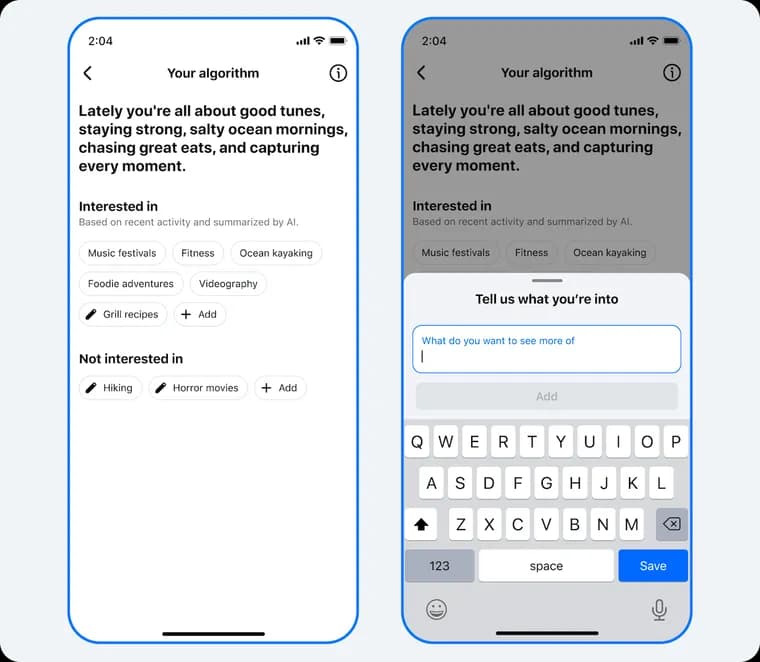
Meta announced on Tuesday that it is launching "Your Algorithm" on Facebook, an AI-powered feature it first launched on Instagram. The tool lets Facebook users influence the content they see in Feed and Reels by describing their preferences in their own words, using natural language. Instead of relying entirely on automated recommendations, users can tell the platform which topics and content they want to see more or less often.
According to Meta, the feature is designed to make content recommendations more relevant. Users can adjust their preferences and interact with the algorithms that rank and recommend posts, and changes are reflected in their recommendations in real time.
Meta has also updated Facebook's three-dot menu so users can manage content preferences straight from individual posts. Opening the menu gives access to "Your Algorithm" or to the "Interested" and "Not interested" options, which signal whether a piece of content fits what the user wants.
Meta says the platform may ask follow-up questions to better understand what users liked or disliked, which lets people give more detailed feedback. Users can explain what they want to see more or less of, and Facebook uses the answers to refine its recommendations.
The article frames the launch as part of Meta's broader effort to give people more influence over their social media experience as AI increasingly shapes content discovery. It describes the move as a shift away from the traditional recommendation systems that have shaped social media for years, bringing the platform closer to streaming services where users personalise recommendations around their interests.
The launch builds on Meta's existing personalisation work. Instagram introduced Your Algorithm in June, extending customisation across Feed and Explore after first launching the feature for Reels in December 2025. Threads has its own related feature, called "Dear Algo", which lets users influence the content recommended to them.
Key facts
- Meta launched "Your Algorithm" on Facebook on Tuesday, after first releasing it on Instagram.
- Users describe their preferences in natural language to influence what appears in Feed and Reels, with changes reflected in recommendations in real time.
- Facebook's three-dot menu now offers "Your Algorithm" plus "Interested" and "Not interested" options on individual posts.
- The platform may ask follow-up questions to understand what users liked or disliked.
- Instagram brought the feature to Feed and Explore in June, after launching it for Reels in December 2025; Threads has a related feature called "Dear Algo".
Why it matters
The feature moves Facebook away from purely automated ranking toward a system where users steer recommendations in plain language. The source describes it as a shift from traditional recommendation systems, closer to streaming services that let people personalise what they are shown. It also extends a pattern already visible on Instagram and Threads, so the idea is now present across several Meta platforms.
Who it affects
Facebook users who see content in Feed and Reels are the direct audience: they gain a way to say what they want more or less of. The article's wider framing places it among social platforms giving users more control over the algorithm that decides what appears in their feeds. Users of Instagram and Threads already have related controls.
How to use it
Open the three-dot menu on a post in Facebook to reach "Your Algorithm", or pick "Interested" or "Not interested" to flag whether that content fits your preferences. Within "Your Algorithm" you describe in your own words what you want to see more or less of, and you may be asked follow-up questions about what you liked or disliked. Changes show up in recommendations in real time, according to Meta.
How solid is it
This is Meta's own announcement as relayed by a news report, and the claims about relevance and real-time updates are attributed to Meta. The report gives no usage figures, user counts or test results. It also names no Meta spokesperson or executive.
Risks and caveats
The report does not give a rollout schedule, regional availability or supported languages for Facebook. It does not say whether the feature can be turned off or whether it affects ads. It also does not say when "Dear Algo" launched on Threads. The claim that recommendations become more relevant is Meta's, and the report offers no independent evidence for it.