Inkling 2 Mini decodes 40% faster on RTX PRO 6000 after agent tuning
Authors writing on the Hugging Face blog set out to find how fast they could serve Inkling 2 Mini on a single NVIDIA RTX PRO 6000 96 GB. The model, which they say came out last week, has about 26B total parameters (3B active per token), multimodal inputs and a 1M-token context window. It is a looped Mixture-of-Experts design: 24 physical layers, with the middle 12 run three times, so every token passes through 48 layers. The checkpoint ships in mixed NVFP4 and MXFP8 and includes a DSpark drafter for speculative decoding.
Instead of tuning flags by hand, the authors gave a coding agent an inference-optimisation skill, the hf CLI and access to Hugging Face Jobs, and let it experiment for an afternoon. The skill sets a protocol: measure the hardware and estimate ceilings first, change one variable at a time, bracket each candidate between two control runs, keep a change only if it beats both without regressing other metrics, log every run, and pass long-context, concurrency and greedy-equivalence checks before naming a winner.
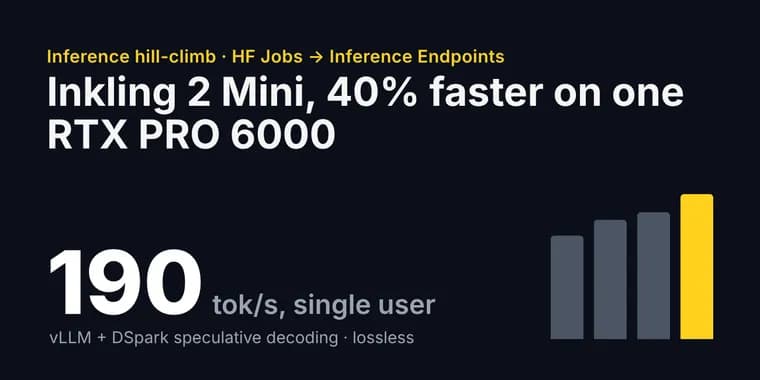
Across 46 valid benchmark runs, single-user decode rose from 136 to 190.6 tok/s (+40%), and aggregate throughput for 8 users went from about 570 to 716 tok/s (+26%). The baseline was the organisation's existing endpoint setup, SGLang with the fa4 attention backend and no speculative decoding. The winner was vLLM nightly with DSpark. The authors place it ahead of a 167.7 tok/s community SGLang + DSpark benchmark on LocalMaxxing for the same GPU.
The gain came in two steps. Moving to vLLM nightly without speculation added 15% (136 to 157 tok/s). Enabling DSpark with 7 drafts and probabilistic draft sampling added another 21% (157 to 190.6 tok/s over four runs). Two memory settings were needed for that setup to start on 96 GB: a 262144 maximum model length and GPU memory utilization of 0.85. Greedy draft sampling cut vLLM decode speed by 11% at temperature 1.0, and shorter draft counts such as 5 were rejected at startup.
The authors estimate that further flag tuning has almost nowhere left to go. Their ceiling for plain decode, based on memory bandwidth, is about 256 tok/s. With speculation at the measured acceptance rate it falls to about 201 tok/s, which puts 190.6 tok/s at roughly 95%.
Greedy outputs were byte-identical with and without speculation, and long-context needle retrieval passed 3/3 up to 250K tokens. The winning configuration was deployed as an Inference Endpoint from a pinned image digest, where the benchmark script measured 194.9 tok/s for a single user. Logs, scripts and raw measurements are in the repository NielsRogge/inkling-2-mini-hillclimb.
Key facts
- Over 46 valid runs on one RTX PRO 6000 96 GB, single-user decode rose from 136 to 190.6 tok/s (+40%) and 8-user aggregate throughput from about 570 to 716 tok/s (+26%).
- The speedup came from switching to vLLM nightly (+15% over SGLang without speculation) and then enabling DSpark with 7 probabilistic drafts (+21% on top).
- Two memory settings let vLLM's DSpark setup start on 96 GB: --max-model-len 262144 and --gpu-memory-utilization 0.85.
- The authors estimate a bandwidth ceiling of about 201 tok/s with speculation, so the result sits at roughly 95% of it.
- Greedy outputs were byte-identical with and without speculation, and the live endpoint measured 194.9 tok/s single-user.
Why it matters
The published serving recipes for Inkling 2 Mini, the authors note, target NVIDIA B200 and GB300 GPUs (sm100) and leave out sm120 cards such as the RTX PRO 6000, where kernel compatibility can differ. This run gives a measured configuration for that card.
It also shows an agent doing the tuning under a strict experimental protocol. When a flag was undocumented, the agent ran a cheap CPU Job to search the installed Python package inside the container, which is how it found SGLang's SGLANG_OPT_* environment variables and vLLM's speculative-config fields.
The analysis explains the limit too. Plain decode re-reads about 2.7 GB of attention and dense weights, about 2 GB of routed experts (8 of 128 per layer) and about 0.9 GB for the LM head. Verifying 8 positions together reads roughly 40% of each layer's experts instead of 6%.
Who it affects
Anyone serving Inkling 2 Mini on an RTX PRO 6000, including users of the nvidia-rtx-pro-6000 Inference Endpoint, can compare their setup with this one. The authors describe the model as a strong open option for coding, tool use and reasoning on modest hardware.
Teams tuning other models may care more about the method. The authors say the loop can be reused by putting candidate and control server commands into a plan file and submitting it to the Hugging Face Jobs GPU flavor that matches the target endpoint.
How to use it
The winning command is vllm serve thinkingmachines/Inkling-2-Mini with --tool-call-parser inkling, --enable-auto-tool-choice, --reasoning-parser inkling, --max-model-len 262144, --gpu-memory-utilization 0.85 and a speculative config setting method dspark, num_speculative_tokens 7 and draft_sample_method probabilistic.
The verified build is a pinned vLLM nightly digest, 0.34.0rc1.dev1235+gf2f9edcac. The authors deployed it with a single hf endpoints deploy command that pins both the image digest and the model revision, with authenticated access and scale-to-zero after 60 idle minutes. The rtx-pro-6000 Job flavor and the matching Inference Endpoint use the same GPU and both cost $2.75/h, so the authors say Job numbers transfer directly.
How solid is it
This is a first-party account on the Hugging Face blog, run on Hugging Face Jobs and Inference Endpoints. The panel was fixed: six prompts at temperature 1.0, thinking on, 512 output tokens, and 12 repetitions whenever speculative decoding was on. The four runs of the winning setup came in at 189.3, 190.4, 191.1 and 190.7 tok/s. Across identical runs with speculation, vLLM stayed within 0.4% while SGLang swung by 4.5% either way.
The live endpoint result of 194.9 tok/s matches the Job runs once network latency is accounted for, according to the authors. Raw ledgers and scripts are published in the repository. The 201 tok/s ceiling and the 95% figure are the authors' estimates from measured bandwidth and draft acceptance.
Risks and caveats
The 40% figure compares against the organisation's own SGLang setup without speculative decoding, so it combines an engine change with turning on DSpark. SGLang's RTX PRO 6000 DSpark recipe caps running requests at 4; raising the cap to 8 reached 660 tok/s, still behind vLLM.
The winning setup limits model length to 262144 tokens, well under the 1M-token context window, because the default KV cache needed 52.6 GiB with only 48.1 GiB free alongside the drafter. The authors also skipped the "fly" and "synthetic" rejection sampling methods because they alter the output distribution.
Measurement traps are real. Kernel compilation during a timed request made vLLM's first 4K prefill read 202 tok/s instead of 20K, and the first run in each Job still under-reported 32K prefill. An orphaned server held GPU memory and broke a later launch. SGLang's variance made one setting look like a 4% win until repeat controls ruled it out.
“At 190.6 tok/s, vLLM + DSpark is already at ~95% of hardware bandwidth, so further flag tuning has almost nowhere left to go.”
— Hugging Face blog post on the Inkling 2 Mini tuning run