Integral lets a vision-language model generate images
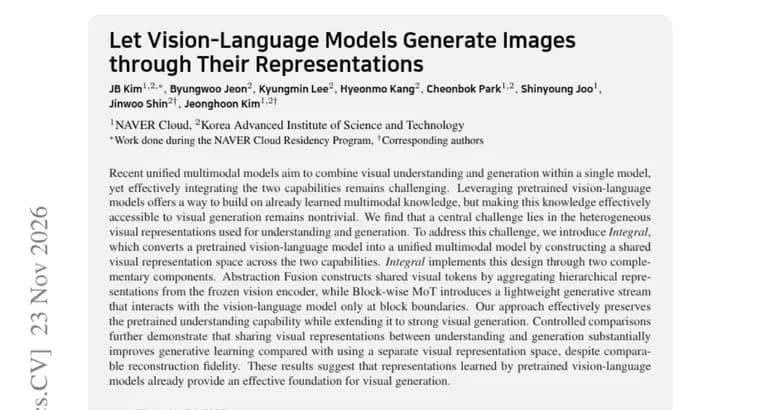
A paper titled "Let Vision-Language Models Generate Images through Their Representations" introduces Integral, a method that converts a pretrained vision-language model into a unified multimodal model, one that handles both visual understanding and visual generation.
The authors start from a known difficulty. Recent unified multimodal models try to combine the two capabilities in a single model, but integrating them effectively remains hard. Building on a pretrained vision-language model offers a way to reuse multimodal knowledge it has already learned, yet making that knowledge accessible to image generation is not trivial. The authors find that a central challenge lies in the different kinds of visual representation used for understanding and for generation. Integral's answer is to construct one visual representation space shared by both.
The design has two complementary components. The first, Abstraction Fusion, builds shared visual tokens by aggregating hierarchical representations from the vision encoder, which is kept frozen. The second, Block-wise MoT, adds a lightweight generative stream that interacts with the vision-language model only at block boundaries.
According to the authors, the approach effectively preserves the pretrained model's understanding capability while extending it to strong visual generation. They also report controlled comparisons: sharing visual representations between understanding and generation substantially improved generative learning compared with using a separate visual representation space, even though the two had comparable reconstruction fidelity. The authors say these results suggest that the representations learned by pretrained vision-language models already provide an effective foundation for visual generation.
Key facts
- Integral converts a pretrained vision-language model into a unified multimodal model with a visual representation space shared by understanding and generation.
- Abstraction Fusion creates the shared visual tokens by aggregating hierarchical representations from the frozen vision encoder.
- Block-wise MoT adds a lightweight generative stream that interacts with the vision-language model only at block boundaries.
- The authors say the model's pretrained understanding capability is effectively preserved while it gains strong visual generation.
- In controlled comparisons, shared representations substantially improved generative learning over a separate representation space, with comparable reconstruction fidelity.
Why it matters
Combining visual understanding and generation in one model is a goal of recent multimodal work, and the authors say doing it well is still difficult. Their diagnosis is specific: the two tasks rely on different visual representations, and that mismatch is a central challenge.
The more interesting claim is about reuse. If the results hold, the representations a vision-language model learned for understanding are already a good base for generating images, so a separate representation space for generation would be a weaker choice.
Who it affects
The work is most relevant to researchers building unified multimodal models, and to anyone who wants to extend an existing vision-language model to image generation without giving up what it already understands. It speaks directly to a design decision such teams face: whether generation gets its own visual representation space or shares the one used for understanding.
How to use it
Treat it as an architecture recipe with two parts. First, form shared visual tokens by aggregating hierarchical representations from a frozen vision encoder. Second, attach a lightweight generative stream that connects to the vision-language model only at block boundaries.
The abstract mentions no release of code or model weights, so there is nothing ready to run on the strength of this description.
How solid is it
These are the authors' own claims, taken from the paper's abstract. The strongest support offered there is a set of controlled comparisons between a shared and a separate visual representation space, which found a substantial gain in generative learning at comparable reconstruction fidelity.
The abstract gives no numbers, so the size of that gain and the quality of the generated images cannot be judged from it. It also names no datasets, benchmarks or competing models.
Risks and caveats
"Strong visual generation" and "effectively preserves" understanding are qualitative descriptions here, with no scores attached. The base vision-language model that was converted is not named, which leaves open how widely the method applies.
The comparison reported is between shared and separate representation spaces. It is not a claim that Integral beats other unified multimodal models. The closing point about pretrained representations is also worded cautiously: the authors say their results suggest it.
“These results suggest that representations learned by pretrained vision-language models already provide an effective foundation for visual generation.”
— The paper's authors