Interpretable MEG decoding traces perceived speech to cortical sources
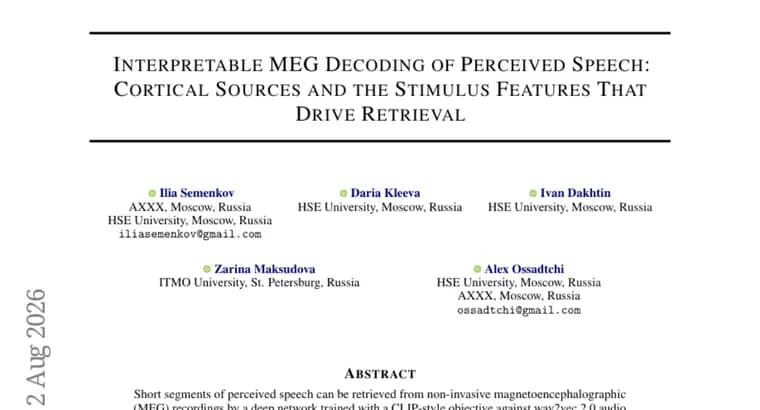
A new study redesigns a MEG-to-audio speech retrieval architecture so its internals can be tied back to brain anatomy and to specific properties of the speech signal, rather than staying a black box. The starting point is a known approach: deep networks trained with a CLIP-style objective to retrieve short segments of perceived speech from non-invasive magnetoencephalographic (MEG) recordings, matching brain activity to wav2vec 2.0 audio embeddings. The problem the authors set out to fix is that such networks reach high accuracy while their weights do not correspond to any electrophysiological quantity, leaving it unclear which speech properties actually drive retrieval.
The redesign touches both ends of the network. The front end's spatial attention, which previously operated on a flattened sensor layout, is replaced with spherical harmonics defined on the three-dimensional geometry of the MEG helmet. The subject-specific representation is cut from 270 to 25 branches, each given its own temporal filter so it can be matched to a neuronal source in both space and time, and the convolutional decoder is made shallower. Eye and heart-related signal components are removed before training to prevent the model from taking shortcuts tied to those artifacts rather than to speech processing.
On the MEG-MASC benchmark, the redesigned model reaches 39.75 +/- 0.34% Top-1 accuracy when retrieving the correct segment among 1005 candidates, averaged across six trained solutions, while using about 20 times fewer decoder parameters than the prior architecture. Because the weights now map to source space, the authors can show that the recovered generators line up with the known speech-perception network, and that branches on the left side of the brain carry higher-frequency rhythmic components that are not evident on the right.
To find out what the model is actually listening for, the authors run paired MEG occlusion, systematically removing parts of the signal and measuring the effect on retrieval. Of 19 stimulus features tested, 15 contribute to retrieval, with the largest effects coming from silence, sound intensity, vowels, and acoustic onsets. A second test uses random word lists, which lack narrative structure: substituting MEG recorded during coherent narrative speech into these random-word trials improves retrieval, indicating that brain activity during narrative speech carries more recoverable information than activity during non-narrative speech. Separately, the authors find that the wav2vec 2.0 target used for training can be compressed to about twelve learned feature dimensions without any loss of retrieval accuracy, whereas compressing it strongly in time, rather than in feature count, does cause a clear loss.
Key facts
- The redesigned front end replaces flattened-sensor spatial attention with spherical harmonics on the 3D MEG helmet geometry and cuts subject-specific branches from 270 to 25, each with its own temporal filter.
- On the MEG-MASC benchmark, the model reaches 39.75 +/- 0.34% Top-1 accuracy among 1005 candidates across six trained solutions, using about 20 times fewer decoder parameters than before.
- Paired MEG occlusion finds that 15 of 19 tested stimulus features contribute to retrieval, with the largest effects from silence, sound intensity, vowels, and acoustic onsets.
- The model's weights map to source space, recovering generators consistent with the speech-perception network, and left-lateralized branches carry higher-frequency rhythmic components not seen on the right.
- The wav2vec 2.0 training target can be reduced to about twelve learned feature dimensions without losing accuracy, and substituting narrative MEG into random-word-list trials improves retrieval, showing narrative speech carries more recoverable brain signal than non-narrative speech.
Why it matters
MEG-to-audio decoding networks have reached useful retrieval accuracy before, but their internal weights carried no interpretable meaning, so nobody could say which part of the brain signal, or which property of the speech itself, the model actually relied on. This redesign closes that gap by tying the architecture directly to MEG helmet geometry and to per-branch source and timing information, then using occlusion experiments to test which stimulus features matter. The result is a model that is both more efficient, at roughly 20 times fewer decoder parameters, and more explainable, since its weights can be read back as source-space brain activity rather than treated as an opaque fit.
Who it affects
The direct audience is researchers working on non-invasive speech decoding from MEG, and more broadly on brain-computer interfaces and computational models of speech perception, who need architectures whose internals correspond to known neuroscience rather than arbitrary sensor-space patterns. It is also relevant to anyone building or evaluating retrieval-style decoders trained against audio embedding targets such as wav2vec 2.0, since the paper's findings about compressing that target apply to that broader modeling choice.
How to use it
This is a methods and analysis paper rather than a released product: the value for other researchers is the architecture itself, spherical-harmonics spatial attention on 3D helmet geometry, 25 subject-specific branches with per-branch temporal filters, and a shallower decoder, which can be adopted or adapted for other MEG decoding work. The finding that the wav2vec 2.0 target compresses to about twelve learned dimensions without losing accuracy is directly actionable for anyone training similar retrieval models, since it points to a smaller, cheaper target representation.
How solid is it
The headline accuracy, 39.75 +/- 0.34% Top-1 among 1005 candidates, is reported with a small error range and is averaged across six trained solutions on the established MEG-MASC benchmark, which supports some robustness. The interpretability claims rest on two separate lines of evidence: source-space mapping showing generators consistent with the known speech-perception network, and paired occlusion showing 15 of 19 stimulus features contribute to retrieval, which is a more direct test of what drives the model than accuracy alone. The paper does not report what the six trained solutions vary across (subjects, seeds, or folds are not specified), nor does it compare its accuracy against human listener performance or against other published MEG decoding methods.
Risks and caveats
The source text names no authors, institutions, or publication venue, and gives no submission or publication date, so the claims here cannot be attributed to a specific team or checked against a preprint history from the abstract alone. The prior, unredesigned decoder that the "about 20 times fewer parameters" comparison is measured against is not named, which limits how the efficiency gain should be read. The paper also does not compare its retrieval accuracy to human listeners or to other published decoding approaches, so the practical significance of 39.75% Top-1 accuracy among 1005 candidates is best judged relative to the MEG-MASC benchmark itself rather than as an absolute measure of decoding quality.