L3G-World uses latent 3D Gaussian memory to generate worlds at 9 FPS
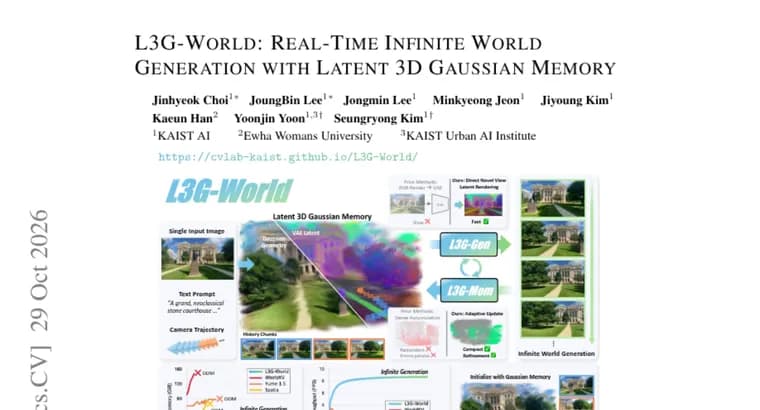
The paper tackles interactive world models: systems that generate visual content in response to user actions. The hard part is keeping the world spatially consistent while the user explores for a long time, and doing it in real time. The authors say existing approaches rely on either temporal context or explicit 3D memory, and both scale poorly because memory grows with the length of the generated stream. They add that explicit 3D memories feed latent video generators by re-encoding RGB renderings, which precludes real-time generation.
Their answer is a Latent 3D Gaussian Memory, or L3G. It combines the efficiency of feed-forward reconstruction with a compact scene representation that can be rendered quickly. On top of it they build L3G-World, where a memory updater and a video diffusion transformer (DiT) alternate autoregressively to generate spatially consistent worlds.
Two design choices carry the efficiency claims. First, the memory updater spawns Gaussians in newly observed regions and refines the existing ones, so memory grows with the extent of the scene rather than with the length of the stream. Second, each Gaussian also stores a VAE latent feature. That lets the memory be rendered straight into the DiT's latent space, with no VAE re-encoding step.
The authors report that experiments show L3G-World reaching state-of-the-art generation quality and long-horizon spatial consistency. Against the most efficient prior 3D-memory baseline for each metric, they report up to 38.6 times fewer 3D primitives, 3.2 times faster memory updates and 359 times faster memory rendering. Together, they say, this enables real-time world generation at 9 FPS.
Key facts
- L3G-World alternates a memory updater and a video diffusion transformer (DiT) autoregressively to generate spatially consistent worlds in real time at 9 FPS.
- The Latent 3D Gaussian Memory grows with scene extent rather than stream length, because the updater only spawns Gaussians in newly observed regions and refines existing ones.
- Each Gaussian stores a VAE latent feature, so memory renders directly into the DiT's latent space without VAE re-encoding.
- Reported gains are up to 38.6 times fewer 3D primitives, 3.2 times faster memory updates and 359 times faster memory rendering, each against the most efficient prior 3D-memory baseline for that metric.
- The authors claim state-of-the-art generation quality and long-horizon spatial consistency.
Why it matters
Interactive world models need to remember what the user has already seen, or the scene drifts when they look away and come back. The paper's argument is that current memory schemes get more expensive the longer a session runs, and that explicit 3D memories also slow generation by re-encoding RGB renderings. L3G is presented as a way around both problems: memory tied to the size of the scene instead of the length of the stream, and a render path that skips the re-encoding step. If the reported 9 FPS holds up, that is the part that makes interactive exploration practical.
Who it affects
Mainly researchers working on world models, video diffusion and 3D scene representations, who deal with the trade-off between long-horizon consistency and speed. The source is a paper abstract, so it does not describe any product or user-facing application.
How to use it
There is nothing to try yet. No code or model release is mentioned. For readers building on this line of work, the transferable idea is the design: store a VAE latent feature in each 3D Gaussian so the memory can be rendered directly into the generator's latent space, and let a separate updater add Gaussians only where the scene is newly observed.
How solid is it
All the claims come from the authors' own abstract. The efficiency figures are best-case ('up to') ratios, each measured against the most efficient prior 3D-memory baseline for that metric, not against one common baseline. The 3.2 times and 359 times figures are likewise relative to that best baseline per metric. The names of the baselines and benchmarks, absolute quality scores, resolution and the hardware behind the 9 FPS figure are not given in the source text.
Risks and caveats
The 'state-of-the-art' and 'spatial consistency' claims cannot be judged from the abstract alone, since no benchmark numbers are given. The speed and size ratios are the best cases, not averages across all comparisons. Without hardware and resolution details, 9 FPS is hard to compare with other systems. No limitations are stated in the source text.
“The memory updater spawns Gaussians in newly observed regions and refines existing ones, so that the memory grows with scene extent rather than stream length.”
— L3G-World paper abstract