Latent Dynamics Reasoning cuts extrapolation error gap over 20x versus video diffusion baseline
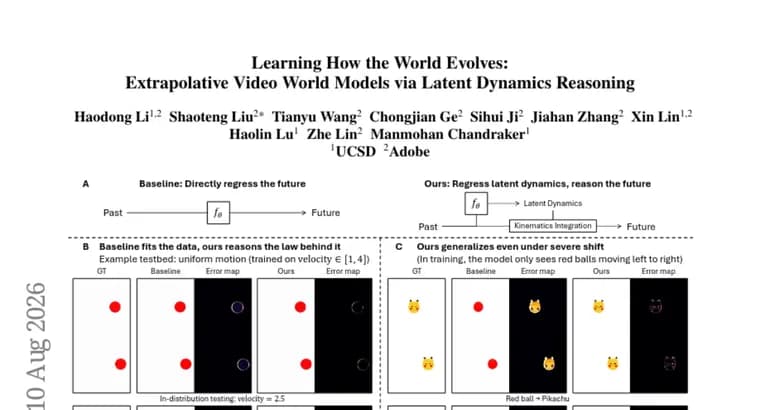
Video diffusion models built to act as world models, meant to predict how a scene evolves, tend to fit the pixels of a scene rather than the physical rules that generate those pixels. The paper's authors argue that, as a result, such models can render frames that look visually plausible without actually obeying the underlying laws of motion. That gap shows up most clearly once a model has to predict motion unlike anything in its training data.
To address this, the paper introduces Latent Dynamics Reasoning (LDR), which treats the transition between a video's latent states, its internal frame-to-frame representation, as an explicit kinematic integration rather than something the network has to discover purely from data. The lower-order dynamics, the part of motion that follows directly from basic kinematics, are integrated numerically, and the network is left to learn only the residual: the third- and higher-order terms that actually drive how a rollout departs from simple motion. LDR runs this integration on a structured latent representation rather than the dense convolutional features typical video models use, because the authors say that structure is what lets the integration extrapolate well beyond the training data.
Following the PhyWorld benchmark methodology, the authors test LDR on a controlled, white-box physics benchmark covering five tasks: uniform motion, parabola, collision, bouncing and looming. The tests focus specifically on out-of-distribution scenarios, motion the model never saw during training, since that is what reveals whether a model has actually learned the underlying dynamics rather than memorized patterns. Under both single-task training (one task at a time) and joint-task training (all tasks together), at 256-by-256 resolution, the gap between LDR's in-distribution and out-of-distribution error is more than 20 times smaller than the same gap for a video diffusion baseline. In the same comparison, LDR also uses 26 times fewer parameters than the baseline and runs 143 times faster.
The paper also reports that LDR generalizes under severe distribution shift: trained only on red balls moving left to right, it correctly predicts the motion of a blue square moving right to left, a test that changes color, shape and direction all at once. The authors say that, to their knowledge, this is the first video world model that extrapolates learned dynamics beyond its training distribution. The paper links a project page at lat-dyn-reason.github.io, though the text does not state whether code, model weights or the benchmark itself are available there.
Key facts
- Latent Dynamics Reasoning (LDR) treats a video world model's latent frame-to-frame transition as explicit kinematic integration: lower-order motion is computed numerically, and the network learns only the third- and higher-order residual, applied to a structured latent rather than dense convolutional features.
- On a five-task, white-box physics benchmark following PhyWorld (uniform motion, parabola, collision, bouncing, looming), the gap between LDR's in-distribution and out-of-distribution error is more than 20 times smaller than a video diffusion baseline's, under both single-task and joint-task training at 256-by-256 resolution.
- In the same comparison, LDR uses 26 times fewer parameters and runs 143 times faster than the video diffusion baseline.
- Trained only on red balls moving left to right, LDR correctly predicts the motion of a blue square moving right to left, a test that changes color, shape and direction simultaneously.
- The authors say that, to their knowledge, this is the first video world model that extrapolates learned dynamics beyond its training distribution.
Why it matters
Video generation models are increasingly proposed as stand-ins for physics simulators, for robotics planning, forecasting, or generating plausible continuations of a scene. If a model only learns to fit pixels rather than the underlying laws of motion, it can produce frames that look right while drifting from correct physics exactly when it matters most: predicting something outside its training data. LDR's approach is to build known kinematics directly into the model rather than hope a network rediscovers it from pixels alone, computing the lower-order motion numerically and leaving the network to learn only the harder residual. On a five-task white-box benchmark following PhyWorld, the paper reports that this design shrinks the gap between LDR's in-distribution and out-of-distribution error to more than 20 times smaller than a video diffusion baseline's, while using 26 times fewer parameters and running 143 times faster.
Who it affects
This is a research result, not a shipped product. It is most directly relevant to researchers building or evaluating video-based world models for robotics, simulation or physics-aware video generation, and to anyone benchmarking how well video diffusion models extrapolate beyond their training distribution. On the evidence given, it does not yet affect people using existing video generation tools.
How to use it
There is nothing to install or buy: this is a paper describing a method (LDR) and its evaluation, with no pricing or licence to report. The paper links a project page at lat-dyn-reason.github.io, but the text does not say whether code, model weights or the physics benchmark itself are available there, so that should not be assumed.
How solid is it
The evidence is a controlled, white-box physics benchmark, following the existing PhyWorld methodology, covering five tasks (uniform motion, parabola, collision, bouncing, looming), tested under both single-task and joint-task training at 256-by-256 resolution. The headline results, an in-distribution/out-of-distribution error gap more than 20 times smaller than a video diffusion baseline's, 26 times fewer parameters, and 143 times faster inference, are reported as ratios rather than absolute figures; the paper gives no absolute error, parameter count or runtime numbers for either model. The authors also demonstrate generalization across a simultaneous change of color, shape and direction: red balls moving left to right in training, a blue square moving right to left at test time. Their claim to be the first video world model that extrapolates learned dynamics beyond its training distribution is explicitly hedged as to their knowledge, not stated as an unqualified fact.
Risks and caveats
All reported results are on a controlled, synthetic benchmark built from simple shapes and five motion tasks; the paper makes no claim about performance on real-world video. The video diffusion baseline used for comparison is not named or otherwise identified beyond that description, which limits how precisely the comparison can be checked. Because only ratios are given rather than absolute numbers, the underlying error, parameter and speed values cannot be independently verified from the text alone. The paper also does not describe LDR's full architecture, training data or training procedure beyond casting the latent transition as kinematic integration on a structured latent.
“The world evolves following its dynamics, i.e., its laws of motion.”
— the paper's authors