Intern-S2-Preview pairs a 397B backbone with agentic RL for long-horizon science
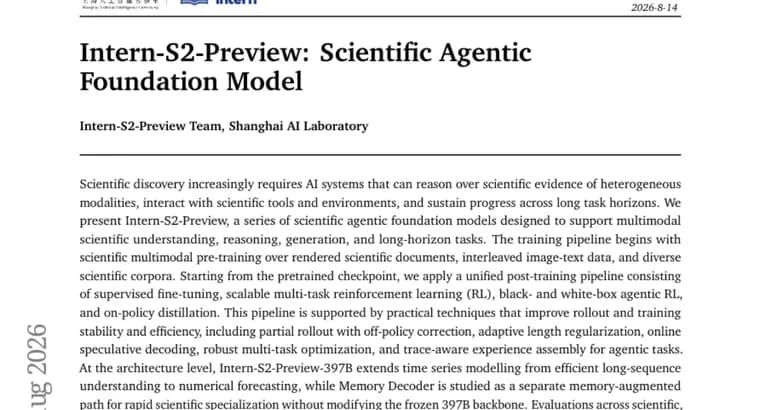
A paper presents Intern-S2-Preview, a series of scientific agentic foundation models built for multimodal scientific understanding, reasoning, generation and long-horizon tasks. The authors frame the motivation around a shift in what scientific discovery demands from AI: systems that can reason over evidence in different modalities, work with scientific tools and environments, and keep making progress across tasks that span many steps rather than answering a single question.
Training starts with scientific multimodal pre-training over rendered scientific documents, interleaved image-text data and a range of scientific corpora. From that pretrained checkpoint, the authors apply a unified post-training pipeline: supervised fine-tuning, scalable multi-task reinforcement learning, both black-box and white-box agentic reinforcement learning, and on-policy distillation. They describe a set of supporting techniques meant to keep this training stable and efficient, including partial rollout with off-policy correction, adaptive length regularization, online speculative decoding, robust multi-task optimization, and trace-aware experience assembly for agentic tasks.
On the architecture side, the flagship model, Intern-S2-Preview-397B (397 billion parameters), extends its time series modeling from efficient long-sequence understanding to numerical forecasting. Separately, the authors study a Memory Decoder as an alternative, memory-augmented path for rapid scientific specialization, one that does not require touching the frozen 397B backbone.
On evaluation, the authors report that Intern-S2-Preview-397B achieves competitive or leading results in multiple settings across scientific, multimodal, agentic and general-purpose benchmarks. Its time series modules improve scientific signal understanding and forecasting on a benchmark called SciTS. A separate extension built on the Memory Decoder idea, Intern-MemDec-4B (4 billion parameters), raises the average score on the Biology-Instructions benchmark from 56.92 to 60.32, again without changing the frozen 397B backbone.
Key facts
- Intern-S2-Preview-397B is the flagship model in a new series of scientific agentic foundation models aimed at multimodal scientific understanding, reasoning, generation and long-horizon tasks.
- Training combines scientific multimodal pre-training with a unified post-training pipeline: supervised fine-tuning, multi-task reinforcement learning, black-box and white-box agentic RL, and on-policy distillation.
- The 397B model extends its time series modeling to numerical forecasting, improving scientific signal understanding and forecasting on the SciTS benchmark.
- A separate Memory Decoder extension, Intern-MemDec-4B, adds scientific specialization without modifying the frozen 397B backbone, raising the Biology-Instructions average score from 56.92 to 60.32.
- The authors report competitive or leading results across scientific, multimodal, agentic and general-purpose benchmarks, though the paper names no specific competing systems or baseline scores behind that claim.
Why it matters
Scientific work increasingly needs AI that can read evidence across formats such as text, figures and data tables, operate scientific tools, and keep working through long, multi-step tasks rather than answer one question at a time. Intern-S2-Preview is built directly for that gap: a foundation model pretrained on rendered scientific documents and multimodal scientific data, then pushed through a stack of reinforcement learning stages, including agentic RL, aimed at sustaining performance across long-horizon scientific work rather than short, single-turn exchanges.
Who it affects
The paper is aimed at people building or evaluating AI for scientific research workflows: multimodal reasoning over scientific evidence, agents that operate scientific tools, time series forecasting on scientific signals, and biology-focused instruction following, the domain covered by the Biology-Instructions benchmark. It reads as a research contribution for teams assessing foundation models for long-horizon, tool-using scientific work, not a consumer-facing product.
How to use it
The source does not state whether Intern-S2-Preview or its weights are publicly released, open-sourced or downloadable, and it gives no pricing or access terms. For now, what exists publicly is the paper's description of the architecture and training pipeline, not a model or API anyone can call.
How solid is it
The authors report that Intern-S2-Preview-397B achieves competitive or leading results in multiple settings, evaluated across scientific, multimodal, agentic and general-purpose benchmarks, and that its time series modules improve scientific signal understanding and forecasting on SciTS. The one fully quantified result in the text is the Memory Decoder extension raising the Biology-Instructions average score from 56.92 to 60.32. The paper does not name the specific competing models or numeric baselines behind the broader competitive-or-leading claim, and it does not explain what the SciTS or Biology-Instructions benchmarks measure or how they are scored, so the strength of that comparison is hard to judge from the text alone.
Risks and caveats
The source text names no individual authors, institution or affiliation behind Intern-S2-Preview; the listing's author field is submission metadata, not a statement made in the paper itself. No publication or release date is given, and the paper does not state a total parameter count for the full model series, only the 397B backbone and the 4B Memory Decoder extension individually. Treat the benchmark figures as self-reported until independent evaluation catches up.