Latent Interface Training curbs robots' vision-action shortcuts
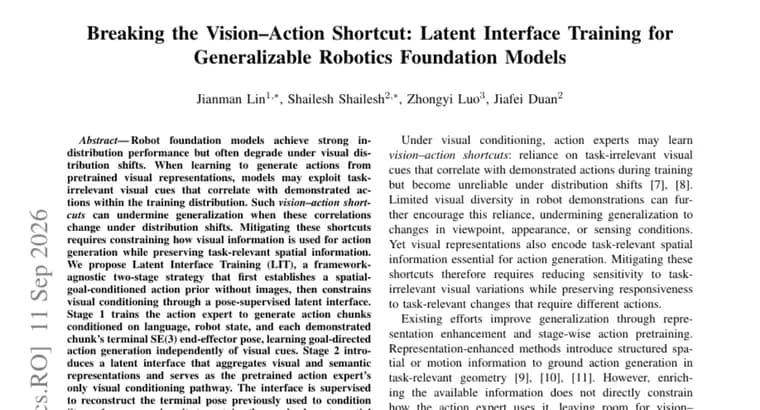
Robot foundation models often perform well on the tasks and conditions they were trained on, then degrade once the visual scene changes. The authors argue this happens partly because, when a model learns to generate actions from pretrained visual representations, it may latch onto visual details that happen to correlate with the demonstrated action during training but are not actually relevant to the task itself, a vision-action shortcut. Change the camera angle, the lighting, or add clutter, and the correlation the model was leaning on breaks, so performance drops even though the task has not changed.
To fix this without losing the spatial information a robot needs in order to act, the authors propose Latent Interface Training (LIT), a framework-agnostic, two-stage strategy. Stage 1 trains the action expert to generate action chunks using only language instructions, the robot's own state, and the terminal SE(3) pose of the robot's end-effector, its gripper's final position and orientation, for each demonstrated chunk, with no images at all; this teaches goal-directed action generation independent of vision. Stage 2 then adds a latent interface that aggregates visual and semantic information and becomes the pretrained action expert's only channel for visual conditioning. That interface is trained to reconstruct the same terminal pose used in Stage 1, which forces it to keep the goal-relevant spatial detail while screening out the shortcut cues.
LIT was evaluated across four vision-language-action and world-action architectures: Pi0.5, MolmoAct2, FAST-WAM, and ImageWAM. On the LIBERO-Plus benchmark it lifted overall success by 3.87 to 10.70 percentage points depending on the architecture, while preserving or improving average success on the original, easier LIBERO benchmark rather than trading one off against the other. In real-world tests aggregated across three tasks under unseen camera configurations, lighting variations, and distractors, the gains were larger: 13.30 to 16.70 percentage points. All of these figures are improvement deltas. The abstract does not give the underlying baseline or absolute success-rate numbers for any of the four architectures, nor does it name the three real-world tasks beyond the conditions varied.
Key facts
- Latent Interface Training (LIT) is a two-stage, framework-agnostic method that curbs robot foundation models' reliance on vision-action shortcuts: visual cues that are irrelevant to the task but happen to correlate with the right action during training.
- Stage 1 trains the action expert to generate actions from language, robot state, and each demonstrated chunk's terminal end-effector pose alone, with no images, so it learns goal-directed action generation independent of vision.
- Stage 2 adds a pose-supervised latent interface as the pretrained action expert's only visual-conditioning pathway, forcing it to keep goal-relevant spatial information while filtering out shortcut cues.
- Across four architectures, Pi0.5, MolmoAct2, FAST-WAM, and ImageWAM, LIT lifts LIBERO-Plus success by 3.87 to 10.70 percentage points while preserving or improving average LIBERO success.
- Real-world tests aggregated across three tasks under unseen camera configurations, lighting variations, and distractors show gains of 13.30 to 16.70 percentage points.
Why it matters
Robot foundation models can look highly capable on the tasks and conditions they were trained on, yet quietly depend on visual cues that have nothing to do with the task itself, a particular camera angle or lighting condition that happened to correlate with the correct action in the training data. When those correlations break in a new setting, performance can degrade even though nothing about the task has changed. LIT addresses this generalization failure at the training-recipe level rather than by adding more data: first teaching the action expert to act from language, robot state, and pose alone, then forcing every path from vision to action through an interface supervised on pose to preserve goal-relevant spatial information. The method is framework-agnostic and was tested across four separate architectures rather than tuned for one, so it is presented as a general recipe, not a one-off trick for a single model.
Who it affects
The direct audience is researchers and engineers building vision-language-action or world-action robot models, since LIT was validated across four separate architectures, Pi0.5, MolmoAct2, FAST-WAM, and ImageWAM, rather than tuned for just one. More broadly, it matters to anyone trying to move robot foundation models out of a controlled lab setup and into settings where the camera position, lighting, or surrounding clutter will not exactly match the training data. That mismatch is the precise failure mode the method targets.
How to use it
This is a training recipe, not a released product. The abstract gives no code, dataset, model weights, or release or availability information. A team already training a vision-language-action or world-action action expert could in principle adopt the two-stage recipe itself: first condition the action expert on language, robot state, and terminal end-effector pose with no images, then add a pose-supervised latent interface as the sole visual pathway. But there is nothing here to install, download, or license.
How solid is it
The evidence spans both simulation and real hardware, and four different architectures rather than a single model. On LIBERO-Plus, the harder benchmark, success improved by 3.87 to 10.70 percentage points depending on the architecture, and average success on the original LIBERO benchmark was preserved or improved rather than traded away. On real robots, aggregated across three tasks under unseen camera configurations, lighting variations, and distractors, the gains were larger still: 13.30 to 16.70 percentage points. What the abstract does not give is the baseline. It states only these percentage-point deltas, not the absolute success rates any of the four architectures started from or ended at, and it carries no publication or submission date.
Risks and caveats
The abstract frames the shortcut behavior as something a model 'may' learn, not a certainty in every setup, so how much a given deployment benefits will depend on how much its own training data actually contains spurious visual correlations to begin with. The three real-world tasks used to measure the larger 13.30 to 16.70 percentage-point gain are not named or described beyond the fact that camera configurations, lighting, and distractors were varied, which limits how far a reader can judge whether those test conditions resemble their own. The result is also specific to robotic manipulation. This is a fix for one generalization failure inside robot foundation models, not a technique demonstrated on language or vision models more broadly.
“We propose Latent Interface Training (LIT), a framework-agnostic two-stage strategy that first establishes a spatial-goal-conditioned action prior without images, then constrains visual conditioning through a pose-supervised latent interface.”
— the authors