LayoutRecall keeps object appearance across repeated 3D layout image edits
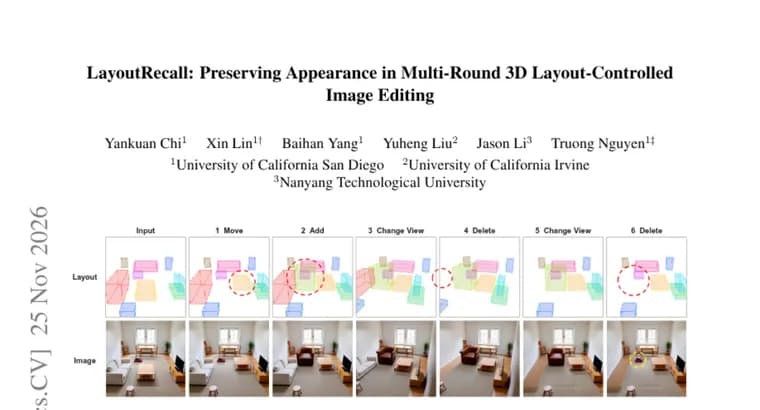
A paper listed on Hugging Face introduces LayoutRecall, an editor for multi-round, 3D layout-controlled image editing. This kind of editing gives users explicit control over where objects are placed and where the camera looks from.
The problem the authors target appears over a sequence of edits. When an object is occluded or leaves the view, the latest image can lose its appearance. The target layout still says where the object should reappear, but what it looked like has to be recovered from earlier observations.
LayoutRecall handles this by storing and reusing appearance in the local coordinate systems of 3D boxes. One component, Box-Surface Latent Memory, retains image latents on the faces of those boxes and retrieves them along rays in the target view. A second, Geometry-Aligned Memory Conditioning, supplies the retrieved tokens to a FLUX.2 editor using target-view positions, shared box-local embeddings and object-wise attention. A correspondence loss encourages the editor to attend to matching observations during denoising.
The authors also introduce LayoutLoop, a benchmark for multi-round 3D layout-controlled image editing with calibrated layouts and designed revisits. They report extensive experiments on LayoutLoop and on real-scene data to verify the ability of their method. The abstract gives no experimental results, metrics or numbers. A project page is available at https://ykchizs.github.io/layoutrecall.github.io/.
Key facts
- LayoutRecall is a multi-round editor that stores and reuses object appearance in the local coordinate systems of 3D boxes.
- It targets a specific failure: across successive edits, an object that is occluded or leaves the view can lose its appearance in the latest image.
- Box-Surface Latent Memory keeps image latents on box faces and retrieves them along rays in the target view.
- Retrieved tokens feed a FLUX.2 editor through target-view positions, shared box-local embeddings and object-wise attention, with a correspondence loss guiding attention during denoising.
- The authors also present LayoutLoop, a benchmark with calibrated layouts and designed revisits.
Why it matters
Layout control in 3D lets a user decide where objects sit and how the camera sees them. Editing in several rounds adds a memory problem: the latest image may no longer show an object that was hidden or moved out of view. A layout can say where it should come back, but its appearance has to come from earlier observations. LayoutRecall's answer is to tie that memory to the 3D boxes themselves, and LayoutLoop is introduced as a benchmark for this multi-round setting, with revisits designed into it.
Who it affects
The work is most relevant to researchers and developers working on controllable image editing, particularly those who need objects to look consistent over a chain of edits that change object placement or camera viewpoint. Those building on FLUX.2 have a direct point of reference, since the method supplies its retrieved memory tokens to a FLUX.2 editor. LayoutLoop is aimed at the multi-round 3D layout-controlled editing task.
How to use it
The starting point is the project page at https://ykchizs.github.io/layoutrecall.github.io/. The abstract does not say whether code, model weights or the benchmark are released.
The design itself breaks into three ideas: keep image latents on the faces of each object's 3D box, retrieve them along rays in the target view and pass them to the editor with geometry-aligned conditioning, and use a correspondence loss so the editor attends to matching observations while denoising.
How solid is it
These are the authors' own descriptions of their method, taken from the paper's abstract. They say they ran extensive experiments on LayoutLoop and real-scene data to verify the method's ability. The abstract gives no experimental results, metrics or numbers, and names no baselines or competing methods. The authors also introduce the LayoutLoop benchmark that is among their test data. Judging how well the approach works requires the results themselves.
Risks and caveats
No limitations, compute cost or speed are mentioned in the abstract. It also leaves open how the 3D boxes or layouts are obtained, how the FLUX.2 editor was trained and which FLUX.2 variant is used. The size of the LayoutLoop benchmark is not stated. Anyone weighing the method for practical use should check these points first.
“In a sequence of edits, however, the latest image can lose the appearance of an object when it is occluded or leaves view.”
— LayoutRecall paper abstract