LightningMoBA speeds up Mixture of Block Attention generation 1.2 to 1.6x
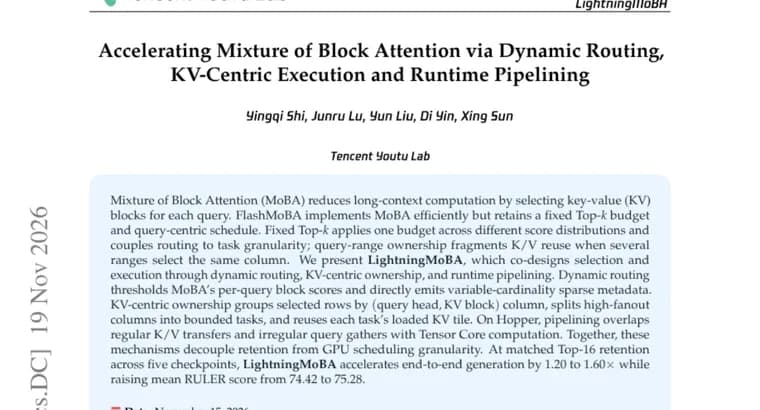
Mixture of Block Attention (MoBA) cuts the cost of long-context computation by selecting key-value (KV) blocks for each query instead of attending to everything. FlashMoBA is an existing implementation that runs MoBA efficiently, but it keeps a fixed Top-k budget and a query-centric schedule. The paper's authors point to two problems with that design. A fixed Top-k applies one budget across different score distributions and ties routing to task granularity. And query-range ownership fragments K/V reuse when several ranges select the same column.
The paper presents LightningMoBA, which co-designs block selection and execution through three mechanisms. The first is dynamic routing: it thresholds MoBA's per-query block scores and directly emits variable-cardinality sparse metadata, so the number of blocks kept can differ from query to query. The second is KV-centric ownership: it groups selected rows by (query head, KV block) column, splits high-fanout columns into bounded tasks, and reuses each task's loaded KV tile. The third is runtime pipelining: on Hopper GPUs, it overlaps regular K/V transfers and irregular query gathers with Tensor Core computation. Together, the authors say, these mechanisms decouple retention from GPU scheduling granularity.
The headline result is measured at matched Top-16 retention across five checkpoints. LightningMoBA accelerates end-to-end generation by 1.20 to 1.60x, and mean RULER score rises from 74.42 to 75.28. So the speedup comes with a small accuracy gain on that benchmark rather than a cost.
Key facts
- LightningMoBA co-designs block selection and execution for Mixture of Block Attention (MoBA) using dynamic routing, KV-centric ownership and runtime pipelining.
- At matched Top-16 retention across five checkpoints, end-to-end generation is 1.20 to 1.60x faster.
- Mean RULER score rises from 74.42 to 75.28 in the same comparison.
- The authors say FlashMoBA's fixed Top-k budget and query-centric schedule limit it: one budget fits all score distributions, and K/V reuse fragments when several query ranges select the same column.
- The pipelining step is described for Hopper GPUs, overlapping K/V transfers and query gathers with Tensor Core computation.
Why it matters
Sparse attention methods like MoBA exist to make long-context work cheaper, but an efficient kernel still leaves speed on the table if its schedule is rigid. This paper targets that gap: instead of a fixed Top-k budget per query, it lets retention vary with the score distribution and reorganises the GPU work around KV blocks so loaded tiles get reused. The reported result is a 1.20 to 1.60x end-to-end generation speedup at matched Top-16 retention, with a slightly higher mean RULER score (74.42 to 75.28).
Who it affects
Mainly engineers and researchers who build or serve long-context models with block-sparse attention, and anyone working on attention kernels for Hopper-class GPUs. The paper frames its work against FlashMoBA, so users of that implementation are the closest audience.
How to use it
The abstract describes the method but mentions no code release, so there is nothing to install from it yet. The practical takeaways are design ideas for kernel authors: threshold block scores to get variable-cardinality sparse metadata, group selected rows by (query head, KV block) column and split high-fanout columns into bounded tasks, and overlap K/V transfers and query gathers with Tensor Core computation on Hopper.
How solid is it
This is a preprint listed on Hugging Face Papers, and what is available is the abstract. The headline numbers are specific: 1.20 to 1.60x speedup and mean RULER 74.42 to 75.28 at matched Top-16 retention across five checkpoints. The abstract does not say which five checkpoints were tested, and it does not name the baseline for the speedup, although FlashMoBA is the comparison the text sets up. It gives no per-checkpoint scores and no statement on whether the RULER gain is significant.
Risks and caveats
The speedup is a range across checkpoints, so the low end of 1.20x is as much part of the result as 1.60x. The RULER gain is under one point (74.42 to 75.28) and should be read as roughly neutral to slightly positive on quality, not a large improvement. The pipelining is described only for Hopper, and no results on other GPUs are mentioned. Context lengths, batch sizes and hardware details are not given in the abstract.