LinkedIn's AI slop button gets over 1 million clicks
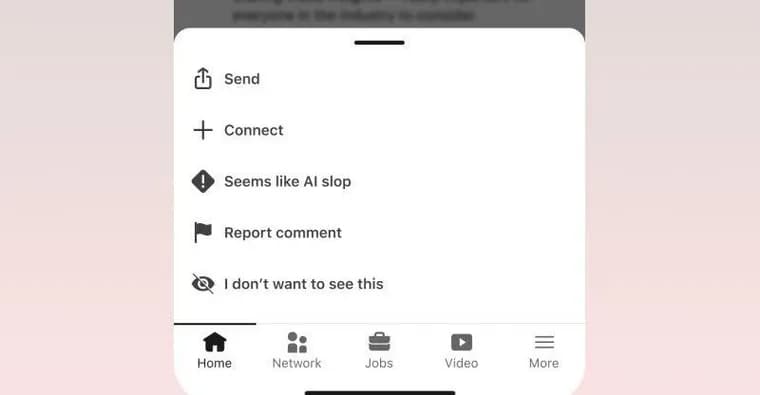
LinkedIn rolled out a "Seems like AI slop" button on July 30th, reachable from the three-dot menu on any post, and the company says it is already seeing heavy use. In a Thursday post, chief product officer Hari Srinivasan said over a million people have clicked the button. Srinivasan also said that content the platform classifies as AI slop is now getting 40% fewer views than it was just a few weeks earlier, though the post did not say whether that drop comes from the new button, from LinkedIn's updated detection classifiers, or from both together. The button followed reporting a few weeks earlier by 404 Media, which cited AI detection company Pangram finding that 41 percent of LinkedIn's longform posts were flagged as fully AI generated. Alongside the slop button, LinkedIn introduced what it called "new and improved" classifiers to identify AI-written posts and pulled a feature that used to "enhance your post" with AI. The company is also rolling out a new prompt that tells a poster directly when "some members told us this post seems like AI." Srinivasan framed the effort as good-faith rather than punitive: "We approached this assuming good intent; I know I'm increasingly conscious on how to not sound like AI & the goal is to provide helpful feedback." He had earlier called AI slop "a top priority for all of us." Separately, LinkedIn said earlier this year it would crack down on comments generated at scale with little or no human involvement, though the company has not detailed what action that crackdown involves.
Key facts
- LinkedIn's "Seems like AI slop" button, launched July 30th from a post's three-dot menu, has been clicked by over a million people, per chief product officer Hari Srinivasan.
- Content LinkedIn classifies as AI slop is getting 40% fewer views than it did a few weeks ago, though Srinivasan did not attribute the drop to a specific cause.
- The button followed a report that AI detector Pangram found 41 percent of LinkedIn's longform posts were flagged as fully AI generated.
- LinkedIn also added "new and improved" AI-detection classifiers, removed an AI post-enhancement feature, and is now telling posters when members flag their post as AI.
- LinkedIn said earlier this year it would crack down on comments generated at scale with little human involvement.
Why it matters
It is a rare public data point on how much AI-generated content is actually flooding a major platform, and on whether user-facing moderation tools can dent it. LinkedIn is not just measuring the problem, it is publishing numbers on an intervention against it, which few platforms do.
Who it affects
LinkedIn users browsing the feed, who get less AI slop in their view if the 40% figure holds; posters, who now see a direct message when their content gets flagged as AI-sounding; and anyone who leaned on LinkedIn's AI "enhance your post" feature, which has been removed.
How to use it
The button sits in the three-dot menu on any LinkedIn post, letting any user flag content that reads as AI generated. There is no cost or setup involved; it is a built-in moderation signal, not a product a user opts into.
How solid is it
The core figures come directly from LinkedIn's own chief product officer in a Thursday post, not from an independent audit. "Over a million" clicks and a "40% less views" figure are both self-reported, with no stated time window for the click count and no confirmation of what specifically drove the view drop. The 41 percent AI-generated-posts figure, by contrast, comes from an outside source, AI detector Pangram, as reported by 404 Media.
Risks and caveats
LinkedIn has not said whether the million-click figure counts unique users or total clicks, nor over what period it accumulated. It also has not disclosed how the flagging button and its classifiers avoid false positives against posts that are simply written in a generic or formal style rather than actually AI generated, and it has not detailed what the earlier promised crackdown on mass-generated comments actually involves.
“We approached this assuming good intent; I know I'm increasingly conscious on how to not sound like AI & the goal is to provide helpful feedback.”
— Hari Srinivasan, LinkedIn chief product officer