LLaDA-Image tops Qwen-Image-Bench among open-source models, releases training recipes
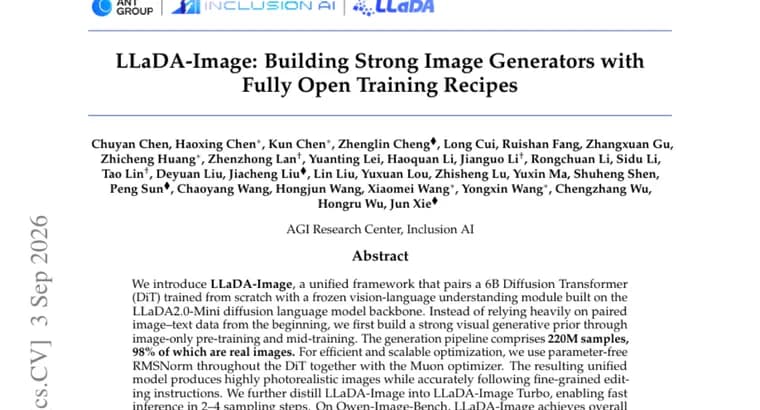
LLaDA-Image is a new unified framework for generating and editing images. It pairs a 6-billion-parameter Diffusion Transformer (DiT), trained entirely from scratch, with a frozen vision-language understanding module built on the LLaDA2.0-Mini diffusion language model backbone. According to its creators, the resulting model produces highly photorealistic images while accurately following fine-grained editing instructions.
Rather than leaning on paired image-text data from the start, the team first built a strong visual generative prior through image-only pre-training and mid-training. The generation pipeline draws on 220 million samples, 98 of which are real images. For efficient, scalable optimization, the DiT uses parameter-free RMSNorm throughout, together with the Muon optimizer.
The team also distilled LLaDA-Image into a lighter version, LLaDA-Image-Turbo, which enables fast inference in just 2 to 4 sampling steps.
On Qwen-Image-Bench, LLaDA-Image achieves overall scores of 53.53 on the English track and 53.38 on the Chinese track. Its creators say this sets a new state-of-the-art among open-source models on both tracks.
To support further research on capable and efficient generative models, the team has released the model weights, the training code, and detailed training recipes.
Key facts
- LLaDA-Image pairs a 6-billion-parameter Diffusion Transformer, trained from scratch, with a frozen vision-language understanding module built on the LLaDA2.0-Mini diffusion language model.
- Its training pipeline draws on 220 million samples, built through image-only pre-training and mid-training before leaning on paired image-text data, using parameter-free RMSNorm and the Muon optimizer for efficient scaling.
- A distilled variant, LLaDA-Image-Turbo, enables fast inference in just 2 to 4 sampling steps.
- LLaDA-Image scores 53.53 on the English track and 53.38 on the Chinese track of Qwen-Image-Bench, a new state-of-the-art among open-source models on both tracks.
- The team has released the model weights, training code, and detailed training recipes to support further research.
Why it matters
LLaDA-Image pairs a 6-billion-parameter Diffusion Transformer, trained entirely from scratch, with a frozen vision-language understanding module drawn from the LLaDA2.0-Mini diffusion language model. Rather than leaning on paired image-text data from the start, the authors first built a strong visual generative prior through image-only pre-training and mid-training, an approach they say produces a model that generates highly photorealistic images while following fine-grained editing instructions accurately. On Qwen-Image-Bench, they report scores that set a new state-of-the-art among open-source models on both the English and Chinese tracks, and the release includes the training code and detailed recipes alongside the model weights.
Who it affects
Researchers and engineers building open image-generation systems are the most direct audience: they get a documented training recipe, not only a downloadable checkpoint, for combining a from-scratch DiT with a vision-language backbone derived from a diffusion language model. Teams benchmarking open-source image generators against Qwen-Image-Bench now have a new result to measure against. Anyone who needs low-latency image generation may also want the distilled LLaDA-Image-Turbo variant.
How to use it
Available now are the model weights, the training code, and detailed training recipes covering how LLaDA-Image was built, not just a checkpoint to run inference against. That combination lets other teams reproduce the training process itself: the image-only pre-training and mid-training stages, the parameter-free RMSNorm and Muon optimizer setup, and the distillation into LLaDA-Image-Turbo. For applications that need fast turnaround, the Turbo variant enables fast inference in just 2 to 4 sampling steps.
How solid is it
The headline evidence is a benchmark result: LLaDA-Image posts overall scores of 53.53 and 53.38 on the English and Chinese tracks of Qwen-Image-Bench, respectively. The state-of-the-art claim is explicitly scoped to open-source models only; the source gives no comparison against closed-source systems on the same benchmark. The abstract also does not name any individual author, affiliation, or institution behind the work, describing itself only in the collective 'we'.
Risks and caveats
One figure in the source resists a clean read: the generation pipeline is said to draw on 220 million samples, 98 of which are real images, but the source does not specify whether that 98 is a percentage, a raw image count, or some other unit. The source also gives no date for the paper's submission or publication, or for when the weights, code, and recipes were made available, so how recent the reported state-of-the-art result is cannot be established from the abstract alone.