MAI-Gym: open platform trains a 9B GUI agent for phones and PCs
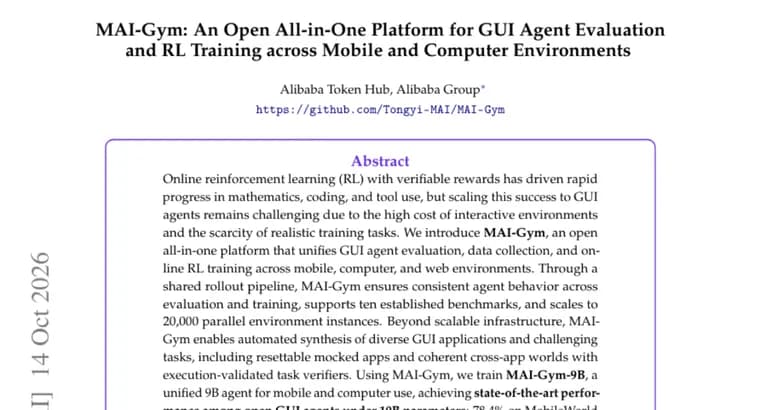
A paper on Hugging Face introduces MAI-Gym, an open all-in-one platform for GUI agents. It brings evaluation, data collection and online reinforcement learning (RL) training together across mobile, computer and web environments. The authors start from a familiar problem: online RL with verifiable rewards has driven fast progress in mathematics, coding and tool use, but scaling it to GUI agents is hard because interactive environments are costly to run and realistic training tasks are scarce.
MAI-Gym tackles this in two ways. First, the infrastructure: a shared rollout pipeline that, according to the authors, keeps agent behaviour consistent between evaluation and training. The platform supports ten established benchmarks and scales to 20,000 parallel environment instances. Second, content: the platform can automatically synthesise diverse GUI applications and challenging tasks, including resettable mocked apps and coherent cross-app worlds, with execution-validated task verifiers.
Using MAI-Gym, the authors train MAI-Gym-9B, a unified 9B-parameter agent for mobile and computer use. They report state-of-the-art performance among open GUI agents under 10B parameters: 78.4% on MobileWorld and 76.2% on OSWorld-Verified.
The authors also stress a transfer result. RL run in a mocked train-ticketing app carries over to the real-world counterpart app, raising task success on a physical phone from 28.8% to 48.1%.
The release covers the framework, the synthesis skills, the mocked apps, 2,000 verified tasks and the model checkpoint, aimed at reproducible research and further work on scalable GUI agent training.
Key facts
- MAI-Gym is an open platform that unifies GUI agent evaluation, data collection and online RL training across mobile, computer and web environments.
- It supports ten established benchmarks and scales to 20,000 parallel environment instances through a shared rollout pipeline.
- The MAI-Gym-9B agent reports 78.4% on MobileWorld and 76.2% on OSWorld-Verified, claimed as state of the art among open GUI agents under 10B parameters.
- RL in a mocked train-ticketing app transferred to the real app, lifting task success on a physical phone from 28.8% to 48.1%.
- The authors release the framework, synthesis skills, mocked apps, 2,000 verified tasks and the model checkpoint.
Why it matters
Online RL with verifiable rewards has worked well for mathematics, coding and tool use, but the authors say GUI agents lag because interactive environments are expensive and realistic training tasks are scarce. MAI-Gym is an attempt to remove both obstacles in one open package: large-scale parallel environments plus automatically synthesised apps and verified tasks. The mock-to-real transfer result is the part the authors single out, since it suggests cheap resettable mocked apps can train behaviour that carries over to a real app.
Who it affects
Researchers building and evaluating GUI agents for phones, desktops and the web are the direct audience, since the platform covers all three in one pipeline and supports ten established benchmarks. Teams working with models under 10B parameters get a released 9B checkpoint to compare against or build on. Anyone who needs mocked apps and verified tasks for RL training gets those too.
How to use it
The authors release the framework, synthesis skills, mocked apps, 2,000 verified tasks and the model checkpoint. In practice that means a team can run evaluation and online RL training through the same rollout pipeline, generate new mocked apps and tasks with the synthesis skills, and start from the MAI-Gym-9B checkpoint. No link or repository is given in the text, and no license is stated for the framework, mocked apps, tasks or checkpoint.
How solid is it
The results are the authors' own claims from the paper's abstract. The state-of-the-art claim is limited to open GUI agents under 10B parameters, not to all agents. The metric behind 78.4% on MobileWorld and 76.2% on OSWorld-Verified is not named, and the abstract gives no scores for competing models or for a baseline of MAI-Gym-9B on those benchmarks, so the size of the lead cannot be judged from this text. The abstract names no authors or institutions.
Risks and caveats
The 28.8% to 48.1% gain is for one real app, train ticketing, on a physical phone. No number of trials or devices is given, and the source does not say the gain generalises to other apps. The abstract does not list the ten supported benchmarks beyond naming MobileWorld and OSWorld-Verified in the results, and does not say those two are among the ten. No training compute, cost or training duration is stated.