OpenGCUA releases an open stack for computer-use agents
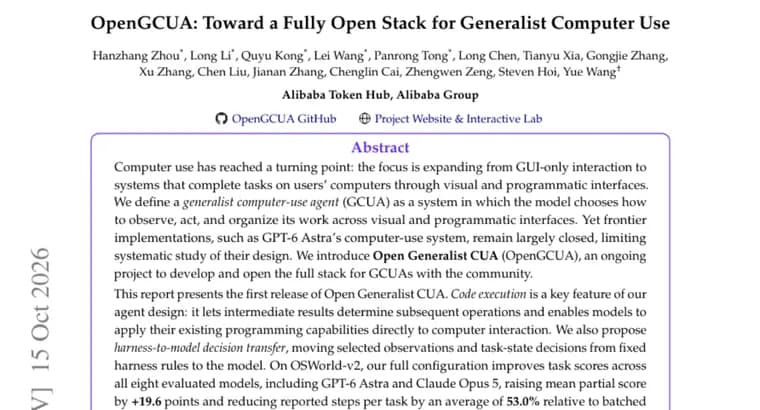
A new report introduces Open Generalist CUA (OpenGCUA), described as an ongoing project to develop and open the full stack for generalist computer-use agents together with the community. The report presents the project's first release.
The authors start from a definition. A generalist computer-use agent (GCUA) is a system in which the model chooses how to observe, act and organize its work across both visual and programmatic interfaces. They say computer use has reached a turning point, with the focus widening from GUI-only interaction to systems that finish tasks on users' computers through both kinds of interface. Their complaint is that frontier implementations, such as GPT-6 Astra's computer-use system, remain largely closed, which limits systematic study of how they are designed.
Two ideas sit at the centre of the agent design. The first is code execution. According to the authors, it lets intermediate results determine subsequent operations and lets models apply their existing programming skills directly to computer interaction. The second is what they call harness-to-model decision transfer: moving selected observations and task-state decisions out of fixed harness rules and into the model.
The headline result comes from OSWorld-v2. The authors report that their full configuration improves task scores across all eight evaluated models, including GPT-6 Astra and Claude Opus 5. Mean partial score rises by 19.6 points, and reported steps per task fall by an average of 53.0% relative to batched GUI-only execution.
The release includes the implementation and prompts, evaluation trajectories from all eight models, and preliminary versions of a real-device harness and a cross-device SDK. The harness targets real-device challenges that benchmarks do not fully capture. The SDK offers a common programming interface across computers, mobiles and browsers.
The report also includes a small real-device comparison. Across four real macOS tasks under the real-device harness, selected Qwen3.8-Max runs used 19.4 times as many reported reasoning tokens as GPT-6 Astra. The authors say this points to substantial differences between models in real-device execution efficiency.
Key facts
- OpenGCUA is an ongoing project to open the full stack for generalist computer-use agents; this report is its first release.
- On OSWorld-v2, the full configuration improved task scores for all eight evaluated models, including GPT-6 Astra and Claude Opus 5, with mean partial score up 19.6 points.
- Reported steps per task fell by an average of 53.0% relative to batched GUI-only execution.
- Released: implementation and prompts, evaluation trajectories from all eight models, and preliminary versions of a real-device harness and a cross-device SDK.
- On four real macOS tasks, selected Qwen3.8-Max runs used 19.4 times as many reported reasoning tokens as GPT-6 Astra.
Why it matters
The authors argue that the most capable computer-use systems, GPT-6 Astra's among them, remain largely closed, so outsiders cannot study how they are built. OpenGCUA is an attempt to open the whole stack, not just a model. Its design bet is that an agent should choose between looking at the screen and running code, and that more observation and task-state decisions should move from fixed harness rules to the model. The reported gains on OSWorld-v2, in both score and step count, are the evidence offered for that bet.
Who it affects
Researchers and developers building or studying computer-use agents are the main audience: the release covers prompts, code and trajectories from eight models. The cross-device SDK, which gives a common programming interface across computers, mobiles and browsers, is aimed at people who want to drive agents on real devices. The report also compares models directly, so teams choosing between models for computer use may find the efficiency figures relevant.
How to use it
The authors release their implementation and prompts, evaluation trajectories from all eight models, and preliminary versions of a real-device harness and a cross-device SDK. The trajectories let readers inspect how each model behaved on OSWorld-v2. The harness and SDK are described as preliminary. The text states no repository URL or licence, and no timeline for later releases.
How solid is it
The numbers are the authors' own results on OSWorld-v2, reported in a Hugging Face Papers listing. The gain is stated as a mean partial score increase of 19.6 points across eight models, and a 53.0% average cut in reported steps per task relative to batched GUI-only execution. No per-model scores or absolute baselines are given in the text, so the size of the improvement for any single model cannot be read from it. Releasing trajectories from all eight models gives others material to check the claims against.
Risks and caveats
The 19.6-point figure is a mean across eight models, and the text does not say how it splits between them. The text does not say which baseline the 19.6-point gain is measured against. The 19.4 times token ratio covers selected Qwen3.8-Max runs on four macOS tasks and counts reported reasoning tokens only, so it is not a general or average figure across models or tasks. The real-device harness and SDK are preliminary, and OpenGCUA is described as ongoing, so the stack is unfinished.
“Code execution is a key feature of our agent design: it lets intermediate results determine subsequent operations and enables models to apply their existing programming capabilities directly to computer interaction.”
— OpenGCUA report