MameLoshnLM debuts as first open-source Yiddish language model
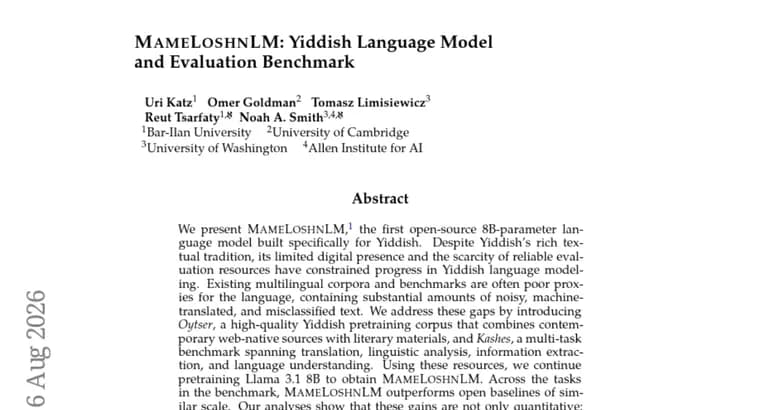
A team of researchers has released MameLoshnLM, which they describe as the first open-source, 8-billion-parameter language model built specifically for Yiddish. The model was produced by continuing to pretrain Meta's Llama 3.1 8B on Yiddish-specific data rather than training a new model from scratch.
The authors say Yiddish has a rich textual tradition but a limited digital presence, and that the multilingual corpora and benchmarks typically used to build and evaluate language models are poor proxies for the language: they contain substantial amounts of noisy, machine-translated, and misclassified text. To address this, the team built two new resources. The first is Oytser, a high-quality Yiddish pretraining corpus that combines contemporary web-native sources with literary materials. The second is Kashes, a multi-task benchmark spanning four kinds of tasks: translation, linguistic analysis, information extraction, and language understanding.
Using Oytser for pretraining and Kashes for evaluation, the authors report that MameLoshnLM outperforms open baselines of similar scale across the tasks in the benchmark. They add that the improvement is not purely quantitative: further analysis shows that, compared with general-purpose multilingual models, MameLoshnLM better captures lexical and morphological patterns specific to Yiddish. The authors present this as evidence of a broader problem: noisy, web-scale multilingual training data tends to fail low-resource languages in ways that a targeted, curated approach avoids.
The paper frames its contribution as twofold: a working foundation for Yiddish natural language processing, and a practical template that other researchers could apply to build language models for other historically rich but digitally underrepresented languages.
Key facts
- MameLoshnLM is an 8-billion-parameter language model built for Yiddish by continuing to pretrain Llama 3.1 8B on Yiddish-specific data.
- Oytser is a new high-quality Yiddish pretraining corpus combining contemporary web-native sources with literary materials.
- Kashes is a new multi-task benchmark covering translation, linguistic analysis, information extraction, and language understanding.
- MameLoshnLM outperforms open baselines of similar scale across the tasks in the Kashes benchmark.
- Analysis shows MameLoshnLM captures Yiddish-specific lexical and morphological patterns better than general-purpose multilingual models, which the authors attribute to a broader weakness of noisy web-scale multilingual training data for low-resource languages.
Why it matters
Yiddish has a rich textual tradition but very limited digital presence, and the multilingual corpora and benchmarks that language model builders normally rely on are poor proxies for it, full of noisy, machine-translated, and misclassified text. MameLoshnLM and its two companion resources close that gap for one specific language. The authors frame their underlying method, curating a clean, purpose-built corpus and benchmark before training, as a template usable for other historically rich but digitally underrepresented languages, not Yiddish alone.
Who it affects
Researchers working on Yiddish natural language processing get a concrete foundation: a pretraining corpus (Oytser), an evaluation benchmark (Kashes), and a working 8B model derived from continuing to pretrain Llama 3.1 8B. More broadly, researchers and institutions working on other low-resource languages, and anyone studying why general-purpose multilingual models underperform on such languages, are the audience the paper speaks to.
How to use it
The paper presents MameLoshnLM, the Oytser corpus, and the Kashes benchmark as an open-source contribution. The source text does not give a release date, license, or download links for any of the three, so those availability details are not established here. The method itself, continuing to pretrain an open base model such as Llama 3.1 8B on a quality-controlled, language-specific corpus, is described as a template other teams could follow for their own low-resource language.
How solid is it
The claims come from the paper's own reporting. MameLoshnLM is said to outperform open baselines of similar scale across the tasks in the Kashes benchmark, and separate analysis reportedly shows it captures Yiddish-specific lexical and morphological patterns better than general-purpose multilingual models. The source text does not include specific benchmark scores, percentage margins, or corpus and benchmark size figures, so the exact scale of the improvement cannot be quantified from what is given here.
Risks and caveats
The source text does not name the authors or their institutional affiliations. The comparison is limited to 'open baselines of similar scale,' so the paper does not address how MameLoshnLM compares against larger-scale or closed, non-open models.