MAS splits state from rendering to scale multiplayer world models
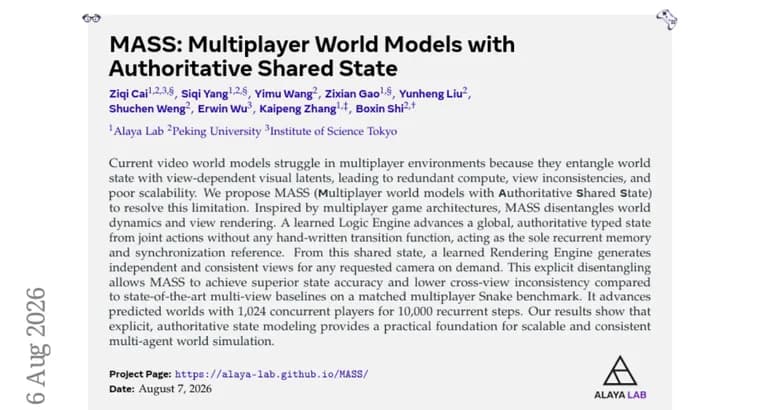
A paper titled "MASS: Multiplayer World Models with Authoritative Shared State" argues that today's video world models struggle in multiplayer settings because they entangle the world state with view-dependent visual latents, the authors say this causes redundant compute, inconsistencies between different players' views, and poor scalability. To fix this, the authors propose MAS (Multiplayer world models with Authoritative Shared State), an architecture inspired by traditional multiplayer game engines. MAS disentangles world dynamics from view rendering into two learned components. A Logic Engine advances a single, global, authoritative typed state from the joint actions of all players, without any hand written transition function, and serves as the model's sole recurrent memory and synchronization reference. A separate Rendering Engine then reads that shared state and generates an independent, consistent view for any requested camera on demand, rather than each player's view carrying its own copy of the world. The authors report that on a matched multiplayer Snake benchmark, MAS achieves higher state accuracy and lower inconsistency between different players' views than state of the art multi view baselines. They also report advancing predicted worlds with 1,024 concurrent players for 10,000 recurrent steps. The authors conclude that explicit, authoritative state modeling provides a practical foundation for scalable and consistent multi-agent world simulation.
Key facts
- The paper proposes MAS, a multiplayer world model that splits a shared authoritative state from per-player view rendering.
- A learned Logic Engine updates one global typed state from all players' joint actions, with no hand written transition function.
- A separate learned Rendering Engine generates each camera's view on demand from that shared state, instead of baking view-specific latents into the state itself.
- On a matched multiplayer Snake benchmark, the authors report better state accuracy and lower cross-view inconsistency than state of the art multi-view baselines.
- The authors advanced predicted worlds with 1,024 concurrent players for 10,000 recurrent steps.
Why it matters
World models that generate multiplayer environments have mostly grown out of single-player video generation, where the model's internal state and the rendered view are tangled together. The authors argue that this entanglement is what breaks down once many players share one world: each view effectively recomputes its own version of the state, which wastes compute and lets different players' views drift out of sync with each other. MAS's fix, an explicit split between a single authoritative state and on-demand rendering, mirrors how conventional multiplayer game servers already work, and the authors present it as the reason their approach scales further while staying consistent.
Who it affects
The paper is aimed at researchers building world models and simulators for multi-agent or multiplayer settings, including game world generation and multi-agent simulation research. It is a research architecture evaluated on a benchmark, not a released product, so it does not directly affect end users of games or consumer AI tools.
How to use it
The stored text gives no code, model, or dataset release, so there is nothing here for a practitioner to install or run today. The described mechanism, an authoritative shared state produced by a Logic Engine plus a separate Rendering Engine for per-camera views, is presented as an architectural pattern that other multiplayer world model work could adopt.
How solid is it
The evidence is a single matched benchmark: multiplayer Snake, where the authors report that MAS beats state of the art multi-view baselines on state accuracy and cross-view consistency, and that it scales to 1,024 concurrent players over 10,000 recurrent steps. The stored text does not name the specific baseline methods being compared against, nor does it give the numeric accuracy or consistency scores behind the reported gains, so the size of the improvement cannot be judged from the abstract alone.
Risks and caveats
Snake is a simple, discrete game, and it is not established from the available text how the approach transfers to visually or physically richer multiplayer environments. The claims of superior accuracy and consistency, and of practical scalability, come from the authors' own paper; no independent replication is mentioned. No author names, institutions, publication venue, or date appear in the stored text, which limits how the claims can be checked further.