Memory Decoder scales parametric memory to 6.9B parameters
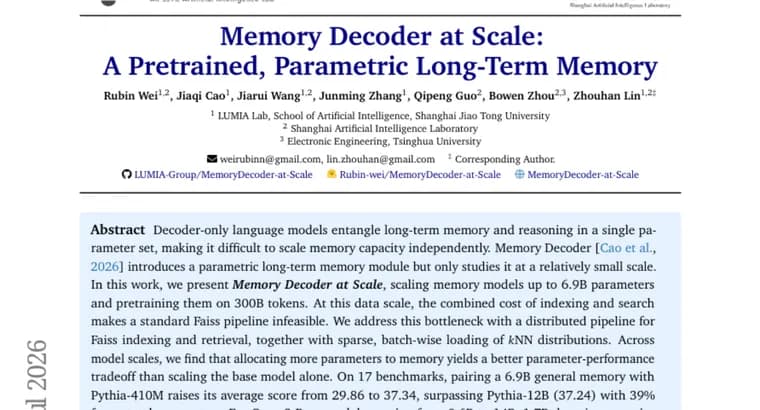
Decoder-only language models pack long-term memory and reasoning into a single set of parameters, which makes it hard to grow memory capacity without also growing the model itself. A prior method called Memory Decoder introduced a separate, parametric long-term memory module that plugs into a base model, but that work only tested the idea at small scale. The new paper, titled 'Memory Decoder at Scale,' scales the approach up to 6.9 billion parameters and pretrains it on 300 billion tokens.
At that data scale, a standard Faiss pipeline for indexing and searching the memory becomes infeasible because of the combined cost of indexing and retrieval. The researchers built a distributed pipeline for Faiss indexing and retrieval, combined with sparse, batch-wise loading of kNN distributions, to make training and inference at this scale practical.
Across model scales, the paper reports that putting more parameters into the memory module gives a better tradeoff between parameter count and performance than simply scaling up the base model. On a suite of 17 benchmarks, pairing a 6.9B general memory module with the much smaller Pythia-410M model raises its average score from 29.86 to 37.34, which beats Pythia-12B's score of 37.24 while using 39% fewer total parameters (410M plus 6.9B versus 12B). For Qwen3 Base models spanning 0.6B to 14B parameters, adding a 1.7B domain-specific memory module improves the average score across three domains by more than 9 points at every model size tested.
The authors conclude that independently scaling a model's pretrained memory, rather than only scaling the base model, offers a more parameter-efficient path to improving language model performance.
Key facts
- Memory Decoder at Scale scales a parametric long-term memory module for language models up to 6.9 billion parameters, pretrained on 300 billion tokens.
- Pairing a 6.9B general memory module with Pythia-410M raises its average score across 17 benchmarks from 29.86 to 37.34, surpassing Pythia-12B's 37.24 while using 39% fewer total parameters.
- For Qwen3 Base models from 0.6B to 14B parameters, a 1.7B domain-specific memory module improves the average score across three domains by more than 9 points at every scale.
- Standard Faiss indexing and search do not scale to hundreds of billions of tokens, so the team built a distributed Faiss pipeline with sparse, batch-wise loading of kNN distributions.
- The results indicate that scaling memory independently of the base model is a more parameter-efficient way to improve language model performance than scaling the base model alone.
Why it matters
Decoder-only language models entangle long-term memory and reasoning in one parameter set, so today the only way to give a model more "memory" is to make the whole model bigger, at the cost of more compute for reasoning too. This paper tests whether memory can be scaled as its own, separate module instead, and finds that at scales up to 6.9 billion parameters it can, with a better performance return per parameter than growing the base model.
Who it affects
The result speaks mainly to researchers and engineers building or serving language models under a fixed parameter or compute budget, since a smaller base model paired with an external memory module can match or beat a much larger dense model. The domain-memory result, where a compact 1.7B module lifts Qwen3 models of every size from 0.6B to 14B, also speaks to teams building domain-specific models who need a cheaper way to inject specialized knowledge than fine-tuning the whole model.
How to use it
This is a research contribution rather than a shipped product: the paper does not mention pricing, licensing, or a public release of the models or code. Applying the idea in practice means adopting the memory-module architecture and, at scale, the distributed Faiss indexing and retrieval pipeline the authors describe, since off-the-shelf Faiss setups do not handle indexing and search at the 300-billion-token scale used here.
How solid is it
The claims rest on evaluation across 17 benchmarks and across two different model families (Pythia and Qwen3, from 0.6B to 14B parameters), with concrete before-and-after scores rather than vague claims, and the paper also documents the engineering problem (Faiss infeasibility at scale) and its specific fix. That said, it is a single paper with modest early traction (40 points, 1 comment), so the results have not yet been independently replicated or stress-tested outside the authors' own benchmark suite.
Risks and caveats
A smaller total parameter count does not mean a simpler system: retrieval-augmented memory requires building, storing, and querying a large index (built here with a custom distributed Faiss pipeline), which adds infrastructure and latency considerations that a plain dense model with the same parameter count would not have. The reported gains are also measured on the specific benchmark suites and model families used in the paper, and it is not yet established how they generalize to other architectures, tasks, or much larger scales.