Meta's Muse wins on design and ad money, not new tech, essay argues
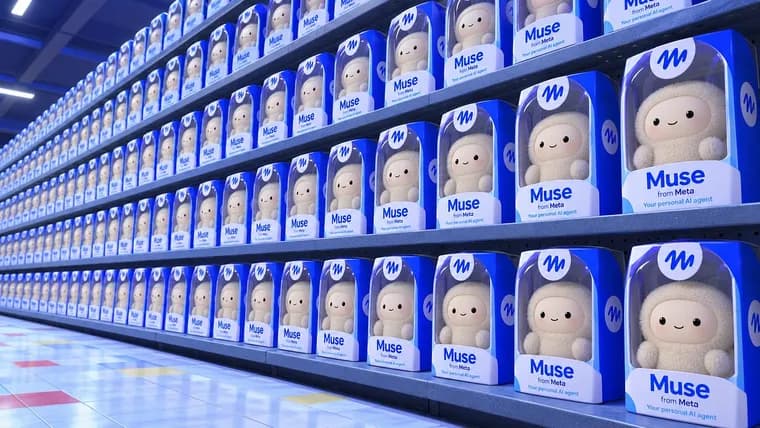
Mete, a product designer and builder with 10+ years of experience at companies like Netflix and Peloton, argues in a Substack essay that Meta's Muse is not a technical breakthrough but a well-assembled product. In his words, there is nothing fundamentally novel about it: its core components have existed for over a year in frontier agentic products and harnesses such as Codex, Claude Code, Hermes and OpenClaw, and it does nothing you couldn't do 6 months ago with a bit of tinkering. What Meta did, he says, is put the pieces together in just the right way. He reads the hype around Muse as proof of the lasting value of design, product marketing and an ad-driven business model, and says it may be the first time agentic AI clicks for the average consumer, putting Meta in the lead for owning consumer AI in a way that can scale.
He builds the case on three points. The first is the right metaphor. Leading agentic tools have had the same capabilities since 2025: computer and browser use, cloud workflows, cron jobs and routines, mobile remote control. But the complexity has compounded, and apps like ChatGPT and Claude have become, in his words, a total mess. He calls himself committed to the ChatGPT ecosystem, yet after using Muse the clunkiness of ChatGPT is stark. He lists the desktop ChatGPT versus Codex switch, the chat versus work switch, and ChatGPT projects versus Codex local versus Codex cloud projects, and says he must make 10 choices each time he starts or continues a chat. Muse, by contrast, has no model selector, no work versus chat switch, no obscure slash commands and no mention of MCPs or cron jobs. It is one main chat, with supporting pieces around it: a space to elevate ideas (he thinks that Feed is redundant), a place to track goals, and a place to surface artifacts it created. Most important, he says, it gives users a clear mental model: a personal helper with their own computer. He notes that he had earlier written "AI needs better metaphors", pushing the idea of AI as a coworker rather than a set of confusingly named tools, and ties it to Jobs-To-Be-Done: customers hire tools to get a job done, and you talk to a coworker by chatting.
The second point is ads funding tokens. He says ChatGPT and Claude are in the business of selling tokens, so unless you pay $100+/mo you won't get the best models and enough tokens for useful agentic workflows, and most average consumers don't even pay the $20/mo. He cites Benedict Evans: "usage is a mile wide but an inch deep." Muse's free tier, he says, is extremely permissive (and the ads are becoming pervasive) because it is funded by the best ad business in the world. Unless you are a power user, you won't think about tokens or limits when using it daily. Meta sells attention rather than tokens, so it can fund Muse as long as it needs to capture consumer mindshare.
The third point is making AI cute again. He argues ChatGPT's and Claude's branding is geared toward techies and comes off as sterile and elitist to most people, while Muse leans into anthropomorphization and cuteness so users build affinity with their agent. He personally finds Muse's avatar personalization gimmicky and unnecessary, but says he is clearly not the norm. He repeats an earlier argument that personality is now a core design dimension of AI products, the flavor of the interface, and links it to engagement: connection drives engagement, engagement drives stickiness, stickiness drives profit. He says Muse is unsurprisingly clicking with consumers more than the cold-tool approach.
On competitors, he says Google has the compute and ad money to fund something like Muse but no product chops to build something simple and understandable in consumer AI. OpenAI fumbled consumer AI by not investing in ads earlier; when it realized most people won't pay for subscriptions it refocused on enterprise to compete with Anthropic, and it still has no established cash flow to fund something like Muse. Its new "dots" product, always-on agents in ChatGPT released while he was writing, is a paid-tier feature; he is testing it and plans a fuller write-up likely next week. Apple, he says, fumbled it for now because it never built the expertise to build AI, blinded by iPhone success, privacy posturing and Google bribes. His conclusion: Meta will pick up the pieces, the pie is there for the taking, and Muse is the first positive indicator.
Key facts
- Mete, a product designer with 10+ years at companies like Netflix and Peloton, says Muse is nothing fundamentally novel: its components have existed for over a year in Codex, Claude Code, Hermes, OpenClaw and similar tools.
- The appeal, he argues, is one main chat with no model selector, work versus chat switch, slash commands or talk of MCPs and cron jobs, built on the metaphor of a personal helper with their own computer.
- He says Muse's free tier is extremely permissive because Meta's ad business pays for it, while ChatGPT and Claude sell tokens and he says you need $100+/mo for the best models and enough tokens for useful agentic workflows.
- Muse's cute, anthropomorphic personality is, in his view, a deliberate and effective bet, though he personally finds the avatar personalization gimmicky.
- He concludes Google lacks product chops, OpenAI lacks ad cash flow (its new dots is a paid-tier feature) and Apple lacks AI expertise, so Meta is best placed in consumer AI.
Why it matters
The essay's claim is that agentic AI reaching ordinary consumers depends less on new capability than on packaging. Mete says the abilities behind Muse (computer and browser use, cloud workflows, cron jobs, routines, mobile remote control) have been around since 2025, but piled-up complexity made ChatGPT and Claude hard to approach. If he is right, the contest for consumer AI is decided by clear metaphors, economics and personality, and he sees Meta's ad business as a structural advantage over companies that sell tokens.
Who it affects
Product designers and builders of AI apps, who are told that a simple mental model (a coworker you chat with) beats exposing models, modes and commands. It also touches consumer-AI players: the essay puts Meta ahead of Google, OpenAI and Apple, and says ChatGPT and Claude users face a lot of choices at the start of every chat. Ordinary users are the audience Muse is said to suit, since the author says unless you are a power user you won't think about tokens or limits.
How to use it
The essay is an opinion piece, not a how-to. The practical takeaways for builders are the author's own: offer one main chat that orchestrates everything in the background, hide models, switches and technical jargon, ground the product in a familiar metaphor, and treat personality as a design dimension. He says Muse's free tier is extremely permissive and that, as of now, a non-power user won't hit limits in daily use. He also says OpenAI's dots, released while he wrote, is a paid-tier feature, and that he is testing it with a fuller write-up likely next week.
How solid is it
This is one practitioner's opinion. The author is open about his background (product designer with 10+ years at companies like Netflix and Peloton) and about citing his own earlier articles as prescient. Most statements are impressions: the claim that Muse is clicking with consumers is his view, and he writes that it "may" be the first time agentic AI clicks for the average consumer. No launch date, pricing, user numbers or usage figures for Muse are given. The source does not say what Muse's underlying model is, and the free tier's limits are not quantified. The Benedict Evans quote appears without a source link or date.
Risks and caveats
The argument rests on the author's judgment, with no usage data behind it. The comparisons with Google, OpenAI and Apple are his characterizations. He also concedes limits to his own taste: he finds the avatar personalization gimmicky and the Feed redundant, and notes he is not the norm. He says the ads in Muse are becoming pervasive, so the free tier's generosity comes with that trade. His own 6-month and over-a-year timelines for the underlying capabilities are claims, not measurements.
“Meta is not in the business of selling tokens. They sell attention.”
— Mete, product designer, in a Substack essay