Microsoft open-sources GigaPath-Flash and GigaTIME-Flash pathology models
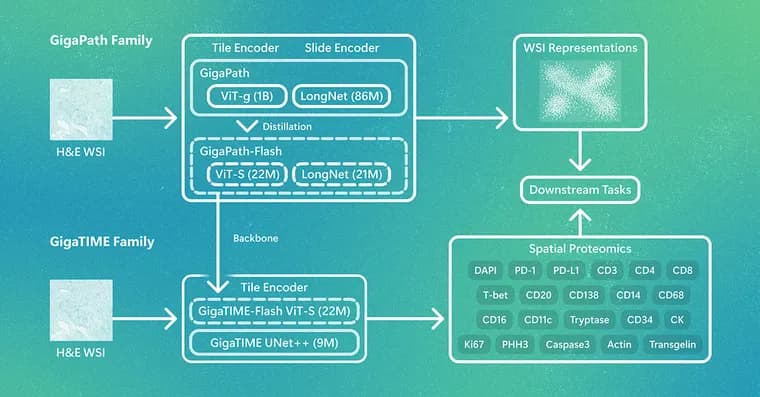
Microsoft Research, working with the University of Washington and Providence, has released GigaPath-Flash and GigaTIME-Flash, efficiency-focused successors to its pathology foundation models GigaPath (published in Nature in 2024) and GigaTIME (published in Cell in 2026). The originals showed that a foundation model can analyze whole-slide histopathology images and model the tumor microenvironment from routine tissue scans, but a single whole-slide image often exceeds a gigapixel and requires processing thousands of tiles; a study covering tens of thousands of patients needs repeated rounds of feature extraction, statistical analysis, hypothesis testing and validation, so compute cost caps how many patients, datasets and hypotheses a lab can actually study. The Flash family targets that ceiling rather than raw accuracy.
GigaPath-Flash is a whole-slide foundation model built from a 22M-parameter ViT-S tile encoder paired with a 21M-parameter LongNet slide encoder. The tile encoder is distilled from the original GigaPath's billion-parameter ViT-g teacher, compressing its representational capacity into a backbone an order of magnitude smaller; the LongNet slide encoder then contextualizes all of a slide's tile embeddings through dilated attention that scales linearly with tile count. On two slide-level classification benchmarks, PANDA prostate grading and EBRAINS brain tumor subtyping, GigaPath-Flash scores within 3% of the original GigaPath while using roughly 50 times less compute, which Microsoft says gives it the lowest inference cost among whole-slide pretrained models it compared it to.
GigaTIME-Flash swaps the original GigaTIME's CNN backbone for the GigaPath-Flash ViT-S encoder, adds a lightweight convolutional decoder for translating routine H&E-stained images into virtual multiplex immunofluorescence (mIF) maps, and is fine-tuned with LoRA adapters while keeping most of the pretrained encoder frozen. Tested on in-distribution and out-of-distribution cohorts spanning brain, breast, colon and lung cancers, it matches or improves on the original GigaTIME's spatial protein prediction quality, with the largest gains on the out-of-distribution cohorts, which Microsoft reads as evidence that the shared foundation-model backbone generalizes better to tissue types it was not trained on. For context on what the original GigaTIME could already do: trained on 40 million cells of paired H&E and mIF data, it was applied to more than 14,000 cancer patients and surfaced over 1,200 statistically significant associations between immune cell states and clinical biomarkers.
Both Flash models are released open-weight under the Apache 2.0 license, with weights and code posted on HuggingFace alongside a technical paper. The work lists Naoto Usuyama, Jeya Maria Jose Valanarasu, Sicong Yao, Hanwen Xu and more than two dozen other co-authors across Microsoft Research, the University of Washington and Providence. Microsoft is explicit that both models are research tools: they are not intended or validated for clinical use, including diagnosis, prognosis, treatment selection or any other patient-care decision, performance can vary across datasets, scanners, institutions and populations, and the current evaluation covers a limited set of benchmarks and cohorts. Any downstream clinical application, the company says, will need additional multi-institutional and prospective validation.
Key facts
- GigaPath-Flash distills a 22M-parameter ViT-S tile encoder and 21M-parameter LongNet slide encoder from the original billion-parameter GigaPath ViT-g teacher, scoring within 3% of the original on PANDA prostate grading and EBRAINS brain tumor subtyping benchmarks at roughly 50 times less compute.
- GigaTIME-Flash replaces the original GigaTIME's CNN backbone with the GigaPath-Flash ViT-S encoder plus a convolutional decoder, fine-tuned via LoRA, and matches or improves H&E-to-mIF spatial protein prediction across brain, breast, colon and lung cancer cohorts, with the biggest gains on out-of-distribution data.
- The original GigaTIME (Cell, 2026), trained on 40 million cells of paired H&E and mIF data, was applied to more than 14,000 cancer patients and uncovered over 1,200 statistically significant associations between immune cell states and clinical biomarkers.
- Both Flash models are open-weight under Apache 2.0, with weights, code and a technical paper posted on HuggingFace, built jointly by Microsoft Research, the University of Washington and Providence.
- Microsoft states both models are research-only: not validated for diagnosis, prognosis, treatment selection or any patient-care decision, with downstream clinical use requiring further multi-institutional, prospective validation.
Why it matters
GigaPath and GigaTIME already showed that foundation models can extract diagnostic and biological signal from routine whole-slide pathology images, but a single gigapixel slide takes thousands of tile computations, and a population-scale study needs that repeated across tens of thousands of patients through multiple rounds of feature extraction, statistical testing and validation. Compute cost, not model capability, was the bottleneck on how many patients, datasets and hypotheses a lab could actually study. The Flash models attack that bottleneck directly: GigaPath-Flash keeps GigaPath's slide-level performance within 3% while cutting compute by roughly 50 times, turning studies that were previously impractical at scale into ones that run on ordinary research budgets.
Who it affects
The release targets computational pathology and cancer researchers who need to run whole-slide analysis or tumor microenvironment modeling across large cohorts rather than one slide at a time, and any institution whose GPU budget previously limited cohort size or experiment count. It is not aimed at clinicians or patients: Microsoft frames both models strictly as research tools, not as anything ready for diagnostic or treatment workflows.
How to use it
Both GigaPath-Flash and GigaTIME-Flash are released open-weight under the Apache 2.0 license, with model weights, code and an accompanying technical paper posted on HuggingFace. GigaTIME-Flash additionally uses LoRA adapters for fine-tuning, so the pretrained encoder stays largely frozen and adapting it to new data does not require retraining the full backbone.
How solid is it
The work builds on peer-reviewed predecessors, GigaPath (Nature, 2024) and GigaTIME (Cell, 2026), and is a joint effort across Microsoft Research, the University of Washington and Providence with more than two dozen listed co-authors. The reported benchmarks are specific: within 3% of original GigaPath accuracy on PANDA and EBRAINS at about 50 times less compute, and matched or improved spatial protein prediction for GigaTIME-Flash across four cancer types, including out-of-distribution cohorts. The blog post does not give the underlying numeric accuracy or AUC scores for those benchmarks, or the runtime and hardware-cost figures behind its cohort-scale efficiency comparison, so independent replication of the exact numbers is not yet possible from the post alone.
Risks and caveats
Microsoft is explicit that GigaPath-Flash and GigaTIME-Flash are research models, not intended or validated for clinical use, including diagnosis, prognosis, treatment selection or any other patient-care decision, and that performance may vary across datasets, scanners, institutions and populations. The company also calls this an early research release whose current evaluation covers a limited set of benchmarks and cohorts, with broader validation across tasks, scanners and patient populations still needed, and says any downstream clinical application will require additional multi-institutional, prospective validation before it could be considered.