Microsoft Research's Magnetar proves Rust, Go and C programs with hash-only security
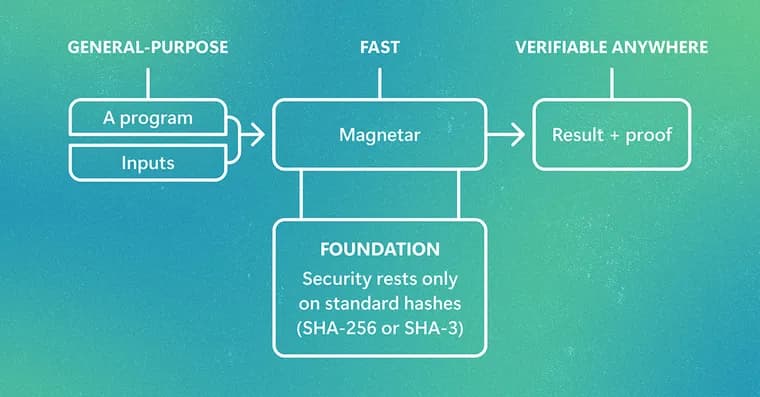
Microsoft Research has published a blog post introducing Magnetar, a zero-knowledge virtual machine (zkVM). It proves the execution of RISC-V, an open processor architecture with mature compilers for every mainstream language. A developer writes a program in Rust, Go or C, compiles it as usual, and Magnetar proves it as written. The post presents it as the latest result of more than a decade of Microsoft Research work on making zero-knowledge proofs and verifiable computing practical.
The pitch starts from a simple idea. A zero-knowledge proof is a short cryptographic certificate, produced alongside a program's output, that this program on these inputs produced this output. Anyone can check it in milliseconds without rerunning the program or trusting whoever ran it, and with the zero-knowledge property it reveals nothing about private inputs. The post says this would let a result be trusted because of what accompanies it rather than who produced it. It offers two conditional examples: an AI agent acting on someone's behalf could attach a proof that each action complied with the policy it was given, and regulated financial institutions could prove transactions were processed correctly without making them public.
The post says three challenges have kept proofs from becoming a general tool. The first is efficiency: producing a proof has historically taken millions of times more computation than running the program, and the fastest systems got their speed by compromising elsewhere. The second is generality and usability: many systems force developers to rewrite a program by hand as a cryptographic circuit, which takes months, needs a new circuit for every change, and is a frequent source of security bugs. Proving an ordinary processor avoids that, but until recently it cost too much speed or security. The third is security: many proof systems rest on elliptic curves, which a sufficiently powerful quantum computer could break. Post-quantum systems exist, but some rest on lattice assumptions, and most use newly invented cryptographic functions that have not had decades of scrutiny, with some depending on unproven conjectures about error-correcting codes. The post ties this to Microsoft's Quantum Safe Program, which will move its products and services to post-quantum cryptography, a goal it recently accelerated to 2029.
The post traces Microsoft Research's lineage of work. Early approaches were practical only for small programs. One used the sum-check protocol but worked only for computations with a layered structure; the other used elliptic curves for very small proofs but required a trusted setup and is vulnerable to quantum computers. In 2019 Spartan returned to sum-check and made it work for general-purpose programs without a trusted setup; because it can use different cryptographic building blocks, it could later be built on hash functions alone. Later pieces include Phalanx (2021), which exploits repetition such as a processor running the same instruction cycle at every step and proves computations an order of magnitude faster than Spartan (Magnetar's processor description builds on it); the folding line of Nova, HyperNova, NeutronNova, Neo and SuperNeo, which makes computations of any size practical; Brakedown (2021), the first Spartan variant whose security rests on standard hash functions; Spice, Lasso, Nebula, Twist and Shout, and Jolt, which made memory operations cheap to prove and showed a full processor can be proven efficiently; Vega, which earlier this year proved facts from a government credential in under a tenth of a second; and BinarySpartan, which brings Spartan to binary fields and relies on Ligerito and ring switching. The post says each solved a piece and Magnetar is where they come together.
On speed, the post says Magnetar proves 7.2 to 8.7 million processor instructions per second on a laptop. Across 15 benchmark programs, from cryptographic hashing to token transfers inside a small EVM interpreter, it is 10 to 39 times faster on average than the fastest existing zkVMs on the same machine, and more than 300 times faster than two others on a token-transfer benchmark. An optimized Magnetar proves 9.5 to 12.8 million cycles per second, which raises each reported speedup by about 1.3 times. Proofs verify in about 12 milliseconds.
On security, Magnetar depends on a standard hash function such as SHA-256 or SHA-3. It requires no elliptic curves, no lattices, no special-purpose hash functions, no trusted setup and no unproven conjecture about error-correcting codes. The post notes hash functions are among the most studied cryptographic primitives and underlie the stateless hash-based signatures NIST standardized as its conservative post-quantum option.
The same design gives a second benefit. Checking a Magnetar proof is mostly evaluating standard hash functions and binary-field arithmetic, which are exactly what Magnetar proves efficiently, so verifying a proof is an ordinary workload for it. That is what lets it prove computations of any size by proving them in pieces and combining the pieces, and it also lets it prove a long-running system such as a ledger or a blockchain. A technical paper gives the full design, security analysis and measurements. The post closes by saying Microsoft Research expects technology leaders to stop asking whether proofs of execution are practical, and invites readers with a use case to get in touch.
Key facts
- Magnetar is a zkVM from Microsoft Research that proves RISC-V execution, so programs written in Rust, Go or C can be proven as written, without hand-building a cryptographic circuit.
- Across 15 benchmark programs it is 10 to 39 times faster on average than the fastest existing zkVMs on the same machine, and more than 300 times faster than two others on a token-transfer benchmark.
- It proves 7.2 to 8.7 million instructions per second on a laptop (9.5 to 12.8 million cycles per second when optimized, about 1.3 times higher speedups), and proofs verify in about 12 milliseconds.
- Security rests only on a standard hash function such as SHA-256 or SHA-3: no elliptic curves, lattices, special-purpose hashes, trusted setup or unproven error-correcting-code conjecture.
- Because verifying a proof is an ordinary workload for Magnetar, it can prove computations of any size in pieces and combine them.
Why it matters
Zero-knowledge proofs have existed since the 1980s but, the post argues, three problems unsolved together kept them niche: proving was millions of times costlier than running the program, general programs needed months of manual circuit work, and fast systems leaned on elliptic curves or newer, less-scrutinised cryptography. Magnetar is presented as addressing all three at once. If the claims hold, a result could be checked by anyone in milliseconds instead of being taken on trust from an operator, vendor or agent. The post also frames its hash-only design as removing a future cryptographic migration, in the context of Microsoft's goal, recently accelerated to 2029, of moving its products and services to post-quantum cryptography.
Who it affects
Primarily engineers who already write Rust, Go or C, since the post says they could prove their programs' executions without specialist cryptographic skills: a business policy, a data pipeline or an EVM interpreter is just a program. It also concerns teams building systems where outputs must be checked without trust, such as blockchains and ledgers, regulated financial institutions that want to prove correct processing without publishing transactions, and operators of AI agents who might attach proofs of policy compliance. Those last two are described in the post as possibilities, not deployments.
How to use it
The post gives no release date, open-source availability, product plans or pricing for Magnetar. What it describes is the workflow: write a program in Rust, Go or C, compile it as usual, and Magnetar proves the RISC-V execution as written. The post points to a technical paper with the full design, security analysis and measurements, and invites readers interested in using zero-knowledge proofs for their own use case to contact Microsoft Research.
How solid is it
All figures come from Microsoft Research's own blog post. The headline numbers are 10 to 39 times faster on average across 15 benchmark programs on the same machine, 7.2 to 8.7 million instructions per second on a laptop, and about 12 milliseconds to verify a proof. The post builds on a documented line of earlier Microsoft Research systems (Spartan, Phalanx, Brakedown, Vega and others). It says the full design, security analysis and measurements are in a technical paper, but no independent or peer-reviewed evaluation is mentioned in the post.
Risks and caveats
The post does not name the competing zkVMs or benchmark systems, and does not say whether the average behind 10 to 39 times is arithmetic or geometric. The laptop model and hardware specs are not given, and proof size in bytes is not stated. The 10 to 39 times and 7.2 to 8.7 million figures are for the base version; the optimized version's roughly 1.3 times gain is stated separately. The 300 times figure applies to one token-transfer benchmark against two other systems, not to the whole suite. The agent and finance uses are conditional ('could'), and the closing line that leaders will stop asking whether proofs are practical is an expectation, not a result. No timescale is given for proofs becoming routine.
“Each of these solved a piece of the problem. Magnetar is where the pieces come together.”
— Microsoft Research blog post