Microsoft's Project Zenith lets developers run 30B+ AI models locally
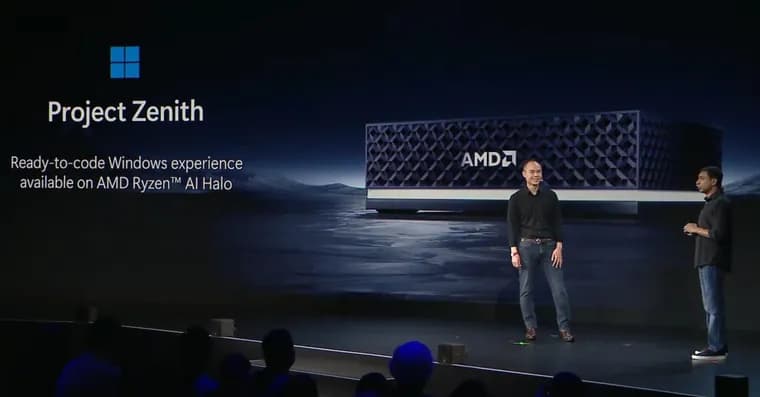
Microsoft has given its developer-focused Windows experience a name: Project Zenith. The company had already announced a similar developer-optimized Windows effort at Build earlier this year, but Project Zenith is a distinct push aimed specifically at new developer-focused devices with 64GB or more of unified memory. Logan Iyer, CVP of Windows platform and developer at Microsoft, describes the devices as coming with a preconfigured Windows setup for development and a set of tools curated for what developers reach for first. According to Iyer, on these devices developers can run models with more than 30 billion parameters locally and unmetered, which speeds up experimentation and reduces dependence on metered cloud tokens.
AMD announced the first Project Zenith device on stage at IFA: a miniature PC powered by its Ryzen AI Halo chips. Microsoft says more Project Zenith devices are coming in the following months, including ones built on different silicon, though it has not named which chipmakers beyond AMD.
The devices ship with preinstalled developer tools: Visual Studio Code, GitHub Copilot, PowerToys, WinAppCLI, and Windows Dev Skills. Microsoft has also tuned the out-of-box Windows configuration for developers: File Explorer shows file extensions, hidden files, and the full path in the title bar; recently used files and folders and sync provider tips are disabled; long-path support is enabled; Start menu tips and account notifications are turned off; and the PowerToys Command Palette is on by default. Iyer frames Project Zenith as the result of listening to developers about what they need from Windows today and where they want the platform to go next, and says Microsoft is committed to evolving Windows alongside the community that builds on it as AI continues to transform software development.
Key facts
- Microsoft named its developer-optimized Windows experience Project Zenith, distinct from a similar effort it announced at Build earlier this year.
- Project Zenith targets new developer-focused devices with 64GB or more of unified memory, letting developers run models over 30 billion parameters locally and unmetered.
- AMD unveiled the first Project Zenith device at IFA: a mini PC built on Ryzen AI Halo chips, with more devices on different silicon due in the coming months.
- The devices ship preconfigured with Visual Studio Code, GitHub Copilot, PowerToys, WinAppCLI, and Windows Dev Skills, plus a File Explorer and Start menu tuned to strip out consumer-oriented distractions.
Why it matters
Project Zenith is Microsoft's attempt to turn Windows itself into a machine-learning workstation rather than just an OS that happens to run developer tools. By pairing a named hardware tier, 64GB or more of unified memory, with the promise of running 30B+ parameter models locally and unmetered, Microsoft is positioning Windows as an alternative to routing AI development work through metered cloud APIs. It also continues a broader 2026 push from Microsoft to strip consumer-oriented friction out of Windows 11, this time by making the developer-tuned defaults a distinct, named product tier rather than a hidden setting.
Who it affects
Software developers who want to run large local models without cloud token costs, and hardware partners building devices around unified-memory chips are the direct audience. AMD is the first partner, with its Ryzen AI Halo chips powering the initial mini PC shown at IFA; Microsoft says devices on other silicon will follow in the coming months. Teams already using Visual Studio Code, GitHub Copilot, and PowerToys get those tools preinstalled rather than set up by hand.
How to use it
Project Zenith is a device configuration, not a downloadable build: it ships preloaded on qualifying hardware with 64GB or more of unified memory, starting with the AMD Ryzen AI Halo mini PC AMD showed at IFA. The preconfigured setup includes Visual Studio Code, GitHub Copilot, PowerToys, WinAppCLI, and Windows Dev Skills, plus File Explorer tweaks (visible extensions, hidden files, full path in the title bar), disabled recently-used-file and sync-provider prompts, long-path support enabled, Start menu tips and account notifications turned off, and the PowerToys Command Palette on by default. No pricing has been disclosed for any Project Zenith device.
How solid is it
The announcement comes directly from Microsoft, via CVP Logan Iyer, alongside AMD's on-stage reveal of hardware at IFA, so the existence of the program and the first device are confirmed. What is not yet confirmed is scope and timing beyond that: Microsoft says more devices with different silicon are coming in the coming months but has not named which chipmakers, and no release dates or prices have been given for any device.
Risks and caveats
The 30B+ parameter, unmetered claim is Microsoft's own framing of the hardware's capability rather than an independently benchmarked figure, and no information on pricing accompanies it, so the actual cost of entry into this developer tier is unknown. The roadmap for additional devices and silicon partners beyond AMD is also unspecified, described only as coming in the coming months, which leaves how broadly Project Zenith will be available an open question.
“Project Zenith devices come with a preconfigured Windows setup for development and a set of tools curated for what developers reach for first.”
— Logan Iyer, CVP of Windows platform and developer at Microsoft