Mixture-of-Loops Transformer reports 1.7x token efficiency at 700M
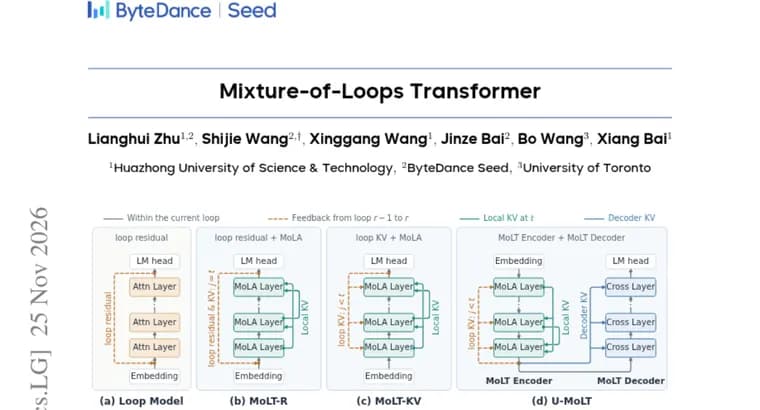
A new paper introduces the Mixture-of-Loops Transformer (MoLT). It starts from a trade-off in looped Transformers: reusing shared layers across loops boosts expressivity, but costs efficiency. The authors argue that improving both requires rethinking what connects adjacent loops, and put the question as "What should be passed as a Transformer loops?"
Their answer is Mixture-of-Loops Attention (MoLA), which uses keys and values (KV) as memory that can be selectively reused across depths and loops. Two variants follow. MoLT-R works under a loop residual: it keeps the residual stream and reads local KV across loops, aiming at expressivity. MoLT-KV works under loop KV: it restarts from embeddings and reads local KV from the current loop together with memory KV from the preceding loop at earlier positions, aiming at efficiency. This removes the dependence between loops at the same position. Paired with a technique called loop forcing for parallel training, it enables single-traversal Mixture-of-Loops (MoL) decoding beyond the number of loops used in training.
To balance efficiency and quality, the authors add a U-shaped version, U-MoLT. It separates building the memory from reading out predictions, and skips unused decoder traversals without changing the predictions.
In 400B-token pretraining, U-MoLT outperforms OLMo3 across 700M and 1.5B dense models and a 3B mixture-of-experts (MoE) model. At 700M it reaches 1.7x token efficiency measured on validation cross-entropy. For the 3B MoE model, it improves perplexity across 10 domains by 0.75 and accuracy across 10 tasks by 2.1 percentage points.
In a second experiment, 100B tokens of continued pretraining on Qwen3.5-0.8B-Base, the U-MoLT adaptation lowers cross-entropy on all 11 domains compared with a matched baseline, with 1.4x mean token efficiency.
On inference speed, U-MoLT with a setting named MoL-Hybrid-2 matches the non-looped OLMo3 on S-size models of about 113M: 996.6 ms against 1,000.6 ms. The code is available at https://github.com/hustvl/MoLT.
Key facts
- MoLT's Mixture-of-Loops Attention uses keys and values as memory for selective reuse across depths and loops.
- In 400B-token pretraining, U-MoLT beats OLMo3 on 700M and 1.5B dense and 3B MoE models, with 1.7x validation cross-entropy token efficiency at 700M.
- The 3B MoE model improves 10-domain perplexity by 0.75 and 10-task accuracy by 2.1 percentage points.
- After 100B tokens of continued pretraining on Qwen3.5-0.8B-Base, cross-entropy falls on all 11 domains versus a matched baseline, with 1.4x mean token efficiency.
- On roughly 113M models, U-MoLT with MoL-Hybrid-2 runs at 996.6 ms against 1,000.6 ms for non-looped OLMo3.
Why it matters
Looped Transformers run the same layers more than once, which adds expressive power at a price in efficiency. MoLT targets the link between one loop and the next, treating keys and values as a memory that later computation can draw on selectively. The authors report gains in both training from scratch and continued pretraining of an existing model, plus latency on par with a non-looped model in one small-scale comparison.
Who it affects
The work is most relevant to researchers who design model architectures, especially anyone studying looped or shared-layer Transformers. Teams that continue pretraining existing small models may also want to look, since one experiment adapts the design to Qwen3.5-0.8B-Base. The reported sizes run from about 113M in the latency test to 3B in the MoE pretraining.
How to use it
The authors say the code is available at https://github.com/hustvl/MoLT. The variants serve different goals: MoLT-R is aimed at expressivity, MoLT-KV at efficiency, and U-MoLT at a balance between efficiency and quality. The headline results are reported for U-MoLT. The abstract mentions code, but does not say that model weights or training data are available.
How solid is it
These are the authors' own results as summarised in the paper's abstract, and no peer review or conference acceptance is mentioned. The comparisons name OLMo3 for pretraining and latency, and a matched baseline for the Qwen experiment. The abstract does not define how token efficiency is measured. It gives the perplexity and accuracy gains as differences, without the starting or resulting values.
Risks and caveats
Keep each number tied to its setting. The 1.7x figure is stated for the 700M model, the perplexity and accuracy gains for the 3B MoE model, and the 1.4x mean for the Qwen adaptation. The latency match was reported on models of about 113M with MoL-Hybrid-2, so it should not be assumed to hold at larger sizes. The abstract gives no hardware, batch size or sequence length for that test, and reports no training cost or memory overhead.
“What should be passed as a Transformer loops?”
— The paper's abstract