MMVistaReason recipe trains a 4B multimodal reasoner on open data
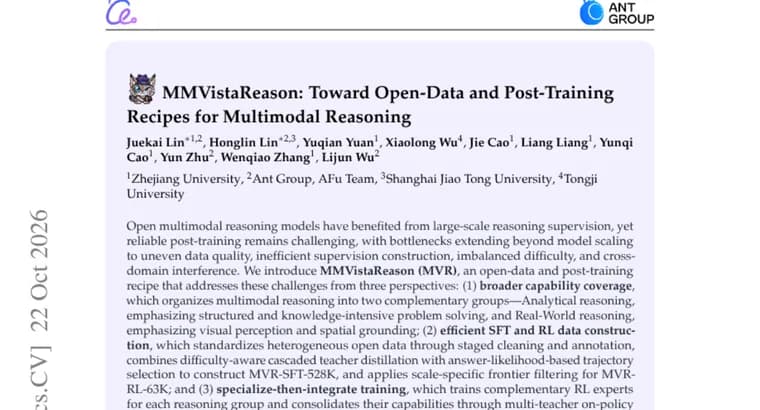
MMVistaReason (MVR) is an open-data post-training recipe for multimodal reasoning models. The authors start from a familiar problem: open multimodal reasoning models have gained from large-scale reasoning supervision, but reliable post-training is still hard because of uneven data quality, inefficient supervision construction, imbalanced difficulty and cross-domain interference.
The recipe has three components. First, broader capability coverage: two complementary groups, Analytical and Real-World reasoning, with an emphasis on structured reasoning versus visual perception and spatial grounding. Second, more efficient data construction. Heterogeneous open data is standardized through staged cleaning and annotation. For supervised fine-tuning, difficulty-aware cascaded teacher distillation is combined with answer-likelihood-based trajectory selection to build MVR-SFT-528K. For reinforcement learning, scale-specific frontier filtering produces MVR-RL-63K. Third, a specialize-then-integrate training scheme: complementary RL experts are trained separately, and their capabilities are then consolidated through multi-teacher on-policy distillation (MOPD).
The authors' analyses point to a capacity-dependent interaction between supervision difficulty, trajectory quality and model capacity. Smaller students benefit more from selected supervision, while larger students are robust to trajectory variation and mixed-domain interference. Mixed-domain RL introduces benchmark-level negative transfer, whereas MOPD gives consistent capability integration. The preferred KL direction varies across model scales.
On results, across 15 multimodal benchmarks MVR-4B reaches an average score of 72.8. The authors say this beats Qwen3.5-9B (Instruct) and MMFineReason-8B, while using about 70% fewer samples than MMFineReason. Scaling to 9B lifts the average to 74.4, which the authors say surpasses Qwen3.5-35B-A3B (Instruct). Their overall conclusion is that systematic open-data construction and capacity-aware post-training offer a practical and scalable path toward reliable multimodal reasoning.
Key facts
- MMVistaReason (MVR) is an open-data post-training recipe with three parts: broader capability coverage (Analytical and Real-World reasoning), efficient SFT and RL data construction, and specialize-then-integrate training.
- Two datasets are built: MVR-SFT-528K via difficulty-aware cascaded teacher distillation plus answer-likelihood-based trajectory selection, and MVR-RL-63K via scale-specific frontier filtering.
- MVR-4B averages 72.8 across 15 multimodal benchmarks, which the authors say outperforms Qwen3.5-9B (Instruct) and MMFineReason-8B while using about 70% fewer samples than MMFineReason.
- Scaling to 9B raises the average to 74.4, which the authors say surpasses Qwen3.5-35B-A3B (Instruct).
- The authors report that mixed-domain RL causes benchmark-level negative transfer, while multi-teacher on-policy distillation (MOPD) integrates expert capabilities consistently.
Why it matters
Small multimodal models that reason well are attractive, and the authors claim a 4B model trained on open data can beat larger or comparable baselines. The reported 9B result against a 35B-A3B model points the same way. The paper also argues that how supervision is selected and how RL experts are merged matters as much as raw data volume: the 4B model is said to use about 70% fewer samples than MMFineReason.
Who it affects
Researchers and teams building open multimodal reasoning models, especially at small and mid scale, are the direct audience. The findings on capacity-dependent effects (smaller students gain more from selected supervision, larger ones tolerate noisier trajectories and mixed domains) bear on how they choose data and training setups for different model sizes.
How to use it
The practical takeaways are the recipe's ingredients: clean and standardize heterogeneous open data in stages; use cascaded teacher distillation by difficulty and pick trajectories by answer likelihood for SFT; filter RL data to the frontier for each model scale; and train separate RL experts, then merge them with MOPD instead of mixing all domains in one RL run. The authors also say the preferred KL direction varies across model scales, so that setting needs tuning per size.
How solid is it
This is a preprint listed on Hugging Face Papers, and all performance claims are the authors' own. The text gives only the two average scores (72.8 for MVR-4B, 74.4 at 9B) over 15 benchmarks. The benchmark names, per-benchmark scores and the baselines' own averages are not given in the source, so the size of the margins cannot be checked from it.
Risks and caveats
The headline numbers are averages, and the source does not say which KL direction is preferred at which scale. It does not state whether weights, data or code are released beyond the open-data framing. It gives no compute cost or training time. The authors also note negative transfer in mixed-domain RL, a reminder that gains on some benchmarks may come with losses on others when domains are combined.