MobilePA-Bench tests whether LLM agents can actually plan on a phone
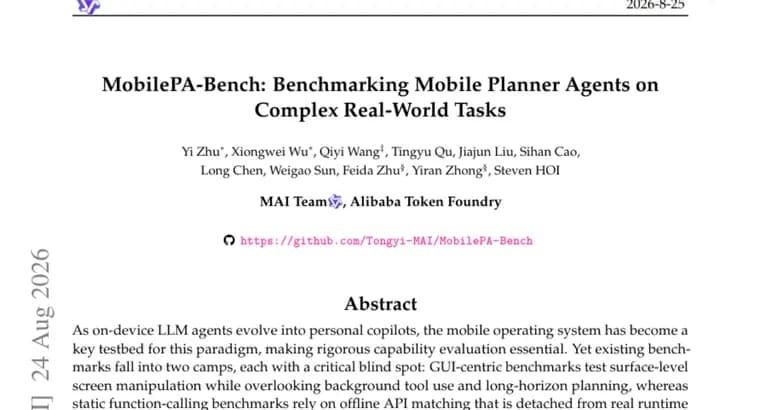
Researchers have introduced MobilePA-Bench, a benchmark built to evaluate mobile planning agents, the kind of on-device LLM systems meant to act as personal copilots on a phone. The authors argue that existing benchmarks fall into two camps, each with a critical blind spot: GUI-centric benchmarks test surface-level screen manipulation while overlooking background tool use and long-horizon planning, whereas static function-calling benchmarks rely on offline API matching that is detached from real runtime constraints. MobilePA-Bench is designed to close that gap. It runs as an interactive, stateful, tool-centric sandbox that maintains live application databases and returns structured feedback rather than checking answers against a fixed offline list, spanning 13 functional domains and 212 realistic mobile tools. Beyond basic tool calling, the benchmark evaluates a central planning agent along three advanced dimensions: sub-agent collaboration, meaning decomposing a complex task and delegating specialized work to capable sub-agents; memory usage, meaning recalling stored memories, user profiles and past preferences to resolve implicit requests; and skill usage, meaning invoking pre-packaged composite skills instead of planning every step from scratch. The authors report that extensive experiments show current frontier LLMs remain unreliable in mobile settings: performance drops sharply under strict tool ordering, permission limits and unexpected runtime errors. They position MobilePA-Bench as both a practical diagnostic benchmark for measuring these agents today and an interactive foundation for agentic reinforcement learning going forward. The text does not name authors, institutions, specific evaluated models, numeric scores, a release date, or a code or dataset link.
Key facts
- MobilePA-Bench spans 13 functional domains and 212 realistic mobile tools inside an executable sandbox with live application databases and structured feedback.
- The benchmark checks three advanced planning dimensions beyond basic tool calling: sub-agent collaboration, memory usage, and skill usage.
- Current frontier LLMs are reported to remain unreliable in mobile settings, with performance dropping sharply under strict tool ordering, permission limits and unexpected runtime errors.
- The authors frame the existing benchmark landscape as split between GUI-centric tests that miss background tool use and long-horizon planning, and static function-calling tests detached from real runtime constraints.
- The work is proposed as a diagnostic tool for today's agents and as an interactive foundation for agentic reinforcement learning.
Why it matters
As on-device LLM agents move toward acting as personal copilots, the mobile OS becomes a key testbed for that paradigm, and existing evaluation methods do not capture it well. GUI-centric benchmarks measure surface-level screen manipulation but miss background tool use and long-horizon planning; static function-calling benchmarks check answers offline against a fixed API list, detached from the runtime constraints an agent actually faces. MobilePA-Bench targets that specific gap with a stateful, interactive sandbox instead of a static test set.
Who it affects
The benchmark is aimed at teams building and evaluating mobile planning agents, on-device copilots that need to call real tools, manage permissions, and hold state across a task rather than just parse a screen. It gives them a shared, executable measure of how such agents perform under realistic conditions, including 13 functional domains and 212 tools.
How to use it
MobilePA-Bench runs as an executable sandbox that maintains live application databases and returns structured feedback as an agent acts, rather than matching against a static offline answer key. It evaluates a central planning agent on three dimensions beyond basic tool use: delegating parts of a complex task to sub-agents, recalling stored memories and user preferences to resolve implicit requests, and invoking pre-packaged composite skills instead of planning every step from scratch. The source gives no release date, code repository, or dataset link.
How solid is it
The claims come from the paper's own description of its design and from experiments the authors say they ran across the sandbox, but the source text provides no author names, institutions, specific model names, or numeric benchmark scores for any evaluated system, so the reported unreliability of frontier LLMs cannot be checked against concrete figures from this text alone.
Risks and caveats
Without named authors, institutions, evaluated model identities, or numeric results, the benchmark's findings are not independently verifiable from the available text. As with any new benchmark, its value depends on adoption and on whether its 13 domains and 212 tools generalize to real mobile agent deployments beyond the sandbox itself.
“Extensive experiments show that current frontier LLMs remain unreliable in mobile settings: performance drops sharply under strict tool ordering, permission limits, and unexpected runtime errors.”
— MobilePA-Bench paper