MovieRoll streaming video framework cuts KV-cache memory by up to 78%
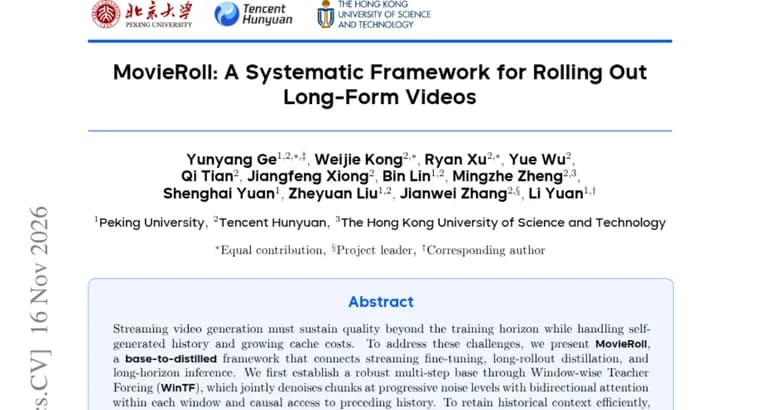
The paper starts from a problem in streaming video generation: a model has to keep its quality beyond the length it was trained on, while coping with its own generated history and a cache that grows with every frame. Its answer is MovieRoll, which the authors describe as a base-to-distilled framework connecting three stages: streaming fine-tuning, long-rollout distillation and long-horizon inference.
The first stage builds a multi-step base model. It uses Window-wise Teacher Forcing (WinTF), which jointly denoises chunks of video at progressive noise levels. Inside each window the attention is bidirectional, and each window has causal access to the history that precedes it.
To keep historical context without paying for all of it, the authors add hierarchical KV-cache compression, called HieraKV. It uses layer-wise attention patterns: shallow layers retain the full history, while deeper layers keep only sink and recent history. The abstract says this reduces cache memory by up to 78% while improving generation quality.
The second stage builds on the base model. Cumulative long tuning with distribution matching distillation (CuLT-DMD) holds the parameters fixed throughout each long self-rollout, then averages local gradients before updating. Each update therefore combines supervision across temporal positions while retaining only one local computation graph. That is what makes long-rollout training of a few-step generator efficient, according to the authors.
The third stage extends generation past the training horizon. KV recomputation bounds the context for both models. Guidance annealing (AnnealCFG) reduces guidance toward the clean endpoint, which stabilizes MovieRoll-Base. Two further components, FBCA attention and PS-VAE decoding, support efficient training and streaming output.
On HeliosBench, MovieRoll-Base remains competitive at 30s after training on videos of up to 15s. MovieRoll-Distilled achieves the highest total scores among the compared methods across single- and multi-event evaluations up to 60s, combining sustained naturalness with active motion.
Key facts
- MovieRoll is a base-to-distilled framework linking streaming fine-tuning, long-rollout distillation and long-horizon inference for long-form video generation.
- HieraKV keeps full history in shallow layers and sink-recent history in deeper layers, cutting cache memory by up to 78% while improving generation quality.
- CuLT-DMD holds parameters fixed during each long self-rollout and averages local gradients, keeping only one local computation graph for efficient few-step training.
- MovieRoll-Base stays competitive on HeliosBench at 30s after training on videos of up to 15s.
- MovieRoll-Distilled reports the highest total scores among compared methods on HeliosBench, single- and multi-event, up to 60s.
Why it matters
Streaming video generation has to hold quality past the length it was trained on, and the cache that stores history keeps growing. MovieRoll tackles both at once: HieraKV shrinks the cache by up to 78% while improving quality, and the training and inference tricks aim to push generation beyond the training horizon. The reported result is a base model trained on clips of up to 15s that stays competitive at 30s, and a distilled few-step model that tops the comparison up to 60s.
Who it affects
The work is aimed at researchers and engineers building streaming or long-form video generators, especially those who struggle with cache memory and quality drift over long rollouts. It also bears on anyone training few-step distilled video models, since CuLT-DMD is presented as a way to make long-rollout training efficient.
How to use it
The paper is a method description, and the components can be read as separate ideas: WinTF for the base model, HieraKV for cache compression, CuLT-DMD for distillation, and KV recomputation with AnnealCFG for extending generation. No release of code, weights or a demo is mentioned, so there is nothing to download or try from the text alone.
How solid is it
The claims come from the authors' own abstract. The headline results are rankings on HeliosBench: MovieRoll-Distilled has the highest total scores among the compared methods, and MovieRoll-Base is described only as competitive at 30s, not best. No numeric HeliosBench scores are given, only the ranking claim, and the names or number of compared methods are not given. The 78% cache reduction is an 'up to' maximum; no typical value or baseline cache size is stated.
Risks and caveats
The evaluations reported go up to 60s, and claims of generation beyond 60s are not made. The abstract does not state the training length for MovieRoll-Distilled. No model size, parameter count or hardware is stated, so the cost of running it is unclear. With no scores or named competitors, the benchmark win cannot be judged from the abstract alone.