Multi-byte prediction speeds up byte-level model inference
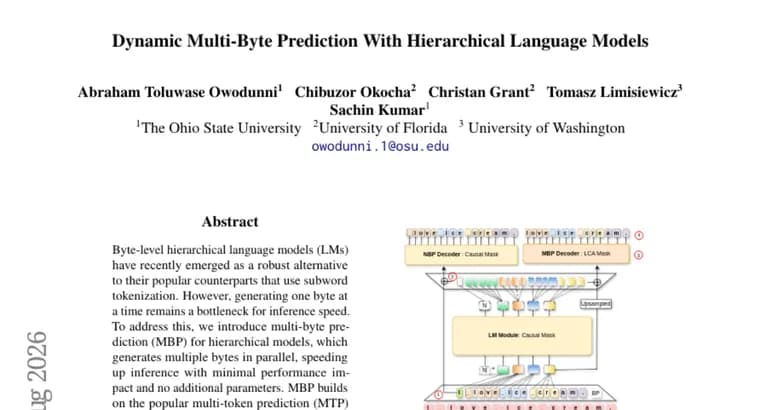
Byte-level hierarchical language models are described in a new paper as a robust alternative to the subword-tokenization models that are more common today, but they carry a specific weakness: generating text one byte at a time remains a bottleneck for inference speed. The paper introduces multi-byte prediction (MBP), a technique that generates multiple bytes in parallel at each step instead of one, with the goal of speeding up inference while keeping the performance impact minimal and adding no additional parameters to the model.
MBP builds on the multi-token prediction (MTP) paradigm, described as popular in other contexts, and adds two specific innovations. First, instead of a fixed-length prediction window, MBP uses a variable-length prediction window that aligns with the latent tokens, or segments, that a hierarchical language model already organizes its bytes into. Second, the authors implement a new attention-masking scheme that allows the model to predict several bytes at once without violating causality, so it still cannot see bytes it has not yet generated when it makes its parallel predictions.
The paper reports that MBP strikes a Pareto-optimal trade-off between performance and inference throughput, tested across four kinds of generative tasks: instruction following, question answering, summarization, and machine translation. The abstract states this as a conclusion but does not give the numbers behind it: no speedup factor, latency figure, or accuracy and quality score is quantified for MBP or for any baseline it was measured against, and no baseline model, dataset, or comparison method is named. The text also does not name the paper's authors, their institutions, or a publication date, and it does not mention any plan to release code, model weights, or data.
Key facts
- Byte-level hierarchical language models are described as a robust alternative to subword-tokenization models, but generating text one byte at a time is a bottleneck for inference speed.
- Multi-byte prediction (MBP) generates several bytes in parallel at each step, aiming to speed up inference with minimal performance impact and no additional parameters.
- MBP extends the multi-token prediction (MTP) paradigm with a variable-length prediction window that aligns with a hierarchical model's own latent segments, instead of a fixed-length block.
- A new attention-masking scheme lets MBP predict multiple bytes at once while preserving causality, so the model still cannot see bytes it has not yet generated.
- The authors report a Pareto-optimal trade-off between performance and inference throughput across instruction following, question answering, summarization, and machine translation, but the abstract gives no numeric results, author names, or baseline comparisons.
Why it matters
Byte-level hierarchical language models are described in the paper as a robust alternative to the subword-tokenization models that are more common today, but generating text one byte at a time remains a bottleneck for inference speed. MBP is aimed squarely at that bottleneck: it predicts multiple bytes in parallel at each step instead of one, and the authors say it does this with minimal performance impact and no additional parameters. That combination matters because it targets the exact weakness, slow byte-by-byte generation, that the abstract names as the main obstacle to fast inference in this class of models, while leaving the parameter count unchanged.
Who it affects
The paper is aimed at people building or evaluating byte-level hierarchical language models, and at researchers working on multi-token prediction (MTP), which the abstract calls a popular paradigm that MBP builds on and extends to the byte level. Because the technique promises to remove a specific inference bottleneck without adding parameters, it also matters to anyone weighing whether byte-level models are fast enough to deploy against subword-tokenization alternatives. The abstract itself names no individual authors and no institutional affiliations, so it is not possible to say from this text which team produced the work.
How to use it
MBP is a research technique described in a paper, not a released product: the abstract mentions no code repository, model checkpoint, or dataset release, so there is nothing yet to install or license. What it does specify is the mechanism itself: replace a fixed prediction window with a variable-length one that aligns with a hierarchical model's own latent segments, and pair it with the paper's new attention-masking scheme so that predicting several bytes at once does not let the model see bytes it has not generated yet. The authors describe MBP overall as adding no additional parameters, which is the detail that matters most to anyone trying to apply it without growing the underlying model.
How solid is it
The abstract lays out a specific architectural mechanism, the variable-length prediction window and the causality-preserving attention mask, but backs its central performance claim with no numbers: no speedup factor, no latency figure, and no accuracy or quality score is given for MBP or for any baseline it was measured against. No baseline model, dataset, or comparison method is named either, so the claim of a Pareto-optimal trade-off across instruction following, question answering, summarization, and machine translation is stated as a conclusion rather than demonstrated with figures in the text available here. The abstract also gives no author names, institutional affiliations, or submission date, so the work cannot yet be tied to a specific team or checked against a fuller, numbers-bearing version of the paper.
Risks and caveats
The largest caveat is how much this text leaves out: no authors, no institutional affiliations, no publication or submission date, no named baseline, and no quantified results for any of the four tasks the paper tests. The paper's own title calls the technique dynamic multi-byte prediction, but the word dynamic does not appear anywhere in the abstract text itself, so it is not clear from what is available here whether that refers to the variable-length prediction window or to some other mechanism the abstract does not describe. Until a fuller version of the paper or its results are available, the Pareto-optimal claim should be read as the authors' own characterization of their findings rather than as an independently verified benchmark result.
“Generating one byte at a time remains a bottleneck for inference speed.”
— the paper's authors