Multiscale Policy Optimization trains long-horizon LLM agents with turn-level credit
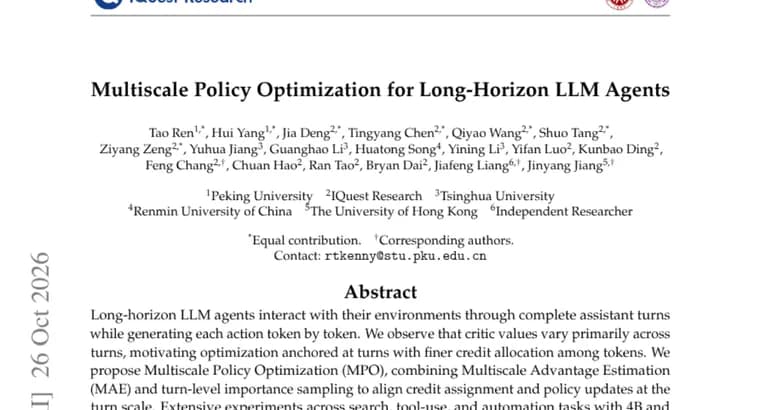
Long-horizon LLM agents act in their environments through complete assistant turns, but each action inside a turn is generated token by token. That mismatch is the starting point of this paper, listed on Hugging Face Papers: reinforcement learning has to decide how to credit a whole turn and how to credit the individual tokens inside it.
The authors report an observation about critic values: they vary primarily across turns, not across tokens. From this they argue for optimization anchored at turns, with finer credit allocation among the tokens within each turn.
The method they propose is called Multiscale Policy Optimization (MPO). It combines two parts: Multiscale Advantage Estimation (MAE) and turn-level importance sampling. Together they are meant to align credit assignment and policy updates at the turn scale.
For evidence, the abstract says extensive experiments across search, tool-use and automation tasks, run with 4B and 30B-A3B models, show consistent gains over strong RL baselines. The abstract does not name the benchmarks, the baselines or the base models, and it does not say how large the gains are.
Key facts
- The paper proposes Multiscale Policy Optimization (MPO) for reinforcement learning of long-horizon LLM agents.
- The authors observe that critic values vary primarily across turns rather than across tokens, which motivates turn-anchored optimization with finer credit allocation among tokens.
- MPO combines Multiscale Advantage Estimation (MAE) with turn-level importance sampling to align credit assignment and policy updates at the turn scale.
- Experiments span search, tool-use and automation tasks with 4B and 30B-A3B models.
- The abstract claims consistent gains over strong RL baselines but gives no figures.
Why it matters
Agents that work over many turns face a credit assignment problem: a final outcome has to be traced back to individual turns and to the tokens that make up each action. The paper's premise is that critic values change mostly from turn to turn, so training signals and policy updates should be organised around turns, with finer allocation among tokens inside a turn. MPO is the authors' attempt to do that in one method.
Who it affects
The work is aimed at researchers and engineers who train LLM agents with reinforcement learning, in particular for search, tool-use and automation tasks. The experiments use 4B and 30B-A3B models, so it speaks to both smaller and larger models.
How to use it
The abstract gives the recipe in outline: estimate advantages at multiple scales (MAE) and apply importance sampling at the turn level, so that credit and updates line up per turn. It mentions no code, model or dataset release, so anyone wanting to try it would need to work from the full paper.
How solid is it
The claims come from the paper's own abstract. It says experiments were extensive and gains over strong RL baselines were consistent, but it does not name the baselines, benchmarks or base models, and it does not quantify the improvement. The critic-value observation is likewise the authors' own.
Risks and caveats
With no numbers in the abstract, the size of the gains and how well they hold up cannot be judged from it. No training cost, compute or limitations are mentioned. Results on 4B and 30B-A3B models in search, tool-use and automation tasks should not be assumed to carry over to other model sizes or domains.