New framework closes rare-entity gap in multilingual entity linking
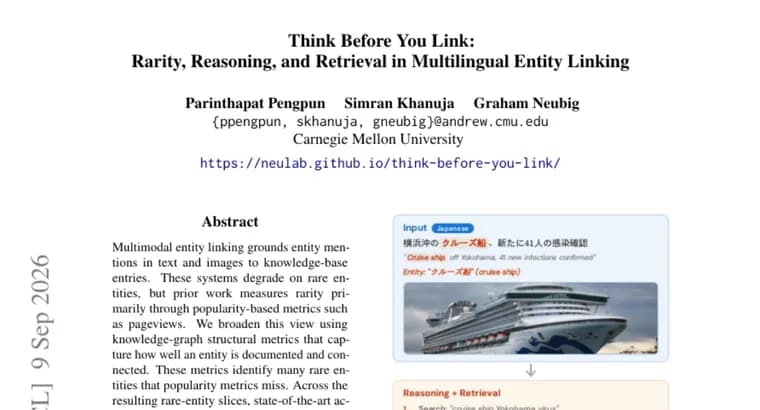
Multimodal entity linking matches mentions in text and images to entries in a knowledge base, and researchers report that current systems degrade sharply on rare entities. Prior work has judged rarity mainly by popularity metrics such as Wikipedia pageviews, but the authors argue this misses a lot of what actually makes an entity hard to link. They instead measure rarity with knowledge-graph structural metrics, which capture how well an entity is documented and connected rather than how often its page is viewed. These structural metrics surface many rare entities that popularity-based measures miss entirely. Once the researchers isolate the resulting rare-entity slices, state-of-the-art accuracy drops by 15.4 to 39.9%, and the size of the drop depends on which rarity definition is used, meaning different definitions expose different failure modes in existing systems.
To address the gap, the authors introduce a training-free framework: a reasoning-capable vision-language model iteratively searches and reasons over Wikipedia, gathering evidence dynamically rather than relying on a single retrieval pass. Controlled experiments isolate the contribution of each ingredient. Reasoning by itself does not significantly improve accuracy on rare entities. Retrieval by itself does improve rare-entity accuracy, but it can hurt overall accuracy. Combining reasoning and retrieval performs best, which the authors describe as the two capabilities being complementary rather than substitutes for each other.
The framework is evaluated on MERLIN, a multilingual multimodal entity-linking benchmark covering five languages: Hindi, Indonesian, Japanese, Tamil and Vietnamese. The best configuration of the new system improves over the prior state of the art by 6.9% overall, and by up to 23.3% on the rare-entity slices specifically. Alongside the framework, the authors release MERLIN-Rare, a set of rare-entity test slices meant for targeted evaluation of exactly this failure mode.
Key facts
- Multimodal entity linking accuracy drops by 15.4 to 39.9% on rare-entity slices identified through knowledge-graph structural metrics rather than pageview popularity.
- The proposed framework is training-free: a reasoning-capable vision-language model iteratively searches and reasons over Wikipedia to gather evidence.
- Reasoning alone does not significantly help rare entities; retrieval alone helps rare entities but can hurt overall accuracy; combining both performs best.
- On the MERLIN benchmark (Hindi, Indonesian, Japanese, Tamil, Vietnamese), the best system improves 6.9% overall and up to 23.3% on rare-entity slices.
- The authors release MERLIN-Rare, a set of rare-entity test slices, alongside the framework.
Why it matters
Entity linking underpins how AI systems ground what they see or read in real-world knowledge bases, and rare entities are exactly where these systems have quietly failed while looking fine on average benchmarks. The paper shows that the standard way of defining 'rare' (pageview popularity) misses a large class of poorly connected entities that popularity metrics never flag, so accuracy problems on those entities go undetected until someone measures rarity differently.
Who it affects
The direct audience is researchers and engineers building multimodal retrieval and knowledge-grounding systems, including any product that has to match an entity mention in text or an image to a specific real-world knowledge-base entry, especially in non-English or lower-resource languages where rare entities are more common.
How to use it
The framework is training-free, meaning it can be applied to an existing reasoning-capable vision-language model by wiring it up to iteratively search and reason over Wikipedia rather than retraining anything. The authors also release MERLIN-Rare, the rare-entity test slices, so others can evaluate their own systems on the same targeted failure mode.
How solid is it
The results come from controlled experiments that isolate reasoning and retrieval as separate factors before combining them, which lets the authors attribute the gains to the combination specifically rather than to either ingredient alone. The headline numbers (accuracy drops of 15.4-39.9% on rare slices, and gains of 6.9% overall and up to 23.3% on rare entities) are measured on MERLIN, a five-language multilingual multimodal benchmark. The source text does not name the underlying vision-language model, its size, the dataset sizes for MERLIN or MERLIN-Rare, or a publication venue or date.
Risks and caveats
The reported gains are relative improvements over a stated state of the art, and the size of the accuracy drop on rare entities varies a lot (15.4-39.9%) depending on which rarity definition and slice is used, so the numbers should not be read as a single fixed figure. The paper does not disclose compute cost, runtime, or how many search and reasoning iterations the framework typically performs, which matters for anyone assessing whether the approach is practical to deploy at scale.