New study: rational AI adoption could destroy professional expertise
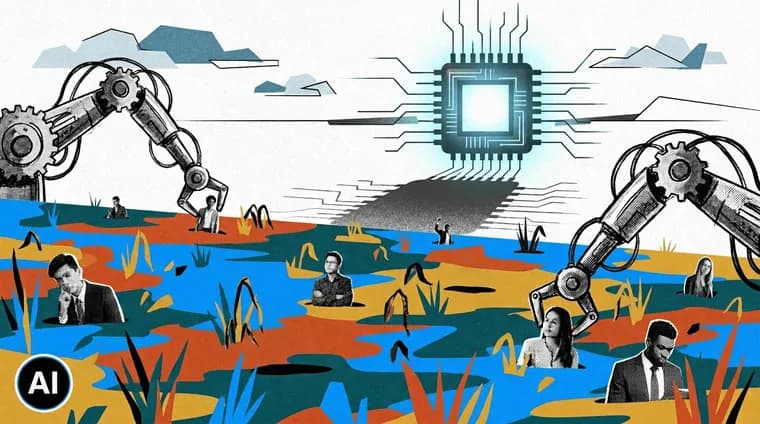
In 1968, ecologist Garrett Hardin described the tragedy of the commons: when every herder rationally adds one more animal to a shared pasture, each herder profits individually while the cost of overgrazing spreads across everyone, and the resource the group depends on collapses. Nolan Lovett of the NATO Special Operations University, in a paper published in the journal Human Resource Development Review, argues the same pattern now threatens professional expertise. When a company replaces entry-level positions with AI, it captures 100 percent of the efficiency gains, while the cost of eroding expertise gets distributed across every organization that draws from the same talent pool.
Lovett identifies two ways this disrupts how expertise gets renewed. The first is direct elimination of entry-level positions, where AI systems take over work that used to go to junior employees. The second is more subtle: even where entry-level jobs survive, junior workers with AI assistance reach productivity levels that used to take years of experience to reach, so the cognitive effort that actually builds deep domain knowledge never happens.
This creates a follow-on problem Lovett calls the validation tether: the ability to oversee AI systems effectively depends on exactly the kind of deep domain knowledge that AI use is wearing away. Spotting domain-specific errors in plausible-looking AI output takes more than catching obvious contradictions, and surface-level checks are not enough to guard against serious mistakes. People who routinely treat AI answers as reliable lose the reflex to question them, and the training environments where junior workers once learned to challenge authority and test claims against reality are vanishing along with traditional entry-level roles.
The damage, if real, would take years to surface. Today's experienced professionals were trained 5 to 20 years ago, and Lovett argues the effects of entry-level cuts starting in 2023 may not fully show up until somewhere between 2030 and 2045. He calls the resulting bind the Human Reserve Paradox: organizations need deep expertise in reserve for validation, crisis management, and situations that overwhelm AI systems, but no single organization has enough economic incentive to maintain that reserve on its own. Even the workers who make it through the pipeline will have shallower expertise, Lovett argues, because they spent their careers orchestrating AI rather than doing independent cognitive work.
The mechanism does not hit every profession equally. Software engineering, financial analysis, and legal research all show high task substitutability, relatively light regulation, and strong modularity, putting them in the highest vulnerability category. Medicine and engineering get some protection from stricter regulatory requirements and stronger professional associations, though Lovett stresses they are not immune.
Lovett does not treat the outcome as inevitable. He argues professionals need AI-free learning environments, phased AI introduction, and a baseline of human performance established before AI gets involved. He recommends that professional associations test domain competence through certifications alongside AI skills, and that policymakers make training and education more attractive. Bans or restrictions on AI use are not among his proposals.
The economic evidence Lovett cites is mixed. A study from summer 2025 found employment declines in AI-affected occupations, especially among young workers, while employment for more experienced workers in the same fields held steady or even grew; the researchers attribute this to AI primarily replacing codified knowledge while practical experience stays in demand. A Federal Reserve Board study found growth in programming jobs has nearly halved since ChatGPT launched, though a clear causal link cannot yet be proven, since factors like tighter monetary policy and a correction after pandemic-era tech overhiring could also play a role. A January 2026 study found the job crisis in AI-affected occupations actually started before ChatGPT's release. An Anthropic study from March 2026 found no measurable overall impact of AI on the labor market, but did flag one warning sign: the job-finding rate in highly AI-exposed occupations dropped by half a percentage point among workers aged 22 to 25.
The research on the cognitive costs of AI use is described as painting a clearer picture. An MIT study using EEG measurements found that even brief AI use weakened neural connectivity, and over 80 percent of participants struggled to recall content from their own AI-assisted writing. An Anthropic study with software developers found that participants with AI access scored 17 percent worse on knowledge tests, with the biggest losses among those who used AI purely as an answer machine, while those who used AI to get explanations learned significantly better. A Swiss study of 666 participants found a strong negative link between AI use and critical thinking, most pronounced among 17 to 25 year olds; students themselves worry about brain rot, according to Anthropic, because AI lets them shortcut too many learning processes. Among students in China, homework grades improved by 18 percent while exam performance dropped by up to 24 percent, with the full effect only showing up after about two years.
Key facts
- Nolan Lovett of the NATO Special Operations University, writing in Human Resource Development Review, argues AI-driven entry-level cuts erode professional expertise the way overgrazing destroys a shared pasture.
- Software engineering, financial analysis, and legal research face the highest vulnerability from high task substitutability and light regulation; medicine and engineering are partly shielded by regulation and professional associations.
- Lovett argues the full effects of entry-level cuts starting in 2023 may not surface until somewhere between 2030 and 2045.
- An Anthropic study found software developers with AI access scored 17 percent worse on knowledge tests; an MIT EEG study found over 80 percent of participants struggled to recall their own AI-assisted writing.
- A Federal Reserve Board study found growth in programming jobs has nearly halved since ChatGPT launched, though a clear causal link to AI has not been proven.
Why it matters
Lovett's argument is that AI adoption decisions that make perfect sense for one company can collectively hollow out the expertise base an entire profession relies on, because no single firm bears the full cost of the erosion it causes. The sharpest version of the problem is what he calls the validation tether: the very ability to catch AI's mistakes depends on the deep domain knowledge that heavy AI use is wearing away, so the safeguard and the risk erode together.
Who it affects
Entry-level workers whose training-ground roles are eliminated or thinned out by AI assistance sit at the center of the argument. Lovett puts software engineering, financial analysis, and legal research in the highest-risk category because of high task substitutability and light regulation, while medicine and engineering get partial protection from stricter rules and stronger professional associations. Organizations broadly stand to lose the human reserve they need for validation and crisis response, and the Swiss study cited in the piece found the steepest critical-thinking declines among 17 to 25 year olds specifically.
How to use it
Lovett does not propose banning or restricting AI use. His recommendations are AI-free learning environments, phased AI introduction, and establishing a baseline of human performance before AI enters a workflow. He also recommends that professional associations test domain competence through certifications alongside AI skills, and that policymakers make training and education more attractive.
How solid is it
This is an argument paper, not itself a new empirical study: Lovett extends Hardin's tragedy-of-the-commons framework and builds his case on existing research. The economic evidence for it is mixed rather than settled. A summer 2025 study found youth employment declines in AI-affected fields while experienced workers in the same fields held steady or grew; a Federal Reserve Board study found programming-job growth has nearly halved since ChatGPT's launch but without a proven causal link; a January 2026 study traced the job crisis in AI-affected occupations to before ChatGPT existed; and a March 2026 Anthropic study found no measurable overall labor-market impact from AI, only a half-percentage-point drop in the job-finding rate for 22 to 25 year olds in highly exposed occupations. The cognitive-cost evidence, the MIT EEG study, the Anthropic developer study, the 666-participant Swiss study, and the Chinese student data, is described in the piece as painting a clearer picture than the labor-market numbers do.
Risks and caveats
The economic case for eroding entry-level expertise is not settled: several of the cited studies point the other way or attribute observed declines to other causes, such as tighter monetary policy and a correction after pandemic-era tech overhiring. The framework itself rests on an analogy to the tragedy of the commons rather than a direct measurement of profession-wide expertise loss, and the timeline Lovett proposes, full effects surfacing only between 2030 and 2045, sits well beyond the reach of any study cited so far.
“validation tether”
— Nolan Lovett, author of the paper